

Gallery Project exhibit takes a provocative look at 'Post Apocalypse' future
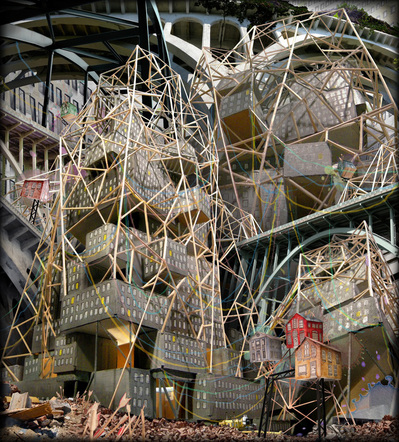
“Beholden Are We All: The Squalor to the Splendor” by Matt Krueger
The gallery’s answer is “Post Apocalypse,” a multimedia exhibit in which local, regional, and national artists explore “the aftermath of some cataclysmic event at the various levels from interpersonal to global.”
This gallery has never shied away from contentious topics, and this one is sufficiently broad to allow the artists tremendous elbow room.
Gallery directors Rocco DePietro and Gloria Pritschet write, “Whether considering an apocalypse as the world without man, the fall of civilization, life after the deluge, fiscal catastrophe, personal tragedy, zombies, or religious prophecy, these are speculations and ruminations on the questions of what might follow life-altering events.”
“Who, if anyone, is left to pick up the pieces?” asks the gallery, “And most importantly what happens next? ‘Post Apocalypse’ is an opportunity for artists to consider and investigate the actions that led us here and the changes and repercussions of those actions.”
Interestingly, these artists’ illustrations aren’t particularly grim. Perhaps it’s a natural optimism, or maybe this particular group simply doesn’t have a pronounced dystopian disposition. But there’s no overt negativity in this complex exhibit.
Rather, the contemplation here runs more along the line of febrile anticipation. There’s a heightened curiosity on the part of many these artists that looks beyond repression in any overt manner. As a result, the 36 works of art that constitute “Post Apocalypse” are more like primers on the boundaries of Armageddon.
Local contributors include Ann Arborites Heather Accurso, Jason Demarte, DePietro, Ryan Molloy, Robert Platt, Pritschet, Jacob Saalberg, Jennifer Seibert, Brian Spolans, and Robin Wilt.
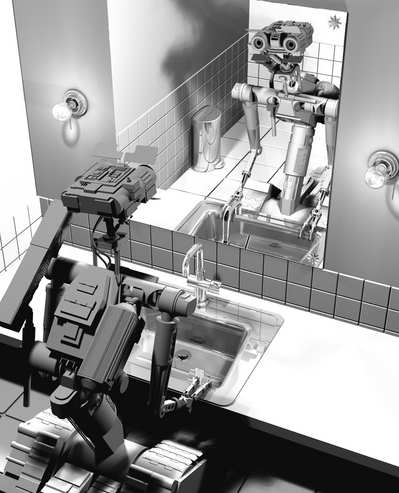
(Untitled) from “Robot Johnny” series by Joe Meiser
As old a conundrum as the Greek myth of Narcissus, Meiser updates the psychology of self-contemplation in reminding us that it’s probable any post-apocalypse consciousness will be prey to the same mundane existential sensibilities that plague us.
New York City’s Owen McAuley has contributed “Somniac,” whose shadowy composition infers a winding-down apocalypse. The oil on canvas painting’s near-impenetrable dusk features a darkened background of trees where a rutted road leads indeterminately. The issue of “somnia”—being of course, a sort of narcolepsy—lends the painting a somber tone which is certainly abetted by its appearance. There’s enough of a compositional vagueness in “Somnia” to make the path unclear and this, too, can be construed as a sort of variation on the human condition.
Another such remembrance of things past is reflected in Detroiter Andrew Thompson’s “We used to dance...” mixed-media. This three-chambered wood cabinet nestled in the Gallery Project’s rear alcove consists of wood, wire, flashing LEDs, paint, plaster, potatoes, pennies, and galvanized nails. The cabinet’s stacked potatoes have plastic wires plugged into them with all this paraphernalia leading up to a tabletop where a triangular plastic frame repetitively flickers the numerals “5” through “8” in sequential order. Oscillating electronically; “We used to dance...” dances alone.
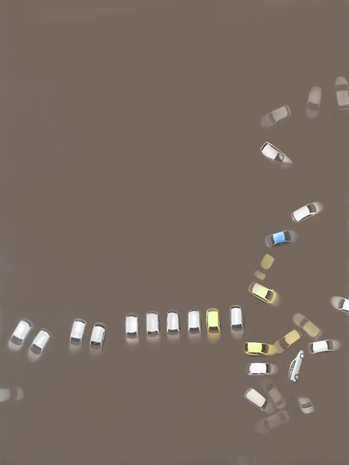
"Flood 3" by Tom Berenz
“The Actual Birth of Venus” illustrates a multi-cellular substratum whose “birth” implies an eternal recurrence. Berenz’s “Flood 3” features rows of cars sinking below muddy water. And “Beholden Are We All” is a constructionist’s colorful nightmare of a vastly overbuilt, abandoned cityscape.
Yet as is typical, the Gallery Project’s lower level houses the single most intriguing work of art in the display. Toledo mixed-media artist Erin Garber-Pearson has built a crushed coal, dirt, wood, paint, and video installation called “The Moving Oracle” that’s as ominous as any “Post-Apocalypse” could be.
Garber-Pearson’s installation, set in the middle of the gallery’s basement floor, whirls in a menacing circular, stormy cascade that’s hypnotic and portentous. For if this is how the world is going to end—or, at least, our portion of this cycle—then “The Moving Oracle,” like all Cassandras, illuminates humanity’s puny powerlessness in predicting the future—and any “post-apocalypse’ thereafter is merely a figment of our fevered imagination.
“Post Apocalypse” will continue through Jan. 22 at Gallery Project, 215 S. Fourth Ave. Exhibit hours are noon-9 p.m. Tuesday-Saturday; and noon-4 p.m. Sunday. For information, call 734-997-7012.
Comments
hut hut
Fri, Jan 6, 2012 : 7:33 p.m.
Another post apocalypse art exhibit?
shepard145
Fri, Jan 6, 2012 : 1:59 p.m.
The post appocalpse exihibit is limited by the artist's understanding of the world as it is today and likely to be in the future. I plan to drop by but this looks like something any artist could have done - not particularly thoughtful.
justcurious
Fri, Jan 6, 2012 : 1:53 p.m.
Thanks for a good article. This reminds me of an on-going exhibit at the Toledo Museum of Art called small worlds. It especially brings to mind the works of Laurie Nix. <a href="http://smallworlds.toledomuseum.org/" rel='nofollow'>http://smallworlds.toledomuseum.org/</a>
justcurious
Fri, Jan 6, 2012 : 1:56 p.m.
That would be Lori Nix.
A2K
Fri, Jan 6, 2012 : 11:57 a.m.
We'll have to check out the exhibition, but I'm a bit non-plussed by "Johny Robot" as that's the same character in that 1980s movie "Short Circuit"...I think it would be more effective with an artist-created character, but perhaps that is what he's going for?