

Greenhills Upper School revisits "Our Town"
This is part of a new series of theater reviews of local high school productions, written by local high school students, that will appear on AnnArbor.com. This week, Huron High School student Mia Ruf (see bio and more about this program at end of story) reviews Greenhills Upper School's production of "Our Town," which ran and closed this past weekend.
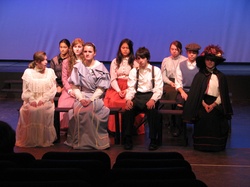
The cast of Greenhills' production of Thornton Wilder's "Our Town."
At first, the citizens of Grover’s Corners hardly seem to possess this sort of exorbitance. They are a bit sad in their simplicity, living amongst themselves, pushed blindly along what they interpret to be a path laid out by God. The Greenhills Upper school actors appropriately speak their parts as if calling from the afterlife, as if knowing the full outcome of their petty loves and fortunes.
When Julia Gibbs (Margot Staebler), the matriarch of one of the play’s two depicted houses, confides in her neighbor Myrtle (McKenna Kring) that she has set her sights on Paris, her words ring hollow. Despite the women’s wistfulness and will — truly, the two play their parts with staunch steadiness — it is clear that neither of them will ever see beyond the town’s limits. Indeed, during the play’s final act — set in Groves Corners’ cemetery, where the dead sit in high-backed chairs arranged in pews — Staebler’s Julia sits stonily in the front row, confined even in death.
But, in keeping with “Our Town”’s most overt message, it is important — for the characters and the audience, too — to relish the depicted lives, even while the characters in question seem moribund from the start. While the script follows George Gibbs (Tom McClure) and Emily Webb (Grace Mangigian) from courtship to marriage, and then from marriage to Emily’s death during childbirth, the seemingly inconsequential bits in between the milestones prove to be the most momentous. What may be the play’s most poignant interaction is between young George and Emily as they lean from their windows and consider their proximity to the moon. The two actors each ascend a ladder, the top of which is intended to be a windowsill. They then call out to one another, musing over their nearness to such an immaculate object as the moon. In doing so, they seem to question where the bounds of human existence meet those of the heavens. The furnishing of the stage is scant (as it is throughout the play), but expert; the two ladders are perfectly symmetrical, as are the two faces inclined towards the heavens.
Every citizen in Grover’s Corners seems to be climbing toward some divine object, laboring toward some end. The town choral conductor, Simon Stimson (Max Radwin), strains toward the perfection of his church choir, but ultimately commits suicide. What is odd, though, is that while the village residents all hustle toward a futile ideal, they still stand in awe of the cosmos, of God. Rebecca Gibbs (Ella Firnhaber) famously recites the address written on an envelope sent from a local minister, “Grover’s Corners; Sutton County; New Hampshire; United States of America; Continent of North America; Western Hemisphere; the Earth; the Solar System; the Universe; the Mind of God.”
As the products of Thornton Wilder’s own mind, the people of Grover’s Corners seem torn over how to justify their existence within this divine intelligence; while Julia feels holed up within God’s head, Emily Webb swoons at the prospect of life amongst the cosmos — of life in general. If there is one thing that the Greenhill Upper School actors managed to synchronously convey, it was a sense of terror mixed with awe — the face of humankind when confronted with a formidable something. But, then again, “that something has to do with humans.”
The Grover’s Corners’ townspeople may not truly know just what it is that awes and terrifies them. Perhaps this great force isn’t divine, isn’t to be found after death. Perhaps the address repeated by Rebecca Gibbs is cyclical, and God’s mind is really that of man.

The aim of AnnArbor.com's student-review program is to recognize, and provide more coverage for, the accomplished theatrical work that's happening in our schools while also providing opportunities for student writers with an interest in arts criticism. To encourage objectivity, our student writers will always review shows from schools other than their own. To learn more about the student-review program, contact Jenn McKee at jennmckee@annarbor.com or 734-623-2546.