

"The Image Wrought" exhibit at UMMA showcases photographic evolution
There’s no mistaking “The Image Wrought’s” steadfast refusal to cater to the present age.
The 80 photos in this University of Michigan Museum of Art exhibit, on loan from the holdings of the University of Texas Harry Ransom Center, are organized in pairs comparing now-outmoded 19th century photographic techniques with likeminded 20th century artworks.
All this sight and fury takes into account the fact that we’re currently in the midst of a technological revolution, as digital photography has now become nearly the norm. Today’s digital photography is not the same process that initiated the photographic medium — that is, visual representation through the manipulation of sensitive emulsions — just as digital printmaking (for example, giclée) is not the same as older methods of the print medium.
By pointed contrast, as the UMMA’s exhibition statement tells us, “The Image Wrought’s” old-school approach to photography has been resurrected by contemporary photographers intent upon “reasserting the hand of the artist” in their work.
“Despite the difficulty and even at times the danger inherent in these processes,” continues the statement, “(these archaic photographic techniques) have grown in popularity among photographers desiring an object that reflects the elements of craft.”
The photographic pioneers on display — among them Charles Bierstadt, Charles Dodgson, William Henry Fox Talbot, and Reinhold Thiele — represent historic photographic process like calotype, daguerreotype, and tintype at the origin of the medium. Seeing samples of their work, much of it shielded from exposure with velvet draping in the UMMA’s A. Alfred Taubman Gallery II, is to witness the origin of photographic aesthetics.
Not to be outdone, 20th century photographers — among them Robert Capa, Rebecca Foley, Michael Radin, and Eric Renner — use color photograms, gelatin silver print, and pinhole cameras to emulate their 19th century predecessors. And there’s simply no diminution of the effort, faculty, or talent involved.
In an exhibit as intricately subtle as this, it would be easy to get lost in the technical and historical thickets. Yet the greatest strength of “The Image Wrought” is that what could easily be overwhelming is instead endlessly fascinating because of each artist’s unwavering ingenuity.
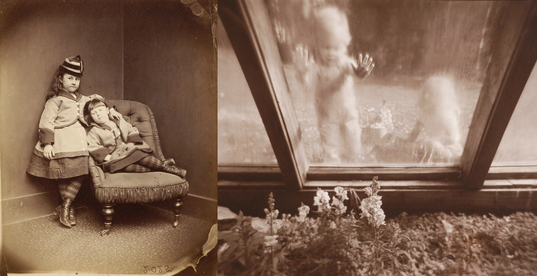
"Beatrice and Ethel Hatch" albumen silver print from wet collodion negative by Charles Dodgson (British, 1832-1898), 1874.
Dos manos" albumen silver print by Kay Denton (American, b. 1939), 1996.
On view in "The Image Wrought: Historical Photographic Approaches in the Digital Age" at the University of Michigan Museum of Art through January 17, 2010.
Photos courtesy of the University of Michigan Museum of Art via the Harry Ransom Center of the University of Texas.
The photos are, or course, separated by a lengthy 118 years. And the albumen silver print photographic technique uniting the artworks (as described on the UMMA’s gallery card as being “prints made on paper coated with egg white which is sensitized with silver nitrate and printed using using a collodion binder”) speaks as much of their historic time as the images reflect both photographers’ technical sensibilities.
Dodgson (as much an avid amateur photographer as he was a writer, mathematician, and logician) places his two young models on and aside a stuffed sitting chair in a corner of his studio. The two sister’s dainty dressing — and more telling; their reserved posture — reflect the subdued mores of their time. There’s a Victorian stiffness to these diminutive models’ stance that compliments the laborious photographic process that forced them to pose rigidly for an extended period of time.
Denton’s “Dos manos,” on the other hand, features an off-angle greenhouse window whose humidified diagonal glass largely obscures two children at play — one child leaning against the windowpane. The composition’s contemporary casualness indicates an artless, yet equally proficient photographic technique as Denton gives her work an offhanded spontaneity that’s carefully measured against her technological expertise.
The rest of this extraordinary exhibit follows this pattern. Each 19th century photograph is a technical marvel through its studied versatility. While the 20th century practitioners seek tenaciously to recapture the original impulse of the art form, they also seek to expand its aesthetic possibilities. That makes each hard-fought image “wrought” in this monumental display nothing less than a heroic effort in both art and deed.
John Carlos Cantú is a free-lance writer who reviews art for AnnArbor.com.
“The Image Wrought: Historical Photographic Approaches in the Digital Age” continues through January 17 at the University of Michigan Museum of Art, 525 South State Street. Museum hours are 10 a.m. to 5 p.m. Tuesday, Wednesday and Saturday; 10 a.m. to 10 p.m. Thursday-Friday; and noon to 5 p.m. Sunday. For information, call 734-763-UMMA.