

Performance Network successfully scales "K2"
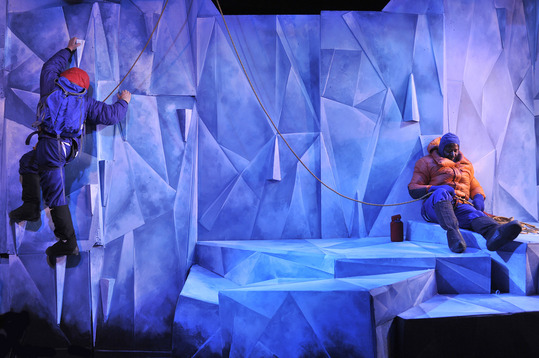
John Manfredi and James Bowen in "K2."
courtesy of Performance Network
And while this may initially sound like a gimmicky exercise — something an aspiring actor would do for a class — Bowen and Manfredi masterfully maintain the illusion throughout the show’s 90-minute run-time, making “K2” far more gripping and physically exhilarating than Meyers’ spotty script would otherwise be.
The two actors play longtime friends Harold (Bowen), a happily married physicist and father who’s just broken his leg while falling onto the ledge; and Taylor (Manfredi), an unattached criminal prosecutor. Though the men are short on equipment and supplies, Taylor is determined to find a way to get both his friend and himself to the bottom of the mountain by nightfall.
So “K2” establishes its crystal-clear central conflict from the outset, and the stakes are indisputably high — which leaves Meyers with the task of getting the audience emotionally invested in the two men, as well as their friendship.
Does he achieve this? Yes and no. For Meyers’ script occasionally feels pretty heavy-handed, thanks to some extensive, self-consciously poetic speeches (usually written for Harold) about physics, albino foxes, etc. This dialogue wouldn’t sound natural in a normal situation, let alone one in which two men are facing a grim, life-and-death reality; and Meyers seemingly made Harold a physicist for no other reason than to wax philosophic about the universe and quarks.
Also, for men who are supposed to be longtime friends, they seem to be lacking in some pretty basic information about each other. (What drives them professionally, their perspectives on romantic love, how Harold met his wife, etc. would seem to have come up before in conversation.) In these moments, the playwright’s need to communicate something of the characters’ personal histories to the audience, in order for us to know them and thus care more deeply for them, clashes clumsily with the scenario at hand.
However, other moments — such as when the two men occasionally get loopy from a lack of oxygen, rage helplessly against their situation, spin a sexually vulgar tale in order to entertain and distract each other, and tease and snap at and confess to each other — feel wholly realistic and natural. Fortunately, there’s enough of this good stuff, and Bowen and Manfredi are such exceptional performers, that the show is powerfully affecting, despite the script’s few forays into pretentiousness.
Yet another crucial part of “K2,” of course, is the set. And while I’ll admit I wasn’t visually wowed at first by Daniel C. Walker’s ice-blue, cubist backdrop — featuring the ledge as a thrust stage, backed by a painted wall dotted with small footholds — I came to be more and more impressed with its design as the play progressed. Manfredi, as the able-bodied climber, scales the set a few times, and the heightened immediacy of a thrust stage definitely worked its magic, bringing the crowd into the heart of the action.
So I soon bought into the illusion; and helping me along the way was Andrew Hungerford’s positively outstanding sound and lighting design. The play begins with darkness and a chest-thrumming, ominous noise, followed by evocative, lightning-quick glimpses of the initial accident. In addition, the sound of the high winds, as well as an approaching avalanche, provided the audience with an exceedingly visceral experience.
Ultimately, however, the production’s success must be primarily credited to director Tim Rhoze and his terrific two-man cast, all of whom seem focused on the play’s subtle details: the actors speak in a huff-and-puff, strained cadence; they handle the climbing equipment with casual authority; they move around on the ledge (and Manfredi climbs the mountain) with convincing effort and caution; and they wince and brace themselves against the cold while scrambling for possible solutions to their predicament.
The end result is a haunting journey through one of the most terrible choices a human can be asked to make — a situation that, in context, makes the simple climber’s rope call, “on belay,” a devastating moment that threatens to irrevocably break you.
Jenn McKee is the entertainment digital journalist for AnnArbor.com. Reach her at jennmckee@annarbor.com or 734-623-2546, and follow her on Twitter @jennmckee.
Comments
Phil Powers
Tue, Jan 19, 2010 : 9:27 a.m.
James Bowen and John Manfredi are actors at the Performance Network. I am currently acting at the Jewish Ensemble Theatre. Montana was suggested merely because it's closer than the Pakistani/China border. I protest when people take unnecessary and ridiculous cracks at good theatre. Jen McKees' review was spot on. Martin Kohn at encoremichigan.com is also accurate. These reviewers loved it. Et tu, A2?
filmguy
Tue, Jan 19, 2010 : 6:45 a.m.
I don't know Mr. Powers or care who he is married to, he's right none the less. Asking for a more realistic set is kinda ridiculous, given the fact that it's a mountain 27,000 feet high, in a theatre with 16' ceilings. When you watch the "Diary of Ann Frank" are you upset their not really in an attic? or do you suspend disbelief that the Nazi's are really 'downstairs'? Would you rather the PN not go after this interesting piece of theatre? I too saw the B'way production and the set was AMAZING,A-MAZING but the 'show' still lacked the realism that it had in AA. The two actors at PNetwork were far more 'in' the elements than the cats I saw do it in NY. There's a reason nobody does this show and that despite critical acclaim it ran so short-it's quite obviously a technical nightmare and I applaud the Network for doing it and doing it so well. As someone in the industry [albeit film]and having worked with mostly men for 30 years I can tell Ms.McKee that I don't know how any of my 'buds' met their wife or what they did in college, guys don't share that stuff usually, I might know an anecdote or story but not details. She is also right that the script is a little heavy handed and the one climber as a physicist is a convenient way to 'wax poetic' but it didn't take me out of the play. I also agree that the conversations I heard in the lobby and had with my wife after the show were some of the most interesting and thought provoking I've ever had after a night of entertainment and THAT makes for good art to me. I also love that the Network used two actors recently seen in completely different and memorable roles, gives me faith and ammunition when dealing with the 'hollywood' folks coming here now that Michigan has some incredibly talented folks.
A2lover
Mon, Jan 18, 2010 : 9:46 a.m.
Phil Powers, actor at the Network and married to the Executive Director of the Performance Network, need we say more. Despite Mr. Powers jovial turn in flying the audience to Montana (Unfortunately, I don't think K2 is in Montana) and his fatuous comment on suspending our disbelief (of course we suspend our disbelief every time we enter the theatre - every see Hamlet not appear for a curtain call because he's dead?) in my opinion the set still needed to be more realistic. To conjure HAMLET once more, it seems Mr. Powers doth protest too much.
Phil Powers
Sun, Jan 17, 2010 : 9:48 p.m.
I attended the opening night performance of K2 at Performance Network and feel that I must respond to the feedback, especially that of the person who hides behind the user name of "A2lover". My name is Phil Powers and I'm a professional actor of 13 years. I have a a good sense of when a piece of theatre speaks to me and when it doesn't. I wonder if the Network had paid to fly A2lover and the rest of the audience to the side of some mountain in, say, Montana and had built seats around a ledge a few thousand feet in the air you'd have complained that the theatre was too cold. Buy the ticket and take the ride. Next time you want to spread your "love" around A2, sign your real name. That show floored me. It provided some of the best conversation I've heard in years in the lobby afterwards and if you can't suspend your disbelief willingly enough to realize that they are not REALLY on the side of K2, why did you buy the ticket?
.com reader
Sat, Jan 16, 2010 : 6:03 p.m.
Jenn provided a fine review (we also enjoyed the show). However, I am a woman with three brothers and I work in a "man's" field and I want to assure her that frequently men consider themselves to have been close friends for decades without ever talking about how they met their wives/girlfriends and other "touchy-feely stuff." I agree with the author of the play that Taylor having those discussions is indicative of the severity of the situation.
A2lover
Sat, Jan 16, 2010 : 1:08 p.m.
The play was ok, although quite a bit dated and suffered from some sophomoric writing, and the performances about average, it was the set that disappointed. A cubist set design for a play that so desperately needs realism is not a good design choice. I'm sure the Network could not afford what was really required, a set that was as realistic as the actor performances. Pity, a less abstract set would have helped support the actors, who already have a tough time convincing us that they high up on an ice ridden mountain.