

Ladysmith Black Mambazo still sharing South African music and culture, performing Sunday
Has it really been almost a quarter-century since Ladysmith Black Mambazo first made a big splash with mainstream-pop fans, via their work on Paul Simon’s “Graceland” album and tour?
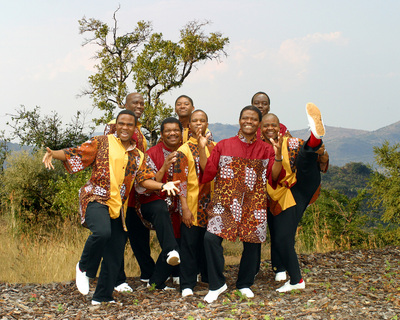
Ladysmith Black Mambazo performs at Hill Auditorium on Sunday.
It has indeed. Next year it will 25 years since that Ladysmith’s intricate, soul-stirring harmonies and high-stepping live show first made inroads with the American masses with that 1986 album and tour — after many years when the group had already been revered by world-music buffs.
Much has happened since then. Eight years after Ladysmith first delighted U.S. audiences with their deft harmonizing and lively dance steps, the system of apartheid — the policy of racial separation and oppression of the black majority — in their native South Africa came to an end. Many cultural historians believe that the music of Ladysmith and other South African musical/cultural groups helped inspire that change — by taking South African culture all over the world and enlightening the general public about how rich that culture was.
“Yes, I believe that our performing so much in America and other countries (after ‘Graceland”) humanized us to the world,” says Albert Mazibuko, a Ladysmith member since 1969. Mazibuko takes the stage on Sunday with the other members of Ladysmith for a Hill Auditorium show sponsored by the University Musical Society.
PREVIEW |
“It helped people connect to us as a people and culture, and not just as a nation that was suffering,” continues Mazibuko, during a recent e-mail interview. “Music knows no boundaries, and our nation’s music rode the sky and seas, and connected us to the peoples of the world. In a way, it brought everyone to South Africa and allowed them to see, hear and feel what we were. I think that continues to this day.”
In the years since Ladysmith was first exposed to the pop music world, several of the “Graceland-era” members have either retired or passed away, and have been replaced by the sons of group founder Joseph Shabalala, who formed Ladysmith way back in the early 1960s.
The group has also continued to build on their initial mid-‘80s ascent to stardom, playing to larger audiences — including special performances for such world leaders / luminaries as South African President Nelson Mandela and England’s Queen Elizabeth — and winning several Grammy awards along the way.
The Hill show comes just a few days after the release of their new effort, a DVD of a live performance titled, simply, “Ladysmith Black Mambazo Live.” The disc is a must-have for those who’ve swooned to the group’s complex, vocally nimble harmonies but have never enjoyed the full visual experience of the group’s meticulously-choreographed dance moves and give-and-take with the audience.
“Our CD recordings can only bring across one aspect of our performance,” says Mazibuko. “Obviously our singing is a very important part of who we are, but we also want people to see us perform. With our dancing and interaction, people seem to really enjoy our concerts. Every night people after the shows would ask if there was a recent DVD of our concerts so they can continue to enjoy the show and show their friends. We felt it important to oblige.”
The DVD captures an Akron, Ohio show from 2008, and also includes 40 minutes of interviews with Shabalala and other group members, as they recount the group’s history and their thoughts about the impact of their music.
“We wanted the DVD to capture an American performance, because we have been touring the U.S.A. for over twenty years, and the American people have helped our careers quite a lot,” explains Mazibuko. “We really appreciate all that America has done for us — given us Grammy awards, and American artists (like Stevie Wonder, George Clinton, Ben Harper, The Winans) collaborating with us, and the months we spend every year touring America.
“The people keep coming to our shows — and this, of course, helps our lives back home.”
It isn’t just the hypnotic vocal arrangements and harmonies that move Ladysmith fans. There is also a spiritual component to the music, which is essentially a synergy of the traditional South African isicathamiya style with American gospel music — including the religious and spiritual aspects of gospel. And, like many of the American civil rights anthems of the ‘60s, many of Ladysmith’s songs are pleas for peace, understanding and harmony, whether between religions, cultures or individuals.
“When people talk about what they take away from our shows, they often say it is an appreciation for the honesty, and the integrity of our culture and country,” says Mazibuko. “We don't try to be anything other than who we really are —Zulus, South Africans, and people striving to sing and speak about all of us working with each other for peace. We always say, and even sing in a song, that music knows no boundaries. We feel that the music should reach across nations and cultures, and bring people together, and that’s what we try to do with our music.”
Watch a video about the "Ladysmith Black Mambazo Live" DVD:
The group members are often described as among South Africa’s leading cultural ambassadors. Mazibuko says he thinks that is a fair assessment of the group’s reach.
“Since we are able to travel the world as we have for many years, we understand that people see us as a constant representative for our country and culture,” he says. “We respect this, and try to be honest about our country. We love to speak of what our people are striving for in building a new nation. It still isn't easy back home, and we continue to face challenges. But we will succeed, and our group will continue to speak about South Africa. That’s our mission.”
Kevin Ransom, a free-lance writer who covers music for AnnArbor.com, first wrote about Ladysmith for the Ann Arbor News in 1991. He can be reached at KevinRansom10@aol.com.
Comments
Angela Smith
Mon, Jan 25, 2010 : 9:24 a.m.
thanks for sharing this. my daughter is seeing this group during a field trip this week. great to hear about the group!