

Local Cold War daughter reckons with history in her first book, "Legacy of a False Promise"
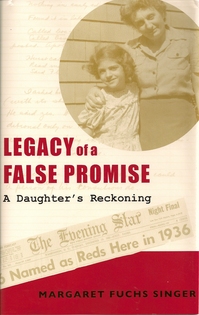
Singer’s parents, Herbert and Frances Fuchs, were both children of Jewish central European immigrants who emerged from the roaring twenties and then the Great Depression well educated — each of them had a law degree — and working in Washington D.C. to repair the devastation caused by the financial collapse. They joined the Communist Party in the mid-1930s, Mr. Fuchs later describing their politics as only a little to the left of the New Deal in the beginning, and applied their considerable dedication and talents to the getting a better shake for the working man.
Both the Communist Party’s emphasis on collective discipline and its insistence on secrecy succeed in occluding its dangers until 1946, when Fuchs got a new job at the National Labor Relations Board and also began to feel incontrovertibly that the American Communist Party was, indeed, a tool of the Soviet Union and about as far from a patriotic allegiance as one could get. The pair stopped going to meetings, broke off their political friendships, got new careers in education and decided never to talk about the sorry mess again.
That hope came to a screeching halt nearly a decade later, when a subpoena from the House Un-American Activities Committee arrived for Mr. Fuchs. Singer, just entering her teens at the time, describes the maelstrom that blew through their previously tranquil existence as pressure began to ratchet up from all sides; then she takes us through the long, torturous process that led her father to decline to take the Fifth Amendment, testify before Congress about his involvement with the Communist Party and finally to name the names of those with whom he’d collaborated. It is the defining moment of their family, a dark period only ever referred to thereafter in her parents’ lifetime as “the troubles,” and one that each member spends many years afterward accommodating.
Singer tells us straightaway that this book — a thoughtful, meticulous and firmly empathetic examination of that history and its enduring effects — is her attempt to reconcile her lingering shame with her sense of her parents as smart, deeply ethical people.
This book ends with a vivid description of the healing the process that you say writing this book has let you participate in. Do you feel healed? I do. On that score, I really do, and I must tell you that I’m very surprised. I certainly set out to work through the shame and feelings of paranoia, but I didn’t expect to be as healed as I feel about it. And that’s just amazing to me.
Is there anything in particular that you feel contributed more than you thought it would to that healing, to make it better than you’d expected? I can’t tell you what makes me feel it. I feel a lack of defensiveness… as though I’ve reached some closure, that level of comfort. I feel actually quite proud of and loving toward my parents, and I have an easier time seeing them as complex human people. I do credit the process of writing, talking, feeling and chewing through the issues.
The writing is lovely. Were you a writer before? No I wasn’t. I had a career of 35 years in special education, and for the last 23 I worked as an administrator in Ann Arbor Public Schools district. So there was plenty of professional writing I had to do, and it wasn’t something that was difficult. But when I wrote the first chapter and showed it to my husband and best friend, they were in shock. They thought they knew me! We were all surprised.
There are a some instances of really counterintuitive behavior among these people who have given much in the name of their ideals, like your parents’ initial rejection of your interracial marriage, your tenant-organizing uncle leaving his estate to his landlord, former fellow Communist Harry Magdoff making his fortune in the stock market. They were so jolting that I wondered if there are any lessons to be learned from that — is it a reminder that every coin has two sides, or that great sacrifice is bound to be paid for in some other way? I like irony. I point that out. (Laughs.) I think that I do enjoy the ironic, but also I think that many people who are politically very intense in their early years do become more conservative as they get older and that’s for sure. It’s not unusual especially when people get burned, but not just then. We all become a little more cautious.
Toward the end of the book, even though you’ve already given us all the facts of the case, you walk us through your father’s decision process again in a way that’s really careful and thoughtful, setting out each decision in a way that takes the hindsight out of it and challenges us to think about the last time we faced something huge, where there was no good course of action but it was required anyway. Your clear-headed empathy made me wonder if this is a way of life for you — if maybe you have a better understanding than most that often “right” and “wrong” just aren’t the choices we usually face. I think maybe I do. I tend to have, to be pretty good at understanding what the other guy is thinking. My dad was a mediator for some years, and I think he taught me some of those skills. As far as right and wrong answers, I’m relating more to your question in terms of people having more points of view and people having different answers. I would say the book — people have said that thing that struck them about the book is how complex the issues are, so to that extent I’m proud of trying to find a balance. And that it was a very satisfying way of exploring something — there are positions on the left and on the right, and they’re both right and wrong. I was looking for the truth between those two different ways of interpreting reality, and they’re different truths. But I do end up thinking that my father was an ethical person who made a decision he later came to regret.
When you write about struggling to “comprehend how intelligent people such as my parents could stay involved after the truth became known about Soviet purges, show trials and other atrocities,” you say, “Passionate and certain, they just didn’t believe what they heard.” That struck a chord with me, because I often feel like certainty is hard to come by, even (or especially) in the news. Do you feel that way too? Absolutely — so when you read things, you don’t know if they’re true or not. But I think it became increasingly clear. I think that my dad shared that view, that in hindsight, he should have left in ’39 when the Nazis created a non-aggression pact (with the Soviet Union). Many Communists left then, because they could not believe that the party would adopt fascism. The party line was that they were just biding their time while they prepared, but it seemed clear to some people at the time. The secretive thing also became a problem for some people, and it seemed that (involvement with the Communist Party became) dangerous before it was acknowledged.
I heard the word “McCarthyism” tossed around during that intense period between 9/11 and the invasion of Iraq, when “patriotism” seemed like a fully-loaded word, and the government’s response to activities it deemed “un-American” is still being discussed. Did you watch those events with an eye toward history? Did you feel like we as a nation had learned anything from our previous experiences? I did try to watch it with an eye toward history, but I’m not a historian, so I found it difficult to judge. I think we’ve learned some things, and it’s not as bad as it was. But I do think we’d do well to remember our past.
Where did you end up on the political spectrum? I am a good liberal Democrat. I really like Obama, even though I know he’s having a terrible time. So that’s where I ended up.
What are you working on next? I’ve written some autobiographical short stories relating to that period, and I’m thinking of writing a novel and using them as events that occur. I’m actually really intrigued by the period, and all of the complexities involved in it — it’s fascinating that people were so sure of their beliefs. And there are so many topics that get covered — family secrets, parents’ relationships with kids, intellectual and academic freedom, the experience of “red diaper babies,” which were just so different from one to another.
What attracts you to fiction this time around? One thing is that I’m very sensitive to talking about real people. But I think it’s time to not worry about that.
Is there anything else you would like us to know? Just how complex it all is — that right and wrong are more complicated than that. I think if I’ve put forth a more balanced view than is presented in some other books, I’d be happy about that. And also that people are only as trouble as their deepest secrets — I’ve come to really believe that it’s the truth that sets you free.
Margaret Fuchs Singer will be at the downtown Borders at 7 p.m. on Tuesday, Feb. 9 to read from and sign "Legacy of a False Promise: A Daughter's Reckoning."
Leah DuMouchel is a free-lance writer who covers books for AnnArbor.com.
Comments
Susan Scott Morales, MSW
Thu, Feb 4, 2010 : 8:33 a.m.
I've read this book and highly recommend it. Not only is it informative about the McCarthy era, the author's heart wrenching experiences growing up with the family secret make it a page-turner.
MsFarm
Thu, Feb 4, 2010 : 6:38 a.m.
I have read this book, and it is one I would definitely recommend. Very readable and interesting from both an historical perspective and also from the perspective of family dynamics. We hear much more about those individuals who didn't name names than about those who did. Since the writer's father was in the latter group, this book is particularly interesting.