

U-M's MUSKET presents "Man of La Mancha"
Rebecca Spooner — director of “Man of La Mancha,” presented by the student-run theater troupe MUSKET at the University of Michigan — hadn’t originally planned on submitting a proposal for the stage musical adaptation of Cervantes’ 16th century novel “Don Quixote,” even though she loves the show.
Why? Because she worried that “La Mancha” was too similar to one of MUSKET’s recent musical productions, “Kiss of the Spider Woman.” Both shows are set in a Spanish-speaking prison, and both feature prisoners who temporarily escape their circumstances by way of their imagination.
“But the show I applied with, we didn’t get the rights to,” explained Spooner. “So we were all sitting around talking about this, and I was almost afraid to propose it. But then I finally said, ‘What about “Man of La Mancha”? I think it could be done well, and that I could bring a lot to it.’ So we hashed it out and settled on that show.”
PREVIEW |
Rather than strictly telling the story of “Don Quixote,” “Man” focuses on the novel’s author, Cervantes, while he’s imprisoned at the time of the Spanish Inquisition. The other prisoners threaten to burn his book manuscript, so to stave them off, he agrees to tell them the story found in its pages — the tale of a delusional man who sees himself as a knight, and sees a prostitute as a fine lady.
With a book by Dale Wasserman, lyrics by Joe Darion, and music by Mitch Leigh, “La Mancha” premiered in Connecticut in 1964, then hit New York in 1965 — winning 5 Tony Awards in 1966, including best musical, and introducing a song that would become a musical theater standard: “The Impossible Dream.”
“I first saw the show in Chicago, where I’m from, when I was in high school, and it was one of those productions that changed my theatrical life,” said Spooner. “The story itself is so beautiful — it’s so much more than the story of Don Quixote.”
Spooner noted that Wasserman struggled to adapt Cervantes’ classic book as it is, so he instead decided to focus on the author, thus making "La Mancha" a “show within a show."
This opened up more thematic opportunities, but it also skewed the show even more toward men.
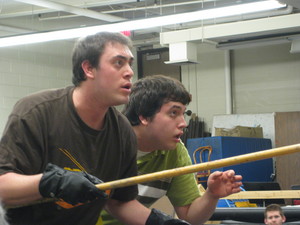
Reed Campbel (Don Quixote) and Joel Sparks (Sancho) rehearse.
It’s a show, for the most part, that Spooner’s young cast didn’t know very well, while older generations of her family thrilled at the news that she was directing “La Mancha.” To bridge this age gap, Spooner has encouraged her cast to note what’s modern about the musical; to explore the ways we still relate to a story that’s hundreds of years old; and to consider the show in relation to the musical MUSKET staged in the fall, “Hair.”
“’Hair’ and ‘Man of La Mancha’ were only about 2 years apart,” said Spooner. “At first it’s strange, looking at the 2 shows together. ‘Hair’ is this anthem of the ‘60s, all about peace and love, and you don’t think of ‘Man of La Mancha’ as saying those same things. But it does. It’s all about Quixote pushing forward, and loving life, and being true to yourself. All these things that carried over the generations and represent the 60s, but also apply now.”
Jenn McKee is the entertainment digital journalist for AnnArbor.com. Reach her at jennmckee@annarbor.com or 734-623-2546, and follow her on Twitter @jennmckee.