

Michael Moore talks about "Roger and Me" and more at U-M
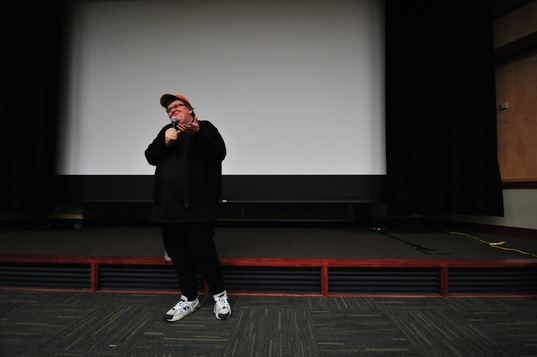
Michael Moore appeared at Angell Hall Thursday night for the 20th anniversary screening of "Roger and Me."
Ryan Stanton | AnnArbor.com
After a 20th anniversary screening of "Roger and Me" on Thursday night, Michael Moore entered Angell Hall's Auditorium A — a space the controversial, Oscar-winning filmmaker referred to as "hallowed ground."
For Moore had often driven to Ann Arbor in the '70s to catch movies (like "8 1/2," "Wild Strawberries," and one of his all-time favorites, "Hearts and Minds") screened by U-M campus film groups, and this largely provided his film education, he explained to the capacity crowd of more than 300.
In fact, U-M's campus was where he first watched "Atomic Cafe" and met filmmaker Kevin Rafferty, who ended up showing Moore some basics about cameras and sound while helping out on "Roger and Me."
As it happens, Rafferty is a nephew of George H. W. Bush, and he reported back to Moore about a private screening of "Roger and Me" that the Bush family had at Camp David during George H. W. Bush's presidency.
"(Rafferty) said, ‘Well, it was interesting. But one of my cousins, he was laughing — he got the whole thing. Of course, he’s high half the time. Yes, his name is George, too.’ And that was my very first experience with George W. Bush."
Some other notable quotes from Moore's nearly 90-minute talk:
On getting started in film: "I had not made a movie before, so this was all trial and error. I screwed up so many things. I would say out of every 10 rolls of film that we shot, one was usable — usable as in, we could develop it. I’m serious. It was just a complete mess from beginning to end, and when I watch it now, I don’t know how we all did this, because we knew nothing. … On some level, I’m glad I didn’t finish school, because one of the really bad things that school … teaches you is that failure is bad. And I never was wired that way. I always thought failure was a good idea, because that’s how you learn."
On his goals for "Roger and Me": "I set out to make the anti-documentary. … To take the principles of what was called New Journalism at the time and apply it to filmmaking. To approach this with the attitude of, make sure that anything you’re stating is a fact is fact, but everything else is open to your interpretation or the audience’s. … The other thing I did was, … I made this to be shown in movie theaters. I want you to see my films in a room like this: in the dark, with two or three hundred other people — I want you to have this communal experience. That’s what the movies are really about. It’s not about sitting at home watching it on the couch by yourself with a remote that you can pause or speed ahead or listen to the director’s commentary. In fact, if you’ve gotten any of my DVDs, you know that I avoid the director’s commentary whenever possible. There’s one on ('Roger and Me'), and I have never done it since. … And I’ve actually been toying with the idea of announcing that, my next film, I’m not going to do a home video of it."
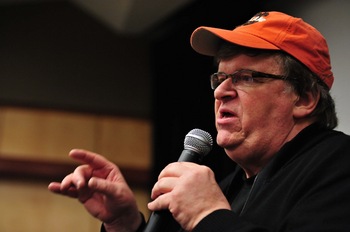
Michael Moore spoke for nearly 90 minutes Thursday.
Ryan Stanton | AnnArbor.com
On "Roger and Me" as a dating test: "One night, the phone rings. I pick up the phone. It’s George Clooney. I’d never met the guy, no contact with him whatever, this was a number of years ago. And he says, ‘I just wanted to call you up. I’ve never met you, and I wanted to tell you how much I love “Roger and Me.”’ And then we got talking about it, and he says, ‘I want to tell you something, and this is the honest truth, that when I decide to ask somebody out to go out to dinner, like a first date or whatever, … this is the typical first George Clooney date: go to dinner, and then come back and watch ‘Roger and Me.’ If they get it, then there’s a second date. If they don’t get it, there’s no second date. So I kind of use you as a barometer as to whether or not there should be a second date.’ I said, ‘That is so pathetic. I can name about three other things you should go for first, other than liking ‘Roger and Me.’"
On the demise of print media, and specifically, the closing of The Ann Arbor News: "I don’t know how to explain this to people outside of Michigan because they don’t understand why what would appear to be the most educated town in Michigan doesn’t have a daily newspaper. … (The media companies) all blame the Internet. … And I say to them, 'Well, how come the papers in Germany aren’t closing? How come there are still 11 dailies in London? Why aren’t papers in Sweden closing, or France? Because I think they got hooked up to the Internet some time ago.' … It's (because of) two reasons, in my humble opinion.
One is the business model. In America, the number 1 source of income for daily newspapers is advertising. Circulation is number 2. … In Europe, it’s the opposite. … So if circulation is going to be your number one way to make money, what do you got to do? … You’ve got to put out a great paper. You’ve got to have the best writers. … In Sweden, they sell enough daily papers every day, one for every man, woman and child. You take the population of Sweden and look at the circulation figures, they’re exactly the same, and that includes children. And they’ve got the Internet. … They want to read that paper, and they want that paper to have — they want the long version (of stories), and they want to take the time to read every day.
… The other reason that the reason that the papers are dying, why we don’t have an Ann Arbor News, is because the papers have helped to dumb down this country. … And here’s how they’ve done it. In 17 (presidential) elections, between 1940 and 2004, the majority of American newspapers endorsed a Republican for president in 14 of the 17 elections. … The … papers endorsed the party that wants to get rid of the Department of Education, that wants to put education on the lowest rung of the funding ladder, that hates the teachers union — they endorsed the party that made them have less readers. Because we now in the this country have 40 million adults who are functional illiterates. … They cannot read and write above a fourth grade level. So when they can’t do that, you have to dumb down the paper. You can’t use words with more than three syllables. Bigger graphics. Bigger pictures. … They brought this on themselves by helping to create a society that can’t even read their own … paper. It’s as stupid as if GM had lobbied to get rid of driver’s ed."
MORE ON MOVIES |
On legal problems: "I was sued or threatened with a lawsuit about 30 different times after ('Roger and Me') came out. And I learned what to do after that. So in the last 20 years, I’ve only been sued twice, and that’s all my movies, TV shows, and books combined. … Both were thrown out of court. … I do a number of things now to make sure I don’t get sued, which is get releases as much as I can, … and hire really scary lawyers to threaten people who are trying to stop me. So it’s kind of a sick game you have to play. Once you start suing them back, when they file frivolous lawsuits against you, they stop doing it. But I didn’t learn that for a while."
On the current Democratic majority in Congress: They just look like a bunch of wimps. That’s why you have to admire, on some level, the Republicans, because they come into town with guns blazing, they run over anybody that’s in front of them, and what they say is, ‘We were elected to do this. The people have had their say. … Get out of my way.’ And we come out and bring out the six-string guitar and sing 'Kumbaya.' We hold out a hand in the spirit of bipartisanship. … They don’t want to hold hands with anybody. … So I give Obama a lot of credit for having a good heart and wanting to have everyone get along, but the other side doesn’t want to get along, and the people spoke. … I have zero optimism. … I feel bad for the young people who worked so hard to get Obama elected, because I hate to see you become cynics and give up so early because nothing happened in the first 15 months."
On "Roger"'s infamous rabbit lady, whose handmade signs were first spotted by Moore's wife: "We’re like, that’s what we’ve become. The hometown of General Motors is like a third-world country now. Bunnies are for sale. You can get them for pets or for meat. And that’s pretty much how we felt we ended up being in that town. The few that succeeded were the pets, and everybody else was just meat. Everybody else was getting clobbered. It’s always amazed me. When I used to speak to audiences when the film came out, people were very upset at watching that poor bunny being clubbed, and there was much more of a gasp in the room than anything else that happens to any of the humans in the film. The job losses, a Christmas tree — the kids' Christmas presents being put out on the curb does not engender the same gasp that the bunny gets when its head is clubbed by a metal pipe. In the film, a black man who’s obviously gone a little crazy has a toy gun, and he’s shot by the police in the middle of the street. And nobody’s ever asked me about what’s up with shooting the black guy in the middle of the street who’s obviously mentally deranged and had a toy gun. … I’ve never, in 20 years, been asked that."
On confrontation: "I’m afraid all the time. I remember, while we were making ('Roger'), I didn’t really enjoy doing a lot of the confrontation stuff. Going into those buildings, I’d always have a sick feeling before going in there."
On this year's Oscar contenders: "I did not like ‘The Hurt Locker.’ It’s a lazy way to make a movie, frankly. I could put you on the edge of your seat quite easily, and have you feel the tension for 2 hours, if every other scene practically is, 'Should we cut the red wire or the green wire?' And if he cuts the wrong wire, he gets blown to smithereens, and you never know who’s going to get blown up in any given second. That doesn’t take a whole lot of skill to get big emotion out of this if you’re in the audience. And there’s a pornographic element to it that’s a little disturbing because you can’t take your eyes off it. But what’s it saying? What’s the substance of this? I think ‘Avatar’ was really trying to say something about the planet, about indigenous people, and about how we construct war now, how we privatize it. And I think these are really powerful things to say in this time, and I give James Cameron a lot of credit."
On mistakes he's made: "I still fall into the trap of thinking I’ve got to interview experts. So I waste all this time going and getting there, doing this interview … where the expert is telling you what’s going on. And I never end up using it. And that’s just a function, I think, of a lack of confidence. … I feel like I need that person with the degree I don’t have, or has the knowledge I don’t have to explain it to people. But it’s always better to show it."
On breaking into the film business: "You can’t break in. That’s the big truth I want to tell you. It’s not about who you know, it’s not about foot in the door, it’s not about getting your break - I don’t think it’s about any of those things. It’s ultimately about you making a good movie. … The audience will forgive a lot of things. They’ll forgive the camera work if the story is really strong."
On unsuccessfully, at first, goading Roger Ebert to forgo the Telluride Film Festival's opening night gala to instead see the premiere screening of "Roger and Me": "Five minutes before the film starts, I look out the window in the lobby, and waddling down the street is Roger Ebert. … He walks in, he sees me, and he goes, ‘OK, OK, don’t say anything. There was just a crazy look in your eye that told me I had to be here.’"
The evening concluded when U-M screenwriting professor Jim Burnstein explained to the crowd that Moore had prioritized his commitment to come to U-M over a booking on "The Colbert Report." Burnstein presented Moore with a U-M sweatshirt and baseball cap.Â
Moore pretended to weigh his options in his hands.
"Ann Arbor, Colbert, Ann Arbor, Colbert — Ann Arbor!"
Jenn McKee is the entertainment digital journalist for AnnArbor.com. Reach her at jennmckee@annarbor.com or 734-623-2546, and follow her on Twitter @jennmckee.
Comments
Alan Benard
Sat, Mar 20, 2010 : 9:10 a.m.
The other reason that the reason that the papers are dying, why we dont have an Ann Arbor News, is because the papers have helped to dumb down this country. Mike doesn't get everything right, but he is absolutely correct about this. Ann Arbor News was a paper which championed stupidity, most likely because any smart paper would have challenged a.) Michigan's Culture of Ignorance; b.) The political and economic dominance of U-M and how it warps our lives out of shape; c.) The dysfunctional lack of regionalism and the racist way Ann Arbor and the collar suburbs both avoid Detroit and refuse to insist that Detroit's political leadership cut the crap and cooperate. Now we have annarbor.com, and between the Greek chorus of ultra-right-wing retirees and cranks in every story's comments, the use of second-rate unedited content and lack of editorial spine, Supidity's triumph is complete.
Moose
Sat, Mar 20, 2010 : 8:59 a.m.
That's mighty hateful language coming from someone who is condemning hate. Essentially you have insulted half of the country and our local institution of higher learning, fish nuts.
stunhsif
Sat, Mar 20, 2010 : 8:35 a.m.
Michael Moore is a disgrace to anyone that loves this country and the principles that this great nation were founded upon. He has never had anything good to say about this country or anyone that might disagree with his laser focused limited socialist thinking. Thank goodness he is for the most part ignored by level headed thinkers and is relegated to speaking at colleges that espouse his words of hate for the USA.
Lokalisierung
Fri, Mar 19, 2010 : 5:15 p.m.
You've characterized people that post anti Michael Moore messages as people that have little knowledge to the world/concepts of journalism. I didn't misunderstand what you said at all. As for our schools, they must have failed us both. I "would't" have thought it possible as you like to say, but I guess so.
Moose
Fri, Mar 19, 2010 : 5:03 p.m.
What I said had no relation to whether someone agrees or disagrees with Michael Moore. It can be easy to confuse metaphor and allegory. But to confuse a metaphor about someone's lack of knowledge of filmmaking or journalism as a reason to categorize someone who doesn't like or agree with Michael Moore? A perfect example of how our schools have failed us. I guess reading comprehension was an elective at some folks schools.
Lokalisierung
Fri, Mar 19, 2010 : 4:30 p.m.
"What most anti Michael Moor posters know about journalism, new or old, or documentary filmmaking would't even fill those little holes on film that go over the sprockets of a projector." Haha. That's great...casue if someone doesn't agree with michael Moore it MUST be the reason you've come up with, brilliant.
Macabre Sunset
Fri, Mar 19, 2010 : 4:19 p.m.
New Journalism is the sanctimonious notion that as a reporter, you have an obligation to slant your reporting for what you would call the "common good," though it's often simply a personal religious or political bias (or both). Obviously, that's a "New Journalism" definition of New Journalism. But the result has been people trust newspapers less today than they did even during the halcyon days of yellow journalism. So I think Michael Moore is correct to a certain extent in his comments, but he is representative of a big part of the problem.
Moose
Fri, Mar 19, 2010 : 3:56 p.m.
What most anti Michael Moor posters know about journalism, new or old, or documentary filmmaking would't even fill those little holes on film that go over the sprockets of a projector.
thurber
Fri, Mar 19, 2010 : 2:47 p.m.
We need more voices not fewer. There's a lot of group think going on in the country; In Ann Arbor there are two online information silos, the Chronicle's 'socialists' and AnnArbor.com's 'I fear and hate socialists.' Neither camp talks to the other. There's more simplistic polarizing parroting unoriginal thinking going on that Moore offers just one not terribly factual but thought provoking voice to and the United States as leader of human liberty, or so we say. ought to have more of that not less. We're all in it together, why not work together?
Macabre Sunset
Fri, Mar 19, 2010 : 2:36 p.m.
He talks about "New Journalism," which is more responsible for the demise of the American newspaper than anything. It no more resembles journalism than anything "New" that came out of a ministry in Orwell's "1984." That is the society he seeks. But he does make a good point about the dependency on advertising resulting in lost circulation. We definitely saw that with The Ann Arbor News. It was once a great mid-sized paper. By the time it closed, it was a shadow of its former self. It's too bad Moore is such a nut job. He has tremendous energy and some intelligence. But he's also a fundamentally dishonest person. Maybe we do need a few Moores, Olbermanns and Frankens to balance out the Limbaughs, Huckabees and Coulters. But I wish we had unbiased commentators instead. Or at least commentators who strove to be unbiased.
Moose
Fri, Mar 19, 2010 : 12:11 p.m.
I don't think Michael Moore's films are made to advance or enlighten anything. They're made to get people worked up about issues about which he cares. I love it when right wingers get all faux outrage because some fat guy from Flint pokes them in the eye with a sharp stick. I bet Moore loves it too.
Moose
Fri, Mar 19, 2010 : 12:01 p.m.
All Michael Moore does is hold up a mirror on our culture and politics. His real mastery is stirring the pot by showing us who we are.
Barb
Fri, Mar 19, 2010 : 9:40 a.m.
Good point, chimarathon. Look what that cad is doing to Traverse City! Year-round Film Festivals, bah! Who needs tourism in Michigan?
babarossa
Fri, Mar 19, 2010 : 9:16 a.m.
At least there is one crazy left winger with the guts to fight the slanderous, morally bankrupt, right wing machinery. After unabashedly conning America for decades it must hurt to give you a taste of your own medicine.
belboz
Fri, Mar 19, 2010 : 8:38 a.m.
Anyone developing a smear campaign against one or all of the big 3 is an enemy of Michigan and someone who has interests counter to the development of our economy. Why doesn't he take his plight of the people to China, or Korea, or Mexico - and see how the factories are run there, the quality of life for the people, and the health of the society. Maybe he would realize the problem isn't the corporations, it is the government allowing such a free flow of work out of the country. With all of the treaties our government has signed, letting in products made from cheap labor - our companies have no choice. "The consumer!!! It is all about choices for the consumer!!!" Tell that to your pension plan - if you have one. How did his material help the image of Michigan, our corporations, and our cities? It didn't... And where is Roger these days... Looks like Mike might have eaten him...
Anonymous Due to Bigotry
Fri, Mar 19, 2010 : 8:07 a.m.
in4mation: I think you're right that the Christopher Hitchens story is perhaps the best example of a critique of Moore by the political left. Moore is such an ignorant and intellectually dishonest propagandist that any university that hosts a talk by him is seriously damaging its reputation by doing so. What's next? Will U-M be inviting Paris Hilton to speak?
chimarathon
Fri, Mar 19, 2010 : 8:04 a.m.
Michael Moore-worst thing Michigan has ever produced.
Top Cat
Fri, Mar 19, 2010 : 7:23 a.m.
Michael Moore's films are fiction not "documentaries". And Michael is firmly in the corner of America's leading fiction, President Oborrow.
David Briegel
Fri, Mar 19, 2010 : 7:11 a.m.
Why no "all of the above"? You are right Mike D!! He is a treasure!
Marvin Face
Fri, Mar 19, 2010 : 7:07 a.m.
Who is this Michael Moore person? Why do people seem so interested in what he has to say?
Mike D.
Fri, Mar 19, 2010 : 6:35 a.m.
For every 20 vile hate mongering right-wing pundits stretching the truth to sell their evil story, there's only 1 Democrat doing the same. It's a dirty job, but somebody's got to do it. Bravo Michael Moore. And honestly, I mean that as a compliment.
A2JetGuy
Fri, Mar 19, 2010 : 6:24 a.m.
I vote "none of the above", too!
jondhall
Fri, Mar 19, 2010 : 5:54 a.m.
Real nice we can now print "hearsay information " about our past President, need to start printing some about the current one. Did the author attempt to reach Bush to get his comments? How fitting for the U of M to invite Roger over for a speech he will likely get prime seating when the Obama ( Is he still a closet smoker?)shows up in about sixty days. Liberal Press liberal Professors, hum has a pattern if you ask me.Maybe we should get a bumper sticker for MM that say "Do you Miss me yet" How about giving him one of those "PHD's" Hos about some "hearsay" information about MM, now that his Dad Walt has passed! Get real find some facts, d o a little work. Not everyone is a MM follower some still like Donald Duck more. Just my thoughts on the whole "liberal mess". I also do not drive a Toyota.