

Monday's choice: Lambchop or 'Monterey Pop'
Lambchop
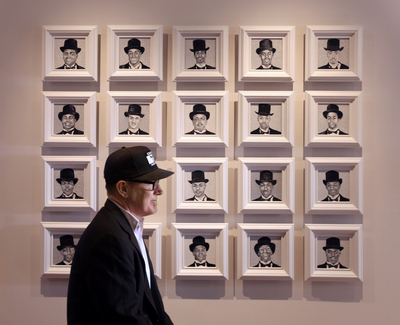
Lambchop is the long-running indie-rock band from Nashville led by singer-songwriter Kurt Wagner, finally making its Ann Arbor debut Monday evening at The Ark. With a fascinating and unpredictable sound that draws from the worlds of alt-country, pop, jazz and the avant-garde, Lambchop has just released a terrific album entitled “Mr. M,” one of the most beautiful and emotional works in the group’s career.
Recently I had the chance to talk to Kurt Wagner about all things Lambchop.
Q: Besides being the chief vocalist and songwriter on “Mr. M,” you also are responsible for the exquisite artwork on the album. Have you been a visual artist as long as you’ve been a musician?
A: Oh, longer, for sure. It was what I had intended to do when I went to college. Music came along quite a bit later. I fooled around with it in art school and grad school, but never really thought about it much more than that. Making music really was just another expression, an art form—we just didn’t realize that people would actually listen.
Q: Are you originally from Nashville?
A: I was born in Bethesda, Maryland, but moved to Nashville when I was 2. I went to the Memphis Academy of Art and then Montana State University, where I got a graduate degree in painting and sculpture. I thought I was going to be a college teacher but there weren’t any jobs, so I started laying floors and painting pictures.
Q: “Mr. M” is dedicated to your musical compatriot Vic Chesnutt, who died in late 2009. When did you first meet and work with him? A: I met him when he was touring for his first album (1990’s “Little”). He came through Nashville and there were only two people in the audience; I was one of them. We had a lot of time to talk (laughs)! We stayed in touch, became friends and eventually he decided to make a full record with Lambchop (1998’s “The Salesman and Bernadette”).
Q: Is there a specific song on “Mr. M” whose lyrics are about Chesnutt?
A: It’s more about the influence of him in general and the fact that he was a big part of why I got into music. He was very encouraging and very much like a mentor. His presence was always around in the making of Lambchop records, and this was the first time he wasn’t around. What I do as a writer is reflect upon my experiences and my friends’ experiences and let that out in a less than linear way and this record was no different. But I did feel the need to acknowledge his loss.
Q: You use string arrangements on a number of tracks on “Mr. M,” and this is certainly not the first time you’ve done so. Why do strings attract you so much?
A: It certainly started out early on as an element that was available to us working in Nashville. When we first started using strings, I don’t think many, if any, indie-rock bands were using them. It was thought of as being too weird or too expensive. We thought it was part of what you can make happen in Nashville. We were subversively doing our own music but taking advantage of the infrastructure here. This time around we’ve learned a way to use them in a more reconstructed way. The overall approach was to deconstruct them and reconstruct them, making them more like a singular instrument instead of following the traditional way of using strings.
Q: This is the 11th studio release for Lambchop, so obviously you’re written a fair share of songs over the years. Has songwriting gotten a lot easier for you since your first album came out in 1994?
A: Over the course of doing this for a while I’ve tried various ways of going about it. I’ve gone from writing a song every day situation to taking a lot longer to write songs. I appreciate being able to spend a lot longer on a song. I’ve gone from being prolific and writing a lot of bad songs to focusing on refining a few and spending as long as it takes to do it, much the way I work on paintings. A lot of the paintings I do also take a long time, up to a year, and I’m starting to look at songwriting the same way.
Janis Joplin in "Monterey Pop"
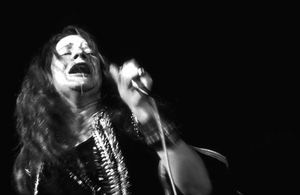
Boasting a lineup equal to, if not better than, 1969’s Woodstock Festival, “Monterey Pop” captures some of rock’s best artists at their peak, with the most incendiary fireworks provided by Hendrix, who sets his guitar on fire at the close of his set. Riveting from start to finish, don’t miss the rare opportunity to catch this one on the big screen at the Michigan. I’ll make sure the volume is cranked up to 11.
Check www.theark.org for Lambchop info and www.michtheater.org for Martin Bandyke's Moving Pictures info.
Martin Bandyke is the 6-10am morning drive host at Ann Arbor’s 107one, WQKL-FM. Follow him on Facebook, Twitter and at www.martinbandyke.com.