

Ann Arbor Civic Theatre's "Nine," like its main character, has both charms and flaws
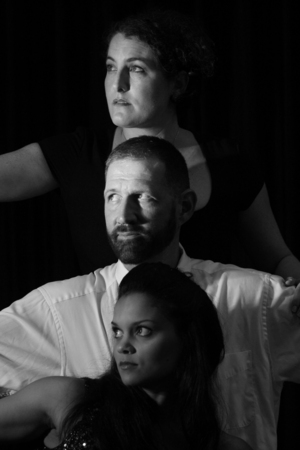
From top, Caitlin Rowe, Norman Weber, January Provenzola.
Based on Federico Fellini’s film “8 ½,” with a book by Arthur Kopit and music and lyrics by Maury Yeston, “Nine” mashes memory, fantasy and reality together to convey the psyche of this profoundly self-absorbed, but stalled, artist.
And due to an unbelievably appropriate typo, the A2CT program lists the show’s penultimate song as “Getting Tail” rather than “Getting Tall” - which efficiently sums up Guido’s issues regarding growing up and respecting women.
The show’s dream-like, hallucinogenic quality makes it difficult to plug into quickly, and on opening night, A2CT’s production initially exacerbated this challenge. In the opening moments, lines (spoken with Italian accents) and vocals were shaky; some transitions were confusing; and because there’s only one set, an odd moment involved Guido and his wife Luisa (Caitlin Rowe) talking about going to a Venetian spa when, well, they already appeared to be there.
Fortunately, the show snapped into sharper focus when Weber got his first chance to shine vocally (“Guido’s Song”), showcasing his rich, full voice; and soon thereafter, Rowe offered a moving, lovely rendition of “My Husband Makes Movies.”
Yet perhaps the biggest reasons to see this “Nine” are January Provenzola, playing Guido’s mistress Carla, and Kathy Waugh as Guido’s muse and lead actress, Claudia. Provenzola’s “A Call from the Vatican” is a wildly sexy vamp-knockout, while - at the other end of the emotional spectrum - her later rendition of “Simple” demonstrates how powerful restraint can be.
Waugh, meanwhile, conveys her character’s affection, vulnerability and strength in the numbers “A Man Like You” and “Unusual Way,” the latter of which ends in a duet with Weber that’s a vocal highlight of the production.
But there are several. For although “Nine” is a show I didn’t personally love, certain numbers really hit the mark. “Be Italian,” featuring Tawna Dabney as a prostitute Guido encountered as a child (have I mentioned the show’s not for kids?), combined eye-catching choreography (by Deedee Ulintz and Rachel Francisco) with strong ensemble work; “The Belles of St. Sebastian” showcased the cast’s impressive, collective singing talent, as well as music director Tyler Driskill’s skill; “Nine” was beautifully sung by Amy Bogetto-Weinraub (though microphone issues made her voice sound tinny); and Nicholas Beatty, as Little Guido, provides a sweet, pared-down take on “Getting Tall.”
Meanwhile, Wendy Wright, as Guido’s persistent producer, provides a surefootedly comic performance, and she delivers a fine “Folies Bergeres.” Even so, the number plays a bit too long - and it didn’t seem to be just me who felt that way. As members of the ensemble gathered on stage near the song’s end, they performed dance steps with a blatant sense of fatigue, shuffling their way through a zero-energy kickline.
And while the production didn’t convey this kind of listlessness throughout, at two and a half hours, “Nine” feels similarly over-extended, especially since Guido’s charms were lost on me. Yet even so, director Edmond Reynolds and his cast offer up several well-executed, memorable numbers that nearly make the whole worthwhile.
Jenn McKee is the entertainment digital journalist for AnnArbor.com. Reach her at jennmckee@annarbor.com or 734-623-2546, and follow her on Twitter @jennmckee.
Comments
sbheme
Mon, Jan 18, 2010 : 8:58 a.m.
What a stunning show! If you didn't see the whole thing you missed some of the most moving performances I have seen on stage in a long time. Caitlyn Rowe and Norm Weber's "break-up" scene was very emotionally moving, and this continues through Norm's I Can't make this movie, and the cherry on top is the songs Getting Tall and the duet with Nicholas Beatty and Norm Weber recapping Nine at the end. There were many damp eyes in the audience. Congratulations to all the cast, you are so talented. We are lucky to have such a group in this area to enjoy.
Fran Wakefield
Sun, Jan 17, 2010 : 6:25 p.m.
I did not get to see much of the show, as a musician in the pit, but there are some astoundingly beautiful numbers, like "Unusual Way", and I think kathy Waugh and Norm did a beautiful job. "A Call from the Vatican" was very sexy. The entire cast did a wonderful job, especially the young Guido, Nicholas. It was a real treat to provide musical backup for this production. There were several pages of music cut out of the production, to make the musical more tidy.
Anthony
Fri, Jan 15, 2010 : 4:47 p.m.
This show is the bee's knees. I saw it last night and really enjoyed it. As Jenn pointed out, there are several moving performances. I highly recommend going to see it.
Hatshepsut
Fri, Jan 15, 2010 : 11:58 a.m.
I have to say I really enjoyed the civic's production of "Nine". Sure, a couple of moments could have been tighter, but it was a ballsy, brazen production that took risks and I can't help but applaud that. I loved "Be Italian"- awesome choreography, great ensemble work and a very gripping number. I was also very impressed by Norm Weber's vocal skills. The show did not feel long to me at all. It was a little "out there", but I really liked it.
GreatLakesGuy
Fri, Jan 15, 2010 : 7:04 a.m.
I completely agree with BelleCanto -NINE has one of the MOST beautiful musical scores - and this cast and music director deliver top notch performances! The storyline is a bit crazy, but you can't help getting caught up in it with such powerful and moving performances by this group of actors that Edmond Reynolds has brought together. NINE is a truly a treat for the Ann Arbor adult community, and I applaud A2CT for taking the risk to introduce a show that's not "just another musical". Don't miss it!
BelleCanto
Fri, Jan 15, 2010 : 4:37 a.m.
Although I have never been a fan of musical theater there were moments in this show that took my breath away- or gave me goosebumps! One of those moments was Kathy Waugh and Norm Weber's duet ending of the song "Unusual Way" and the other was January P's "Simple". I went home and bought both songs on itunes and can't get them out of my head. Beautiful. I hardly ever make it through a whole musical without trying to figure out how to leave early but for this one I am glad I didn't because those two songs are in the second act. I loved the little kid who plays Little Guido, his cute little lisp; and the gorgeous prostitute looked like she belonged on Broadway! I was a little surprised that civic gets away with the sexuality but, I guess most people will like that. I will say that I was home in bed by 10:30 last night so the show is not anywhere near as long as the reviewer states.