

Be an encourager: The kindly virtue of generosity
Heidi Hess Saxton | Contributor
My junior year of high school, we had a Finnish exchange student Jaana — living with us. Socially speaking, she was a dream come true for me. Jaana was pretty and curvaceous and had the local boys eating out of her hands. I was/had none of those things . . . but just by hanging around her, my lot in life improved drastically.
Unfortunately, the happiness was short-lived. Just after Christmas, my sister Chris wound up in the hospital due to complications from cancer. My parents were already financially tapped out — they had agreed to take an exchange student only due to the combined efforts of my begging (I thought it would be exotic and wonderful) and their own conviction that we had been so often on the receiving end of kindness the past year, it was time to give back.
We were expecting Jaana’s parents to come and stay with us for a few weeks at Easter time. But now we had barely enough food to feed ourselves! Late one night, I heard my parents talking about whether to have Jaana placed in another home. “It isn’t fair to her,” I heard my mother say. I wasn’t sure what that meant … but I put in my own prayer, asking God to let her stay.
The next morning, I found my father on the front porch, painting a wooden sign for our doorway that read: “Tervetuola” (“Welcome” in Finnish). My heart leaped; Jaana was going to stay, after all! At breakfast, Dad said that he believed God was going to send us what we needed to take care of our guests in the coming weeks.
“Not a word to the folks at church,” he warned. “They’ve already done enough.”
Two hours later, we returned from church to find the front porch door wide open. Had someone broken in to the house?
“Stay here,” Dad said, slowly getting out of the car to investigate. The next thing I heard was uninhibited laughter. My mom and sisters and I ran to see what had happened.
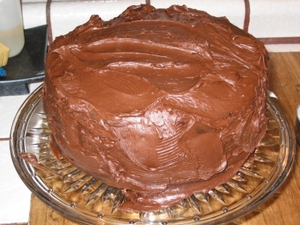
There on the porch were ten large boxes of groceries, with a triple-layer chocolate fudge cake on top. We never did find out who left the food. After Jaana’s parents had gone, Dad took down the large sign and affixed another marker — this one permanent — on a popsicle stick just beneath the mailbox. “Tervetuola.” He wanted God’s chocolate cake angel to know she was welcome anytime.
Twenty years later, that popsicle stick is still there — long after my parents had moved away. I know because I check every time I visit the old neighborhood in Jersey. That popsicle stick is a childhood icon of faith, a symbol of the power of a timely gesture of encouragement. The chocolate cake angel in my mind has big, blue eyes and flowing blonde tresses; she reminds me of how God deputizes some of us as temporary “angels” to encourage others at the time they need it most.
How? In the twelfth century, the great Jewish scholar Rabbi Moses Ben Maimonides enumerated the eight degrees of charity.
The first and lowest degree, he said, was a “gift of the hand, but not of the heart” - giving with reluctance or regret.
The second (and slightly better) way is to give “cheerfully, but not in proportion to the distress of the sufferer.”
The third degree gives proportionately - but only when asked.
The fourth kind of giver gives in a way that is cheerful, proportionate and timely … but “put it in the poor man’s hand, thereby shaming him.”
The fifth degree gives charity in a way that the recipient knows the benefactor but is unknown by him. The sixth, then, is to know the recipient but remain anonymous to him (like my chocolate cake benefactors).
“The seventh degree is still more meritorious,” writes Maimonides. “Namely, to bestow charity in such a way that the benefactor may not know the relieved person, nor they the name of the benefactor.”
And what could be better than this, according to this wise man? “To anticipate charity by preventing poverty. That is, to assist the reduced fellow man … by teaching him a trade, or by putting him in the way of business, so that he may earn an honest livelihood and not be forced to the dreadful alternative of holding out his hand for charity.”
The difference between being a truly generous person, then, is as much about the dignity of the other person as it is about our own warm-and-fuzzy feelings. As parents, we need to model the wisdom of Maimonides for our children, so that they learn the important difference between a hand-out ... and a hand-up.
Lord God, expand my soul with true charity, that I may teach my children to be truly generous.
Heidi Hess Saxton is a contributing writer to the parenting channel of AnnArbor.com and the author of several books. Her blog for adoptive, foster and special needs parents is the “Extraordinary Moms Network.” You may reach Heidi at heidi.hess.saxton@gmail.com.
Comments
Heidi Hess Saxton
Wed, Nov 17, 2010 : 1:07 p.m.
I've been on the road, and just now logged in to respond to your kind words -- thanks so much for being an ENCOURAGER! :-)
Tammy Mayrend
Mon, Nov 15, 2010 : 8:24 a.m.
After going through our own major financial challenges last year I truly appreciate your beautiful story and its message. Thank you!
dotdash
Sun, Nov 14, 2010 : 6:33 p.m.
I loved this story and the lesson from Maimonides. Thank you.