

How not to talk to your kids about giraffes vs. Iron Man
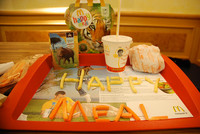
In this case, we opted for McDonald's over, say, Wendy's on the basis of small plastic animals. McDonald's is currently offering Littlest Pet Shop toys in its Happy Meals. About the only thing that could compete with Littlest Pet Shop currently for my daughters' attention would be Silly Bandz, but as far as we know, no fast food joint is giving away small silicone rubber animals. Yet.
Last time we went to McDonald's, out of eight possible animals, the girls really wanted koalas. And that's what they got. This time, they were really hoping for giraffes, and that's what they got. I don't remember having luck like this with Happy Meals when I was a kid. Instead of the Hot Wheels Corvette Stingray, I'd get the stupid Hot Wheels camper, three stupid times in a stupid row.
Because we'd been through this routine before, when the drive-through lady asked if our Happy Meals were for boys or girls, I knew to answer: for girls. If I had answered "boys," then instead of giraffes, the kids would've received little plastic superheros: Iron Man or Captain America or the Silver Surfer. I didn't think about my answer. It came automatically, just another menu choice, the way I know that saying "number two with no onions" gets me a quarter pound cheeseburger with ketchup, mustard, and pickle plus a carton of french fries.
Thinking about it later, it struck me that this framing is arbitrary and annoying. Why don't they just ask what toy your kid wants, instead of what sex he or she happens to be? There's nothing patently feminine or masculine about koalas and giraffes, is there? The boys I know enjoy the zoo as much as the girls do. Littlest Pet Shop seems like a perfectly gender neutral toy to me. Meanwhile, my daughters like superheros just fine. They watch vintage Superfriends cartoons and read superhero comics and ask for Batman toys for Christmas.
Given the choice, I'm pretty sure my daughters would pick Littlest Pet Shop, and my nephews would pick the superheros, every time. But is this because of some intrinsic interest, or is it because of the way the questions get framed? (In this case it probably makes a difference that the pets are gender-unspecified but the superheros are all males.) I'm irritated at myself for simply answering "girls" when the drive-through operator asked who our Happy Meals were for. Going along with the script makes us complicit in the script. And the kids hear from the back seat. I'm constantly amazed at how astute they are at picking up subtext from whatever source -- a radio show, a store display, a conversation between adults.
Whether we mean to or not, we send our kids (and each other) all kinds of signals about what it means to be a boy or a girl. These signals have real consequences. At their worst, and in aggregate, these signals foster sexism, division, exclusivity and violence. A couple of weeks ago there was a report of a 17-month-old child beaten to death by his male guardian because the boy was perceived as acting "feminine." Something like that doesn't happen in a vacuum. Of course very few of us are monstrous enough to literally beat our children in the name of gender norms. But in small ways, conscious or not, we encourage them to accept certain limits, inhabit certain roles, make certain choices. And when we don't, commercials do, and storybooks do, and kids at school do.
I think it's important, then, to consciously question gendered boundaries with our kids, and with each other in front of our kids. That's why I'm irritated at myself for answering that we wanted "girl" Happy Meals at the drive-through. That's also why I was irritated at myself last week for complaining to my daughters that the hair metal band Cinderella "looked like girls." If we want our kids to grow up with the fullest range of choices and opportunities, then we have to fight back against the forces that would box that potential in.
Scott Beal is a stay-at-home dad who eats McNuggets once in a while even though they contain more corn than chicken plus plenty of petroleum-based chemicals.
image courtesy of flickr user happymealy via creative commons license.
Comments
Stonequist
Tue, Aug 24, 2010 : 5:22 p.m.
Thanks for the article. This topic had just come up in our home... my husband and son were traveling and stopped at McDonald's. Since this is a rare happening, my 3 year old was very excited. He loves animals and wanted the cat toy (aka the "girl toy"), not the super hero or "boy toy." My husband was quite surprised when he was questioned for wanting the "girl toy" for his son. He chalked it up to one random employee, but it happened again on the long drive home. I don't get why a cat toy is a girl toy and why McDonald's would train its staff to purposefully reinforce gender stereotypes unnecessarily. Just describe the toy.
Dylan
Wed, Aug 18, 2010 : 9:28 a.m.
Great article, Scott. The "boys/girls" happy meal thing has always bothered me, and it's just one of the most obvious examples from our society. I don't think that gender roles (or rather identities) are bad in themselves - it's often good to know who you are and how you relate to others. The problem comes when certain roles are persecuted/denigrated/etc. We should all work harder to teach the next generation to respect all our sexual differences.
Jeff Gaynor
Wed, Aug 18, 2010 : 6:48 a.m.
Thank you, Scott, for your insight (and your unabashedly genuine, if self-deprecating, honesty). Before our first child was born, we told others the baby's bedroom was in primary colors, and we got gifts in primary colors. After Laura was born, we said we wanted gifts in primary colors, and got... pink. When parents say their children turned out to follow gender norms but "we raised them the same," I do wonder. Of course there are so many gender messages bombarding us and our kids, beyond our control.