

Calming fears about scary weather and disasters
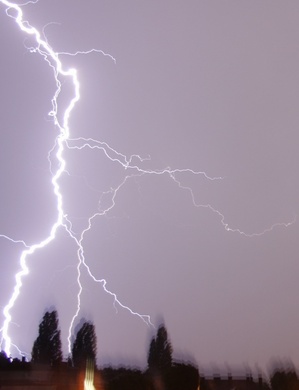
Photo by Flickr user Flóra
Dear Kerry, I have three kids, girls 4 and 6, and a 10-year-old son. Our older daughter has become quite worried about fires and tornadoes, probably due to the drills at school. Those are required and necessary, but she is afraid that something bad might be about to happen any time. How can we help her learn what to do, while calming her fears? KF, Ann Arbor
Dear KF, Summer is the season for severe weather in many parts of the country - kids have to cope with the real possibility of hurricanes, tornadoes, floods or severe thunderstorms. All year round fire drills and earthquake drills are part of school life. It’s not surprising that youngsters have trouble understanding the scale of the danger and why they have to prepare even if it’s never happened in their short lifetime.
Let’s think first about why we have fire drills etc. at home and at school. (Okay, everybody - here’s the pitch for practicing escape routes and procedures at home! Bad things don’t only happen during school hours.) I think the goal is to help children practice promptly following the instructions for actions that will keep them safe. The idea is that practice will make this happen when we need it, should an emergency arise.
Grownups are afraid of natural disasters and dangers like fire for good reason. We take them seriously, because we know they are truly dangerous. So there are actually two challenges. We have to equip ourselves with routines and plans, so that we can control our own fear. Only then will we be able to help children respond constructively to both the practice and the actuality, if it occurs.
Firefighters, police, EMTs, and soldiers all practice repeatedly, so that they can spring into action when needed. They know they will know what to do, which is a tremendous reassurance to them and to us, who will benefit from their calm and expertise. But what about us civilians? And what about our children? How do we balance the importance of preparedness with the danger of insecurity?
Balance may be the key goal. We want our children to be realistically aware of the dangers that can happen, but we also want them to have a generally hopeful and optimistic security in the feeling that we can keep them safe and that their world is unlikely to be turned upside down.
We don’t have to present our children with an idealized image of ourselves or an unrealistic rosy picture of the world. Children feel most secure when they can trust in their parents’ and teachers’ competence. They need to know that we know what to do if something goes wrong. I can remember sitting my youngest at 15 months on the grass by the side of the road while I changed a flat tire. She was perfectly content, because she could see and feel that I knew what I was doing. Once the job was finished, we proceeded on our way, and she beamed while I told the story to the rest of the family at supper.
Fire and severe weather drills can be handled the same way at home and at school. There are different ways to explain and structure them, depending on the age of your child. For preschoolers, who are able to have some sense of time by the age of 3 or 4, you can state, “Usually dangerous things don’t happen, but we want to make sure that we know what to do if there is a fire (or a tornado, or a hurricane, and so forth). That way we will all be safe.” If your child gets worried, you can say to her over several days, “Today everything was fine. Dangerous things almost never happen, and we know how to keep ourselves safe. You don’t have to think about it every day, since we have practiced what to do.”
For a schoolchild, who may hear about disasters from others or overhear the news, a more advanced version of the same conversation can be effective over time. An older child can also be helped by looking together at the map so that she can see how far away the tornadoes or hurricanes were. And you can help her learn about the difference between pretending something can’t happen -- in other words, teach her not to deny reality - and, on the other hand, when it is realistic to focus on current daily life, rather than on things she can’t control, but can deal with if they arise. Feeling effective where we can and accepting that preparation and skills are the best we can do in other circumstances are useful life lessons, which fire drills help everyone learn.
Kerry Kelly Novick is a local child, adolescent and adult psychoanalyst, affiliated with the Michigan Psychoanalytic Institute and the Michigan Psychoanalytic Council, and a family consultant at Allen Creek Preschool. You can reach her through
Comments
Shannon Brines
Mon, Jun 28, 2010 : 9:46 a.m.
I do not know the history or protocols for when the City of Ann Arbor outdoor sirens are used. Perhaps that has changed. I can tell you that the National Weather Service is responsible for declaring tornado warnings and it happens at a county spatial resolution. They understand that it should not be used lightly. They take it very seriously and use all the best tools at their disposal to do it accurately. This summer we are experiencing above average number of tornadoes and above average number of cells capable of producing tornadoes. Detroit News has coverage of suspected tornadoes north of Detroit from yesterday's cells. (As it so happens, you will note that most of the days that had tornado warnings did have actual tornadoes somewhere in Michigan.) I commend the National Weather Service on their work and trust their judgment when they declare a warning for Washtenaw County. Personally, when I hear that there is a warning for the county I examine animated radar online to judge how imminent the danger is for my location. As for the sirens, in my opinion I'd rather have the information that a warning has been declared then not have the information.
Glenn Galler
Mon, Jun 28, 2010 : 8:02 a.m.
I think this situation has become more real because of the number of times the neighborhood sirens have gone off in the last few weeks. I don't remember the sirens being used so often during the summer. I am wondering if the Tornado Warning system has changed recently. I thought it was used when a tornado was sighted in the nearby vacinity and now it is when a tornado is up in the clouds and could hit the ground. When the sirens have gone off, we have brought our kids downstairs until the warning is over. This is pretty traumatic and it didn't use to happen so often. I am also wondering if the excessive use of the neighborhood warnings is going to have us start to "ignore the warnings". For the sirens that occurred yesterday (Saturday), the storm was still well away from Ann Arbor and the threat did not seem imminent.