

Blackbird Theatre's 'Patty Hearst' feels like a rough draft
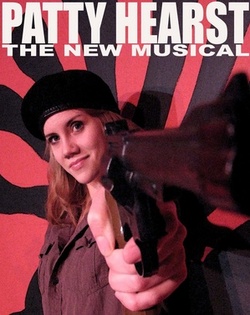
Jamie Weeder stars in the Blackbird Theatre's "Patty Hearst: The New Musical."
Why? Because more often than not, they lack self-awareness regarding their own blind spots, contradictions, and hypocrisies; they can’t truly hear other ideas and opinions, so steeped are they in self-righteousness; and despite living in a world rife with complexity, they refuse to truck in nuance.
Barton Bund’s “Patty Hearst: The New Musical,” now being presented by the Blackbird Theatre at the Sh\aut\ Gallery, necessarily confronts this extremist paradox. Telling the true story of the famous heiress who, at age 19, was kidnapped by a leftist urban guerilla group called the Symbionese Liberation Army, the show follows Hearst through her confinement; her eventual “conversion” to becoming an SLA member herself; her arrest; and her trial. (The show is for mature audiences.)
Not surprisingly, the “extremist paradox” issue arises early in the show, when an SLA member reveals, through song, her dream to form a lesbian and gay army. Bund’s staging of the number, combined with Brian Carbine’s sexually playful choreography, seems to invite the audience’s giggles. Yet I felt conflicted about laughing at a woman who felt persecuted enough to hatch this ambition.
Yes, Bund and his team may have aimed to provoke this occasional, uncomfortable laughter as a means of balancing the scales (obviously, Hearst’s story is a dark one). But by and large, the production seemed to struggle to establish a consistent tone.
One element that sets the production apart, however, is its extreme intimacy — as in, “if you’re in the front row, tuck your feet under your chair and lean back.” The action is staged in-the-round, squeezing 12 performers into a tiny space that’s “in your face”; and when the performers dance or fight, you feel the movement in your bones. This seems fitting, thematically, since Hearst’s story is one of violation and vulnerability; why shouldn’t audience conventions be broken down, too?
But inevitably, the in-the-round staging strains against its limitations. Key moments — like Patty’s reaction to seeing her ex-fiancee when he visits her in prison, and her facial expressions while being questioned — were lost to me because of where I happened to sit.
Bund’s original score for “Hearst” ranges from coffee house folk to politically-charged rock. Many songs work well, but others (“Ghetto Appreciation Night” and one that Patty sings about pizza, to name two examples) left me wondering if they’d really earned their place in the two and a half hour show.
In addition, performers struggled mightily with their vocals on opening night. When singing with recorded accompaniment, actors often got out of sync momentarily; and pitch was a recurring problem, particularly for Steven O’Brien (Teko) and Joe Kathrein (Cujo/Steve Weed), both of whom had featured solos. Similarly, the ensemble’s execution of Carbine’s choreography was pretty rough, suggesting that the cast could have used a longer rehearsal period.
Even so, Jamie Weeder’s performance as Hearst was engaging and honest, carrying us through the heiress’ bizarre journey. And certain members of the ensemble — Ruell Black as Prophet Jones, Chelsea Sadler as Gelina, Gayle Martin as Yolanda, and Analea Lessenberry as Wendy Yoshimura — make significant contributions by way of subtle, small moments.
Ultimately, Patty Hearst’s story is a psychologically tangled and highly complicated one; and while I appreciated learning more about it this dark chapter of American history by way of Bund’s show, I couldn’t help but feel that some of its crucial parts (a bank robbery Hearst participated in, SLA’s safe house showdown with police, Hearst’s trial) got short shrift — not to mention the fact that the way they’re staged may not make the events clear to those unfamiliar with Hearst’s tale.
So although there’s solid potential on display in “Hearst," the show still felt, on opening night, like a very rough draft, both on the page and the stage.
Jenn McKee is the entertainment digital journalist for AnnArbor.com. Reach her at jennmckee@annarbor.com or 734-623-2546, and follow her on Twitter @jennmckee.
Comments
Blackbird
Mon, Jun 7, 2010 : 9:46 a.m.
Go behind the scenes and read the Patty Hearst: The New Musical blog. It's here at http://pattytania.livejournal.com/766.html This is an informal diary of our production, our process, and some of the ideas that went into shaping this production. We talk about the use of humor in telling the story, and reveal some of the crazy details that make this story so unbelievable.
clpblue
Mon, Jun 7, 2010 : 1:10 a.m.
This play is not for everyone. The reviewer is one that didn't like it. The play was not ment to give a historic version of events, but a sateric one. Another point is that things happen in all plays. Talk to anyone who has been on Broadway and they will tell you mistakes, misteps,and mishaps happen every night. This is a diffent type of play, that is ment to "get in your face." Don't let others decide for you, see it with an open mind, you may like it, I did.
Blackbird
Sun, Jun 6, 2010 : 9:04 p.m.
For another view, check out D.A. Blackburn's review in encoremichigan.com, Michigan's most comprehensive source for theatre news: http://encoremichigan.com/article.html?article=3116
BelleCanto
Sat, Jun 5, 2010 : 8 p.m.
Barton Bund's Blackbird Theater is a bold and risky operation by an extremely bold risk taker and for that Ann Arbor should be thankful- hit or miss. I admire the daring of this operation and really, how many times can you sit through "Our Town", "A Funny Thing Happened...", etc before you start to crave some fresh meat- even if it is a bit tough. (or rough as Ms. McKee says!)
Blackbird
Sat, Jun 5, 2010 : 3:29 p.m.
A2Lover, I'm sorry the show wasn't to your liking. We don't like our patrons to walk away unhappy, especially when they are so public and outspoken about it. This community is small, and judging by your other comments on other pages, you are looking for something different. We appreciate that you give feedback. We would like to send you a pair of passes, redeemable at any of our shows in our upcoming season. We have a great mix of things coming up, and if our new and original work is not your thing, we also will be featuring a great bunch of classics and plays by non-local playwrights, directed by some of this area's best. Please send your name and address to blackbird_theatre@yahoo.com and we would be glad to send you two free tickets to the show of your choice. Barton Bund The Blackbird Theatre
A2lover
Sat, Jun 5, 2010 : 3:09 p.m.
Well, the bar for professional theatre in Southeast Michigan is very low. Partly because there aren't many/any knowledgeable and experienced reviewers, and without constructive and discerning criticism, theatre cannot grow. Plus, the theatre companies themselves "think" they are being innovative and risky, when in fact they are extremely predictable and conservative. I understand what you're saying Shan, and agree we have to love all our children equally. However, theatres not having their mistakes pointed out only encourages continued bad habits and, therefore, inferior productions.
Shan
Sat, Jun 5, 2010 : 2:20 p.m.
A2lover, in my humble opinion, it seems as if your expectations are unreasonably high and that your definition of "professional" a bit too idealistic. I apologize if those words are hard to read, but I felt the need to say them, especially after reading some of your previous comments on other reviews that have to do with plays.
A2lover
Sat, Jun 5, 2010 : 1:36 p.m.
Shan, when a theatre posits itself to be a professional organization the expectations are quite a bit higher. Which is why more is expected from the Blackbird Theatre. Performance Network calls itself "Michigan's Premier Professional Theatre". Well that's questionable sometimes too. It's always better to let others determine the status of your organization. Just because a reviewer says something is good (or bad, which is rare for Michigan reviewers) does not make it so. In the case of the Blackbird, it really does need to put on better quality productions, whatever the space they are in, whether one person does everything or whatever repertoire they present. If they want to be considered professional.
Shan
Sat, Jun 5, 2010 : 11:31 a.m.
I have many critical points I'd like to make about this review and the negative comments that follow after. First of all, comic relief is the best medicine for such a serious and dangerous story. I think the way it was injected into the play was brilliant. In addition, I disagree that "the production seemed to struggle to establish a consistent tone." Patty's world caving in on her while succumbing to the brainwashing techniques used against her while being held hostage was the consistent tone throughout the entire show. How someone can miss that who was there watching it is beyond me. I did notice some off key singing here and there and a little physical fumbling during the choreographed minutes, but these slight imperfections didn't get in the way of me feeling completely entranced and enthralled with this show. I loved everything about it. Yes, the space was small and a bit too warm in the beginning, but with windows opened later, it was fine. I can't see how anyone can say the show was misguided or not well directed. And who cares if the playwright, director, and head of the company is the same person?! It has nothing to do with ego and everything to do with the fact that The Blackbird is a SMALL theater. Period. Not only that, but the small theater doesn't have a space yet to put on their plays, so using what became available to them was a perfect use of available resources if you ask me. I feel that it is too easy for lots of people on-line to be overly critical and unnecessarily mean while focusing on the imperfections of a new play. It only shows a huge lack of compassion and understanding on the critics part, in my humble opinion. But I guess I shouldn't be too surprised. Many Ann Arborites lack the compassion and open mindedness that goes hand in hand with the lack of snobbery. My unsolicited advice? Go see the play. You will be amazed at the talent that lies therein.
Blackbird
Sat, Jun 5, 2010 : 10:39 a.m.
Come see for yourself! Thanks to everyone for your feedback. We have a one-night deal tonight 6/5/10. Mention this article and get in for just $15. Give us the secret code word: McKee. This offer is for one night only, so come see the controversial, disturbing, wild, darkly funny saga of Patty Hearst. Check out our youtube trailer here: http://www.youtube.com/watch?v=s5CSVsYPbus And go online to www.blackbirdtheatre.org for tickets, showtimes, and more.
McDowel
Fri, Jun 4, 2010 : 3:40 p.m.
I agree on many points that Ms. McKee has made here- The show seemed to have tried to take on too much. Although I do have to give the story credit where credit is due. To turn a real-life scenario into something for the stage, even a musical, I'll bet is quite a job. Somewhere within the three acts of theatre was a flushed product, it just wasn't near completion. However, those shortcomings were all forgiven by certain performances that I saw last night- some of the best that I've seen in awhile. It seemed as if the casting was hit or miss, and when it hit it hit HARD. And conversely, when it missed it was a bit of a disaster. The women who portrayed Patty was remarkable. Her performance in itself was WELL worth the price of admission.
hapax legomenon
Fri, Jun 4, 2010 : 11:34 a.m.
This was probably the most narcissistic and poorly written piece of theater I've ever seen. There was no character development (and no reason to care about any of the characters), no sense of dramatic structure, and no complexity of any sort.
rusty shackelford
Fri, Jun 4, 2010 : 9:02 a.m.
Things to avoid in order to make good theater: 1. Musicals 2. 2.5 hour musicals 3. Musicals with people who can't dance or sing 4. Stories based on real people 5. Staging that's convenient, rather than appropriate for the production. 6. Allowing the playwright, director, and head of the company to be the same person. How egotistical! Obviously it was bad, there must have been no skepticism, revision, debate or outside interpretation of the text.
A2lover
Fri, Jun 4, 2010 : 8:39 a.m.
The show was pretty misguided, too long, in a terrible space, and not well directed. It may have potential in more experienced hands. However, it was an earnest attempt. Although, I'm not sure that's a good enough reason to do the show. It was nice to read a more nuanced, subjective and analytical review by Ms. McKee.