

Real men drink pink wine: a closer look at Rosé, a great summer wine
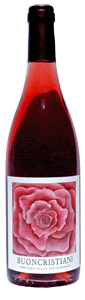
The dry Rose of Syrah from Buoncristiani (Napa Valley) is a saignee from their muscular Syrah.
The Napa Valley dry Rose of Syrah from Buoncristiani
Let start with some basics. Here is what Rosé is NOT:
1. It’s NOT “BLUSH” (a marketing term crafted in the 70s to promote jug wine) and it’s not pronounced like the flower. It’s Rosé (Ro-zay).
2. It is NOT SWEET. At least it does not have to be. In fact most Rosé around the world is produced in a dry or slightly off-dry style. There are entire wine regions (i.e. Provence and Tavel in France) that are celebrated entirely for their production of amazing pink wines. There are sweet red wines. There are sweet white wines. The color of a wine is in no way related to the amount of residual sugar in it.
3. It is NOT CHEAP. At least it does not have to be. There are cheap wines in virtually every category of wine available, be they red, white, pink, orange, sweet, dry, sparkling or still. Again, the color of a wine is in no way related to the price or quality of a wine.
Being inexpensive and very easy to drink due to its sweetness and fruitiness, many Americans are first introduced to wine via the infamous White Zinfandel. Amazingly, it represents about 10 percent of all wine consumed by Americans each year. Unfortunately, White Zinfandel’s resounding sales success has unfairly created two associations with pink wines - cheap and sweet. But the qualities “cheap” and “sweet” have nothing to do with the color pink. There are plenty of cheap and/or sweet red and white wines all around us but we don’t blanket those wines in the same way we do pink wines.
Now, here is what you are missing:
1. Most Rosé is made from red grapes (Syrah, Grenache, Pinot Noir and even Cabernet are just a few). The juice from all of these red grapes is actually clear until the color is extracted from the skins. They’re made almost the same way as their darker-colored brothers and sisters that you are more familiar with. The only difference is that the juice spends less time in contact with the skins, hence drawing out less color from them. In case you’re wondering, this again has absolutely nothing to do with sweetness. One very important thing to note is that some of the most amazing dry Rosés are the result of saignée, the process of draining off some of the juice of a red fermentation to increase the ratio of solids to liquid for more intensity.
So some of those big rich red monsters that you may hold so dear to your heart actually have a Rosé saignée as a piece of their winemaking puzzle. And since the American public still doesn’t understand what amazing wines these are, the winemakers usually keep these small productions around the winery for themselves to drink. And believe me - they love them!
2. It is the best of both worlds. Rosé has some tannin structure like a red, yet is more crisp and refreshing like a white. This makes Rosé particularly perfect for warm weather.
3. Rosé pairs so well with food that its versatility is perhaps only matched by Champagne.
So here is the bottom line. If you thing drinking a pink wine makes you look like a novice, the opposite is true. When I see people drinking Rosé, I assume they must know more about wine than the average bear.
Now, I’m publicly letting you all know that I’m not going to be mister nice guy about this anymore. If you are one those people that thinks Rosé is somehow less of a wine, you shall now be on my list of people that don’t know Bordeaux from Welches.
If you need to rush out and search for some Rosé for a little redemption, find the latest release of Buoncristiani Syrah Rosé. It’s the saignée of a VERY manly red and this may help you get the first glass down while keeping your “I only drink huge reds” ego in check.
I finish this blog by declaring to all Ann Arbor wine drinkers, “Rosé is in!” In fact, all who drink Rosé must now be perceived as very fashionable and wine savvy. And if anyone questions what you are drinking, you not only have the right to, but you are obligated to, raise your brow in pure wine snobbery fashion and explain to them how ridiculous they are for having so misjudged Rosé all this time.
Eric Arsenault is the Sommelier for The Chop House and the Director of Wine and Spirits for Mainstreet Ventures. He blogs about wine for AnnArbor.com
Comments
Bal
Tue, Jul 13, 2010 : 10:45 a.m.
Real men drinks rose wine? I dont know, I spoke to the people at http://www.justrosewine.co.uk and while asking about a few rose wines just slipped in the question of who mostly buys their wines and the answer did lean towards the fact the ladies are crazy for pink wine. Maybe guys might go for darker rose wines rather than bright pink colour styles - what do you think?
haworth
Fri, Jul 2, 2010 : 12:24 p.m.
Hey, if you like it, you like it. If not, well, your loss, my gain. Roses are gaining in popularity, and sadly, also in price. The Loire is, in my view, second to none in the quality of rose wines. Sancerre roses (usually from pinot noir) are amazing, as are a number of Chinons (from cab franc). These have a great balance of acid, fruit, and mineral and are usually low alcohol. Tavels in general, and especially the one from Segries, are great if you want more "stuffing". Michigan wineries also make some mighty pretty rose wines--Left Foot Charley, Willow Vineyards, and Bel Lago all do very well. If you want to avoid high alcohol, I'd suggest staying away from California and Australia roses in general (though read the label). Ultimately, the best way to do this is to taste, taste, and taste some more. Then you can figure out what suits your palate. And, above all, don't fear the pink...
Eric Arsenault
Thu, Jul 1, 2010 : 8:35 a.m.
@Adam Jaskiewicz thanks for reitereating my point, which was how sad it was that "most" people refuse Rose because they think all pink wines are sweet, cheap, inferior wines. @longfellow is using an article my Lettie Teague that uses some awful examples of Rose to make a point that Rose may be overhyped. It is pointless to use Roses more than 3 years old (they are only a touch better than light, dry whites at resisting oxidation over time because they only have a fraction of the antioxident phenolic compounds that their red parents have)or the varietals and/or regions that do not have the right qualities conducive to Rose production as the centerpiece of an argument that generalizes the entire category. I would equate that to writing an article titled "Auto Manufactures No Longer Produce Vehicles With High Fuel Economy" and then only use Hummers and Large SUVs as the examples in the article. That is bias any way you slice it. So here's a short list of the kind of wine I'm advocating. And for the record, I don't sell most of these wines because the market isn't ready to support it (why I'm so frustrated). I would just end up with a lot of oxidized Rose laying around if I did stock all these. Domaine Lafond 'Roc Epine' Tavel Buoncristiani Syrah Rose Celani Family Cabernet Rose Turkey Flat Grenache Rose Goats do Roam Rose Marques de Caceres Rioja Rosado Bonny Doon Vin Gris de Cigare Domaine de Terrebrune Bandol Tempier Bandol Rose R. Lpez de Heredia Rioja Rosado Like @BobbyJohn said, look for recent vintages 09 or 08. Any older and you risk oxidation. There are exceptions that will go onger,but from a technical standpoint, Rose lacks the antioxidants for cellaring. On a side note, it is certainly nice to go away with my family for three days and come back to see that a dozen more comments have been posted on this topic. Thank you all for your input.
maxdoinel
Mon, Jun 28, 2010 : 9:11 p.m.
@Longfellow: thanks for the link to the Food and Wine article. I few thoughts follow. I find it difficult to understand how Cab or Merlot would make good pink wine. Is there something about these grapes that force or encourage winemakers to produce high alcoholic wines? (I consider anything above 14% high alcoholic.) That article also mentions the Lopez de Heredia rose I mentioned above. I think her words say it best: "it's a more intellectually admirable than enjoyable wine." I would consider that a high compliment. Besides that wine, I'd recommend the current vintages from 1. Domaine de Terrebrune (Bandol); 2. St. Martin de la Garrigue; 3. Domaine de Fontsainte. There are some supple pinks from Burgundy too (Domaine Bruno Clair). #s 2 and 3 are definitely under $15. I forget the price of the others. They are all incredibly dry, incredibly summery, and incredibly food friendly. But if I can go slightly off-topic, if pink is not your thing (nothing wrong with that), can I suggest Alsatian Rieslings or village-level Beaujolais? Oh heck, I'm grabbing a Red Stripe.
BobbyJohn
Mon, Jun 28, 2010 : 12:41 p.m.
I have done several group tastings of Roses in the last 2 months, ranging from 7 to 18 bottles per tasting. Both poor bottles were oxidized (typically too old or poorly stored), but all the rest were from fairly good to delightful. A couple of them were under $10, but most were in the $12 to $19 range. The red fruit and acid balance of a well made rose served cold on a hot day is a marvelous combination. I would say that, generally, best to go w/ the most recent vintage, 2009, unless you are familiar w/ the wine, or have a solid recommendation from a trustworthy source. Like Eric.
Hot Sam
Mon, Jun 28, 2010 : 8:09 a.m.
Call me what you like, but sitting in that cafe in Bandol with a crisp rose' and a salad Nicoise is something I would do again in a heartbeat!!!
Bill Wilson
Sun, Jun 27, 2010 : 3:32 p.m.
Eric, If you could give us a short list (rules permitting, of course) of Ross that are good, and in the 10-25 dollar per bottle range, I'd love to pick up a couple. Would appreciate it.
Bill Wilson
Sun, Jun 27, 2010 : noon
This just keeps getting better. @longfellow - are you somehow drawing a correlation between color and alcohol content? Please explain further why a Rose will "often have higher alcohol content". Higher than what? What is your definition of high alcohol content? If I make a Saignee from the must of a Syrah, Cabernet, Pinot, or Grenache, will it not have the exact same alcohol content as the reds made from that same must? Of course, when one makes a claim as to their experience, it always helps to find sources as to others who have experienced similiar instances. It didn't take long via Google: http://www.foodandwine.com/articles/rose-underrated-or-overhyped I quote from the article: "Part of the problem with many ross may be the grapes that winemakers use. I'm not a big fan of Cabernet- or Merlot-based ross or, for that matter, ross made from tannic varietals such as Petit Verdot or Cabernet Franc; I find them too austere and often too high in alcoholas much as 15 or 16 percent. Read the piece: she pretty much has the same complaints that I have. I find your style of argument... those who disagree "don't get it"... "Ros is in!"... etc., to be more "trust me" than objective. From Max: "@Longfellow: there is a boat-load--no, a warehouse-load--of mediocre, bad roses out there. But there are some phenomenal ones too. I believe that I said the very same thing. I have tasted Ros's that were quite good. But it's been my experience that the good are the exception, hence the need for the sales job we see from the Eric's in the wine world.
David Briegel
Sun, Jun 27, 2010 : 7:18 a.m.
AAAhhhhhh, the good ole days of Mateus (sp)! Everyone drank it all the time! It was upscale from Boones Farm! After all, it was French!!
Eric Arsenault
Sat, Jun 26, 2010 : 11:06 p.m.
@maxdoinel is the 4th. Bravo!
Eric Arsenault
Sat, Jun 26, 2010 : 11:05 p.m.
"I think he's overlooking the obvious: a Ros will often have very high alcohol content, and to a drunk this is a recipe for delight. The bootleggers cooking up moonshine in radiators drink their own stuff too. Does anyone really believe that it's because it entices their palate?" This just keeps getting better. @longfellow - are you somehow drawing a correlation between color and alcohol content? Please explain further why a Rose will "often have higher alcohol content". Higher than what? What is your definition of high alcohol content? If I make a Saignee from the must of a Syrah, Cabernet, Pinot, or Grenache, will it not have the exact same alcohol content as the reds made from that same must?
maxdoinel
Sat, Jun 26, 2010 : 10:45 p.m.
@Longfellow: there is a boat-load--no, a warehouse-load--of mediocre, bad roses out there. But there are some phenomenal ones too. This discussion reminds me of discussions I have with friends about Beaujolais. There's a popular notion out there that Beaujolais wines are vapid, cheap, and sweet. I say, drink what you like, and trust a friend, wine merchant, or sommelier (sp.?) to introduce you to something new every once in a while. I've picked up some new favorites that way, and confirmed some dislikes too. Cheers.
maxdoinel
Sat, Jun 26, 2010 : 10:38 p.m.
Thank you, Mr. Arsenault, for your brief comments on pink wines. It's a coincidence that I was drinking a Domaine de Terrebrune Bandol rose when I came across your piece. I'm not in the wine business; I'm merely a wine drinker, but I can't tell you how impossible it is to get my friends to try a rose' wine. "More for me and my wife and less for them," I say. If I may recommend a personal favorite: 1998 Lopez de Heredia Rioja Gran Reserva Rosado. How does a twelve-year-old rose taste like? Young and fresh and very dry. Thanks again.
Bill Wilson
Sat, Jun 26, 2010 : 10:35 p.m.
Reading this piece is like listening to a Mac user describe the (sic) virtues of the Mac: more of a sales pitch than any substance. Most people that I know avoid the Ros... because they've tasted them. A good Ros is the exception, not the rule. The author seems to believe that because some winemakers choose to drink their own Ros, this somehow equates to exceptional quality. I think he's overlooking the obvious: a Ros will often have very high alcohol content, and to a drunk this is a recipe for delight. The bootleggers cooking up moonshine in radiators drink their own stuff too. Does anyone really believe that it's because it entices their palate? Perhaps some are drinking their Ros because there isn't the demand for it as there is with other wines: you drink what you cannot sell.
bs
Sat, Jun 26, 2010 : 9:14 p.m.
Let me point out that bears know little about wine, as a result, knowing more about wine than the "average bear" is not much of a feat.
Eric Arsenault
Sat, Jun 26, 2010 : 8:33 p.m.
@InsidetheHall, Real Men drink a bottle of cab with that steak, and finish with a cigar rather than a Marlboro. But I am still correct. That cab is a terrible pairing with the wedge. A Rose would much better there. I never said anyone should only have 1 wine. How boring is that? You have to course things out my friend. As for 3 Real Men. I'm one. @AndyJacobs and @JayThomas are 2 and 3. I can name dozens more. But people, it's your job to speak out and comment on this one. So if you're out there and you're reading this, comment now and prove my point here.
InsideTheHall
Sat, Jun 26, 2010 : 8:19 p.m.
Eric, name three "real" men who drink it??????? Real Men drink a glass of cab with that steak and baked potato...and the lettuce wedge with bleu cheese! Humdinger, you have an extra Marlboro?
Eric Arsenault
Sat, Jun 26, 2010 : 8:06 p.m.
As Andy said @Chunky. I did read your comment incorrectly. @Humdinger, I'd have to think about that one for a while. I think spell check may be ruining my sarcasm?
Soothslayer
Sat, Jun 26, 2010 : 6:48 p.m.
@Chunky - Touch mon ami! We are the ones who read your comment incorrectly.
Jay Thomas
Sat, Jun 26, 2010 : 6:28 p.m.
Rose is tragically neglected. I always enjoy a nice bottle of Tavel or Bardolino in the summer time. Thanks for the article.
ChunkyPastaSauce
Sat, Jun 26, 2010 : 2:35 p.m.
Eric - Andy: I was agreeing with the article..... I would edit it my comment if I could to say: "I agree, real men drink what they like not what other tell them they should like."
Soothslayer
Sat, Jun 26, 2010 : 1:57 p.m.
@Chunky - No one is telling anyone to do anything. I could be wrong but I think the author was simply employing a title parody off of the 80's phrase "Real men (don't eat quiche)*". I believe the idea here was simply trying to get some attention on an often overlooked wine variety. If the title was simply "A closer look at Ros" it wouldn't have had nearly the attention or impact. Case in point, ibid. Frank Booth: Heineken? (bleep) that (bleep)! Pabst Blue Ribbon! @Eric is Roditis considered a Ros? Roditis used to be relatively inexpensive and great in the summer but haven't had much since college. *BTW quiche can actually be amazing if done right. I'm not telling anyone to eat it but one should give it a try: http://allrecipes.com//Recipe/quiche-lorraine-i-2/Detail.aspx
Eric Arsenault
Sat, Jun 26, 2010 : 1:06 p.m.
Chunky, I completely agree. However, I don't think I said anywhere in this blog that you should like Rose because I said you had too. I said it was ridiculous to assume you don't like Rose based on false presumptions of what Rose is. So "Real Men" shouldn't be affraid to pick up a glass, try it, and explain why they do not like it for reasons other than it's color.
ChunkyPastaSauce
Sat, Jun 26, 2010 : 12:30 p.m.
Real men drink what they like not what other tell them they should like.