

The New Theatre Project's 'Dance of the Seven Veils' could use some variety
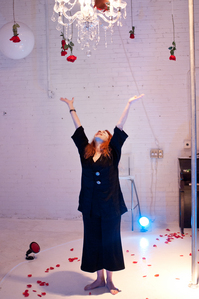
Linda Rabin Hammell stars in TNTP's "The Dance of the Seven Veils."
In our culture, the question that arises almost immediately when meeting someone for the first time is: “So, what do you do?” (A starter version for young adults is, “What’s your major?”) This is hardly a coincidence. In America, a person’s identity is inextricably bound to his/her profession - regardless of whether the gig is the person’s dream job or simply a means to pay bills. As a shorthand way to define ourselves and each other, we are what we do.
So who are you when you can’t talk openly about your work, and in fact must keep it a secret your whole life? That’s one of the questions raised by Amanda Lyn Jungquist’s “The Dance of the Seven Veils” - now being staged by The New Theatre Project - a collage piece largely constructed from sex workers’ testimonials.
Structured as three monologues, “Dance” begins with Jungquist portraying a prostitute with ballet training who’s studying to be a nurse; Maria Thomas, meanwhile, plays a hooker who ventured into prostitution to punish a cheating boyfriend, and when her sister gets sick, she loses her day job while struggling to provide care for her; and Linda Rabin Hammell plays an aging former stripper who’d once fallen in love with a colleague who disappeared after “going out with some guys from work” one night.
Designer Keith Paul Medelis has decorated the small, white, unconventional performance space at Pot and Box simply, but appropriately, with a pole in the center of a large circle; rose petals scattered on the floor, with roses also hanging - along with a couple of chandeliers - from the ceiling; and a piano, guitar, and ukulele parked against the back wall, flanked by two chairs for the actors when they’re not “on.”
“Dance” was inspired by Charles Mee’s “Salome,” which was also built from the words of real sex workers; and because Mee’s belief is that there’s no such thing as an original play, he invites artists to use and alter his dramas as they see fit. TNTP has taken Mee up on this challenge.
And indeed, one of “Dance”’s most compelling passages comes directly from Mee’s play, when Jungquist, near the show’s beginning, challenges those who say they’d never do sex work. “How do you know? You say: because that’s not the kind of person I am. But you don’t know. Because one day you will do something and then you will find out what sort of person you are.”
This kind of “I dare you to really consider this” moment is bracing, and what I’d hoped to experience more of during “Dance.” Yet sadly, much of what follows feels strangely safe, un-sexy, predictable, and, in terms of tone, one-note.
Yes, there’s variation in regard each woman’s persona. Jungquist’s character feels fragile; Thomas’ seems hollowly, defensively defiant; and Hammell’s seems world-wise and at peace with her past choices. But the women all primarily focus on tragic personal stories, and the first two women painfully struggle to come to terms with what they do and who they are. (The show’s unrelentingly dark tone makes the 80 minute run-time feel longer.) Mee’s “Salome,” by contrast, takes pains to include perspectives from women who revel in their work, thereby provoking and (problematically) titillating the audience by way of wholly embracing what’s considered vulgar and unseemly by polite society.
Not that Jungquist should have necessarily hewed closer to Mee’s vision; for that would work at cross-purposes to the playwright’s challenge and TNTP’s ambitions. So I’ll make my case another way: Thomas, in one moment, compares prostitution to working in a war zone, which seems apt; but even in the bleakest tales of war, brief, surprising moments of joy, or at the very least absurdity, occasionally break up the all-consuming darkness and make it more digestible. No such moments of levity or surprise break up “Dance”’s earnestness, and thus provide the play with a more complex, satisfying texture.
That having been said, all three performers do sound work with their roles. Ben Stange provides each with a genre of movement - ballet, tango, and yoga - and this generally works best when used sparingly. (Jungquist’s extended ballet warm-up sequence, which begins the show, seemed overly long, especially since movements are more smoothly worked into her dialogue throughout.) Stange also designed the costumes, which economically convey character before anyone speaks a word.
Medelis directs the show with a sometimes-heavy hand, in that the melodrama is writ extra-large with musical accompaniment here and there, and a passage about playing with fire is preceded by a cigarette being lit and quickly extinguished. (A bit too "on the nose.”) More generally, however, Medelis stages the show with thoughtfulness and care, placing an unflinching spotlight on these women’s stories.
The premise of “Dance” is unquestionably enticing; audiences arrive wanting to connect to these women and get a glimpse into the world in which they operate. And Jungquist’s highly laudable goal is to give the silenced a voice and present sex workers as regular human beings.
Ultimately, though, sex workers are regular people operating within a highly irregular, chaotic system, and for their stories to resonate more profoundly, they need to be represented by a broader range of experiences and responses than those currently found within "Dance."
Jenn McKee is the entertainment digital journalist for AnnArbor.com. Reach her at jennmckee@annarbor.com or 734-623-2546, and follow her on Twitter @jennmckee.
Comments
Robert Rosman
Mon, Feb 14, 2011 : 8:24 p.m.
Rubbish. Another all too frequent example of "know the reviewer's agenda and you know what the review will say before it is written." Disappointing to the largely ignored artists, sad for misled readers who may choose to stay home to watch "Real Housewives of Beverly Hills" but only laughable to those in attendance Saturday who were moved, educated and most of all wildly entertained by a most talented and energetically disciplined cast, an obviously gifted director and a highly original script. Robert Rosman
rusty shackelford
Mon, Feb 14, 2011 : 1:58 p.m.
Excellent review, thank you.