

Kidd Pivot's reinterpretation of 'Tempest' at Power Center becomes a tale of 2 (very different) dances
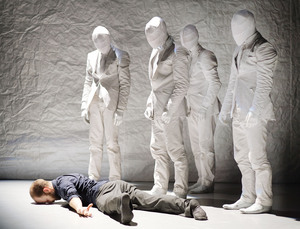
Kidd Pivot publicity photo
In choreographer Crystal Pite’s “The Tempest Replica,” which her company, Kidd Pivot, presented Friday evening at Power Center under University Musical Society auspices, the material is Shakespeare’s “The Tempest,” times two. But the mesmerizing storm the stunning dancers of her company whip up the first time through becomes a numbing drizzle on the next go-round, despite its continued fierceness - or perhaps even because of it.
In this 85-minute intermissionless work, made in 2011, Pite seems to be experimenting with doppelgangers and disengagement. The first part of the dance, which her Canadian company premiered in 2011, is set for ghostly doubles of Shakespeare’s protagonists in “The Tempest.” The dancers-save for Eric Beauchesne as Prospero—are wrapped, mummy-like, in white from head to toe, by costume designer Nancy Bryant; we cannot see any faces or expressions; we can only read the bodies and the bodies’ shapes.
And how articulate those bodies are. With Prospero as her stand-in, Pite moves them like a master puppeteer; their limbs appear segmented, like jointed wooden figures; at the same time, they are both cartoon-like and superhuman, their freeze-frames conveying agony and ecstasy; fear, sorrow and spite (gotta love that Caliban); and love and hate.
And yet, emotion is not the prime focus of this first “Tempest.” Narration seems uppermost in Pite’s mind. Supertitles (on the backdrop or projected onto characters and objects) give us just the facts: the act and scene; who is who on stage; a brief description of what is happening. There’s whimsy: a character sleeps, and a cavalcade of Z’s splash the message of slumber onto the backdrop; Ariel sets a banquet table like a Disney princess wielding a magic wand to make food, drink and chandeliers materialize from thin air.
And there is great beauty: The storm Pite conjures is a wow—all swirling mists and driving rain, a mirage of white and silver, black and gray. (Jamie Nesbitt designed the projections; Robert Sondergaard, the lighting; and Jay Gower Taylor, the sets.) The dancers, as the shipwrecked, struggle in winds of Pite’s imagining (and composer Owen Betton’s creation). They are pushed backward, beaten down, rolled with the waves onto the shore, projected with each toss of the seas further up the beach of the island.
Having told the story, Pite unwinds the cloth that binds the dancers, gives them back their features and starts all over, this time, with raw emotion as the prime thematic material, both in projected text and movement. Repetitions of key sequences look familiar and yet oh-so-different with everyone in street dress.
But the clock begins to slow in the second part. Whispered texts in the sound score seem tedious and dated. Doorbells ring (a sign of ironic distancing?); cars honk, dogs bark; ships sound their horns. It is not clear why. And there is so much whipping about, so much unceasing flailing and flinging of limbs that Pite’s remarkable gift for bringing bodies together and apart wears out its welcome. The piece just seems overwrought and overloaded—to no certain end.
But the dancers in the company—Bryan Arias, Sandra Marin Garcia, Yannick Matthon, Jiri Pokorny, Cindy Salgado and Jermaine Maurice Spivey in addition to Beauchesne—are remarkable, all breath and concentration and flow. They, and Part the First, are what make this storm a knockout.
Kidd Pivot performs again at 8 p.m. Saturday. See the UMS website for details.
Comments
Nan Bauer
Sun, Sep 23, 2012 : 12:54 p.m.
Susan, I had a very different take on the show; here's my blog post: https://nanarama.wordpress.com/2012/09/23/hell-is-empty/ But I love the way you wrote about it. Look forward to reading you regularly.