

University of Michigan's 'Suddenly Last Summer' tells a lush ghost story
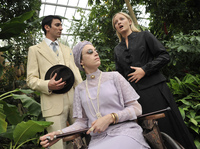
Dan Rubens as Dr. "Sugar," Emily Berman as Mrs. Violet Venable, and Kendra Williams as Catharine in "Suddenly Last Summer."
photo by Peter Smith Photography | courtesy of the University of Michigan
So there was that.
But to their great credit, the two actors then on stage—Emily Berman (playing Mrs. Violet Venable) and Dan Rubens (Dr. Cukrowicz)—handled it well, leaving the stage in character, and then gracefully picking up where they left off when the audience had returned.
The first part of “Suddenly” features Mrs. Venable telling the doctor, who’s developing an experimental surgery for the mentally ill, about the close relationship she shared with her now-deceased son, Sebastian. She gushes about the glamorous, globe-trotting life they led together, and her son’s unknown, unappreciated genius as a poet.
Venable’s true motives for inviting Cukrowicz to her home, however, become clear as she explains that she couldn’t travel with her son the previous summer due to illness, so Sebastian instead traveled with a female cousin, Catharine (Kendra Williams). Sebastian died during the trip, and Catharine was with him; but Mrs. Venable refuses to believe Catharine’s account of what happened, and is so embarrassed by the story that she urges Cukrowicz to perform his procedure on Catharine.
The first thing you’ll likely notice about the production—which runs a little over 90 minutes (sans evacuation)—is the lush atmosphere that’s created by its superb technical elements. Gary Decker’s scenic design breathes life into the Venable garden, described in Williams’ dialogue as Sebastian’s “well-groomed jungle,” and visually conveys a key thematic tension between the vulnerability of freedom and the frustrating limits of being contained. Plus, Rachael D. Albert's lighting design underscores the play’s haunting tone—most noticeably when Catharine tells her ghoulish story while looking like she’s sitting at a campfire; and when her face is eerily illuminated by the Venus Flytrap case in the final scene.
Sound designer Colin Fulton, meanwhile, wisely employs quiet restraint when incorporating sounds from nature, as well as noises that build upon the stories being told (such as a building, tribal percussive beat when Catharine reaches the climax of her own, central tale). And costume designer Christianne Myers helps to place us more squarely in the ‘30s—not to mention the way Mrs. Venable’s turban and dark glasses indicate how she’s hiding from the truth.
Director Philip Kerr helms the play beautifully, drawing out moments of humor, and never allowing the story’s intensity to boil over into caricature. Berman does good work as a heartbroken woman who’s fiercely in denial; but Williams was the clear stand-out on opening night, making Catharine a person painfully, permanently damaged by what she has witnessed.
In the end, though, “Suddenly” always strikes me as an odd play. Perhaps it’s because the character that lies at its heart never appears; and because the story that lies at its center is one that we don’t see unfold during the course of the play, but rather merely hear about by way of storytelling.
This overriding sense of detachment, and the play’s core of absence, make “Suddenly” occasionally challenging in terms of audience engagement. But even so, Kerr, his design team, and his cast offer up a fine production that should spur more close, thoughtful examination of this haunting Williams classic.
"Suddenly Last Summer" continues through Oct. 16. Tickets: www.tickets.music.umich.edu or 734-764-2538. For a complete schedule of events for Tennessee Williams @ 100 Conference: www.music.umich.edu/williams