

San Francisco Symphony, Christian Tetzlaff play with passion, meaning at Hill Auditorium
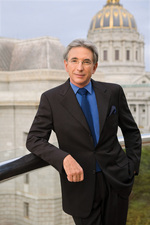
Michael Tilson Thomas
For much of the evening Friday, we were all Dorothy, cresting the hill to an amazing technicolor Emerald City. So much of what the orchestra, under the direction of Michael Tilson Thomas, had to say and tell us in the first of its 2 concerts here (presented by the University Musical Society) was revelatory, and the fun was not only in discovering the new, but in being surprised by what was surprising.
Like the Tchaikovsky Violin Concerto, for example, which in the hands of the extraordinary soloist Christian Tetzlaff and the orchestra was anything but the old warhorse whose every note and turn you thought you knew.
Not so, Tetzlaff and friends were here to tell you, with playing that was arresting and passionate, wild almost at times, and yet somehow modest. Nothing was quite as usual, but nothing was mannered. Tetzlaff’s phrasing, his way of taking time and giving it back, made everything seem fresh. And right.
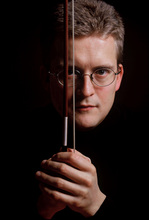
Christian Tetzlaff
There was a lot of dancing in the Tchaikovsky concerto — the composer is ever at the ballet — and dancing followed it, too, in Ravel’s “Valses nobles et sentimentales.” What a feast of nuance and color these pieces offer. The orchestra showed just how many shades of waltzing there can be, from sweeping dances in glittering ballrooms to dances that are all lassitude and dances that just have the merest waltz perfume.
Color, and a sound world that was both familiar and startling, were the calling cards of Kissine’s “Post-Scriptum,” which began the evening and which was written for the San Francisco. It’s a substantial work in length, and an evanescent one in content. Its phrases come forward and die away like waves, each replacing the last. The waves get longer and more substained before they subside, and the sounds are unworldly — eerie almost. And yet, at the same time, they very much recall the natural world. The piece began to feel a little long toward the end, but mostly, it was fascinating.
If the evening began with the unfamiliar — and I’d say it also continued with it in the Tchaikovsky — it also ended with the relatively unfamiliar. Following the Ravel waltzes, the orchestra concluded with Liszt’s “Tasso: Lamento e Trionfo,” played with emotional depth and sound to match.
This evening, the orchestra and Tilson Thomas receive the UMS Distinguished Artist Award at a second Hill concert that features Mahler’s “Resurrection” Symphony. (Information: 734 764-2538.) I say, bring on the awards and bring the orchestra back again soon. And judging from Friday’s concert — and the orchestra and Tilson Thomas’s long exploration of Mahler’s works — tonight’s concert will have its share of revelations, too.
Comments
Austin Han
Sat, Mar 20, 2010 : 3:23 p.m.
To an extent, I must agree with mama247, I thought the programming was perhaps a little odd. I found that I had the most fun listening to the Tchaikovsky. Despite many (in my opinion, cocky) audience members around me complaining that Tetzlaff "moved too much", put "too much showmanship" etc etc, I found his playing to be very exciting to listen to, as well as very original. If the commenter below me was bored last night, I'm sure tonight's mahler 2 will guarantee her the most awesome heart attack. I've never heard the Liszt before, so I find it natural that I am more puzzled of the piece than I am moved. I think it's high time I look for that piece on iTunes.
mama247
Sat, Mar 20, 2010 : 10:22 a.m.
Christian Tetzlaff playing Tchaikovsky was more than extraordinary. Perfection! The orchestra was divine... except that the Ravel and Lizst selections were musically mundane.... very little intrinsic emotional depth. We felt compassion for the excellent musicians who had to waste their time playing such inconsequential sound. However, the Kissine showcased the overall talent of the orchestra and Michael Tilson Thomas. First half: heaven. Post-intermission: dental office waiting room.