

Tales from a free-loading Ann Arbor Film Festival day tripper
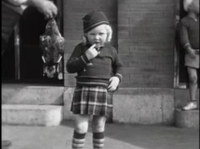
An image of one of the children featured in Vanessa Renwick's "Britton, South Dakota."
In past years, I’ve checked out the Ann Arbor Film Festival’s opening night program of experimental films, and dabbled here and there in AAFF events that most interested me.
But now that I’m a parent, my schedule, particularly my evenings, are far less flexible, so I decided to explore some new territory: the fest’s free afternoon programs. (My thanks to donors who makes these programs possible.)
This year, these included juror presentations; a student film showcase; and a panel discussion about documentaries — precisely the kind of things I used to skim right past.
Though not the heart of the festival — that would be the evening films-in-competition programs — these free programs are a nice option for film fans on a budget; cinephiles-with-kids (or without) who work close to downtown and can cut out for an afternoon, or even just an hour or two; the AAFF-curious who prefer taking baby steps before investing more time, effort and money in attending; and those who, like me, inevitably feel their eyewear may just not be hip enough to go all in.
The good news is that while there is, in fact, plenty of cool, vintage-chic fashion on display among patrons, the mood at these daytime programs is decidedly laid back, congenial, and welcoming — and the crowds are bigger than expected. Yes, you may occasionally be listening to someone discuss “two gestalts of aesthetics,” while others showily throw an unnecessary, erudite quote into a question; but you’ll also likely see some and hear some things that will stay with you in the best way possible.
So here, in a nutshell, are a few observations from my time as a free-loading AAFF day tripper.
• One short film (“Britton, South Dakota”) in Vanessa Renwick’s juror presentation on Wednesday provided, in miniature, the optimal AAFF viewing experience, in that the watcher is actively engaged in putting a film’s puzzle pieces together. Drawn from archival footage filmed by a movie theater manager during the Depression (who filmed townspeople and events as a marketing tool for the theater), “Britton” pairs a haunting organ soundtrack with images of kids and babies on the street who are staring into, or trying to get away from, the camera.
Just by staring for several minutes at the clothes, often-serious expressions, and hairstyles of these children, you think about how all these people are now quite old or dead; how the Depression seems to have prematurely hardened them, so that you can see the old people they will become while in the midst of childhood; and how children aren’t the perpetually happy people we like to think of them being.
• One advantage of attending the juror presentations is that they efficiently provide you with a sense of the range of one experimental filmmaker’s works. In Renwick’s program, there was “Britton” as well as a portrait of an eccentric Portland-based junk artist; a few unconventional personal narratives; and a couple of landscapes.
Stephen Connolly’s juror program on Thursday also revealed an interest in landscapes, but the program additionally featured a more personal, mysterious homage to a friend, and a funny, short commentary on the British Museum’s reading room. Just make sure you stick around to hear from the filmmakers after the program; it’s always revealing to hear them expand on particular works you’ve just watched. Plus, go in knowing that it’s likely (as it is with any AAFF program of films) that some things won't do much for you, while other things will surprise you in wonderful ways. Such is the nature of the fest.
• AAFF’s student film showcase is in its first year, and I hope it will become a staple. (Student work was solicited from U-M, WCC, EMU, Oakland Community College, College for Creative Studies, and Bowling Green State University.) Yes, there are some things you’d expect from young artists-in-training — unnecessary F-bombs (because, you know, they can), preachiness, punchlines, and interviews that beg for more editing.
But there was also an exuberance and energy pulsing through the works that made you look forward to what was coming next. My favorites included “Protocol of a Person,” by U-M art and design student Walter Lowe III, which visually played with the idea of the different personas we assume around different people; and “Humane Society,” by WCC student Zeke Burhans, which allowed a man who gases dogs and cats for a living to tell his side of the story.
• As a side note to the student program, I noted that all 13 of the featured filmmakers were male. I don’t blame or fault AAFF for this — they simply program the best work that’s submitted by the participating schools, and the rest of the fest features plenty of work by female filmmakers — but it did get me to wondering. After the showcase, I asked WCC student filmmaker John Inwood about the makeup of his film classes, and he estimated that young men constitute 75 percent of his courses, generally. Perhaps female filmmakers tend to take alternative paths to filmmaking, other than college study? Still thinking on this one.
• A panel discussion titled New Directions in Documentary began sluggishly, largely due to the fact that only one filmmaker’s work had already been screened at this year’s fest, and the panelists talked in great depth and detail about work that the audience hadn’t yet gotten to experience. (At one point, the moderator suggested this discussion would act as a “teaser,” but it in fact acted as a “distancer,” holding the polite-but-quietly-restless audience at arm’s length.) If even excerpts of the artists’ works had been screened at the talk’s start, this wouldn’t have been such an issue.
As it was, the discussion didn’t feel very accessible until audience members got to ask more broad questions like, “Mainstream docs have a thesis, but with your work, do you want viewers to leave with an emotion? A question?” and “What role, if any, do you see story playing in your work?” This all points to a central question for AAFF and similar events: do you cater to the casual, curious fan, or do you aim for those deeply schooled in what you’re doing? You always want to cast a large net, of course, but it’s impossibly hard to be all things to all people.
Jenn McKee is the entertainment digital journalist for AnnArbor.com. Reach her at jennmckee@annarbor.com or 734-623-2546, and follow her on Twitter @jennmckee.