

Takeshi Takahara exhibit explores "The Four Corners"
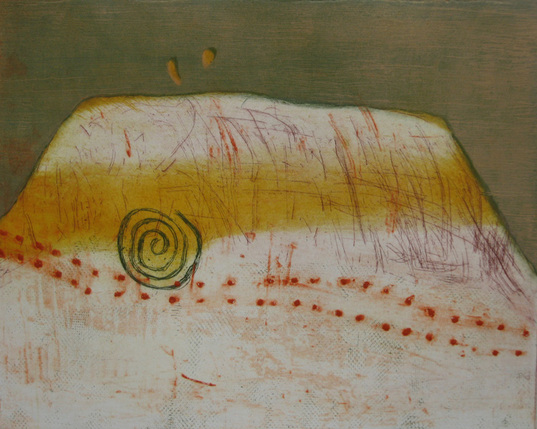
"Passage of the Anasazi" by Takashi Takahara. On view in "Takeshi Takahara: The Four Corners" at the University of Michigan Residential College Art Gallery through Dec. 4, 2009.
Image courtesy the University of Michigan East Quad Residential College Art Gallery.
Takeshi Takahara, a longtime U-M School of Art and Design printmaker (1982-2006), traveled the Four Corners in 2008 after his retirement, and he’s subsequently crafted a set of 19 prints that combines intaglio and relief printmaking to depict the mythic character of this unique American quarter.
Indeed, the impact this remote countryside had on Takahara will be immediately evident to those who have followed his work through these last couple of decades. These prints not only reflect a deep appreciation for this spectacular landscape and its ancient past; far more important, they mark a significant transition in his already distinctive printmaking that has grounded itself in earth tones and geologic formation.
For Takahara’s “Four Corners” is as much abstracted fable as it is a recollection of his visit. It’s a conceptual melding of these two aspects of remembrance as the print cycle is exceedingly powerful, both in its inspired scope and high-spirited execution.
Between history, fable, recollection, and interpretation, Takahara’s “Four Corners” is as impressive as the Four Corners are themselves. Bound by Utah, Arizona, New Mexico, and Colorado — that is, roughly the regions of White Sands National Monument in New Mexico; the Grand Canyon in Arizona; and Arches National Park in northern Utah — Takahara’s abstract ideographs dramatically reflect the region’s terrains and myths.
Many prints — for example, the sublimely totemic “Two Anthropomorphs I,” “Two Anthropomorphs II,” “Shamans,” and “Meeting of Shaman and Anthropomorphs ”— find Takahara illustrating the supernatural shapes that have played a large part in the area’s Native American religions.
Other prints — most impressively, “Passage of the Anasazi” — give his viewers a thorough sense of the shifting Southwestern landscape since 1200 B.C. While yet other prints — for example, the richly imagined “Migration,” with its depiction of a flock moving across a striated landscape — depict these indigenous peoples’ rites of passage.
Adapting the now famed petroglyph and rock art imagery found in this part of the country while also maintaining his own signature preferences in palette and form, Takahara’s crafted a rich travelogue that reflects his abiding reverence for America’s Four Corners. And it’s this heightened sensitivity that makes these “Four Corners” uniquely his own.
“Takeshi Takahara: The Four Corners” will continue through Dec. 4 at the University of Michigan Residential College Art Gallery, 701 E. University St. Gallery Hours are 11 a.m.-8 p.m. Monday- Friday, and noon-8 p.m. Saturday and Sunday. For information, call 734-763-0176.
John Carlos Cantú is a free-lance writer who reviews art for AnnArbor.com.