

U-M Gamelan concert combines old and new
Music for gamelan — the traditional Indonesian orchestra of cast-bronze instruments, bamboo flutes, strings and sometimes a vocalist, is entrancing and accessible — and exotic to Western ears and eyes. But like our own Western music, which is busy absorbing new and foreign influences all the time, gamelan music is doing the same.
What’s new for gamelan and what’s old are the twin subjects of the University of Michigan Gamelan Ensemble concert Sunday afternoon at 2 p.m. at Hill Auditorium. The concert is free and open to the public.
PREVIEW |
Midiyanto, a master Javanese drummer and gamelan musician, leads the ensemble, which is directed by Susan Pratt Walton, an ethnomusicologist and South and Southeast Asian studies specialist at the University of Michigan Residential College.
But don’t expect to see either Midiyanto or Walton up front “leading’ the gamelan.
“There’s nobody standing up there waving their arms around,” Walton said by phone last week. Depending on the style of music — “soft,” which favors the softer-sounding instruments in the 1st row of the gamelan, but includes all instruments; or “loud,” which focuses on the “bonang,” a group of instruments Walton says look “like chamber pots with little bumps on them and that you play with two padded sticks, in a florid pattern” — either the drum and rebab (a stringed instrument) lead together, or the drum leads alone.
“One of the things about the gamelan is that it is a very communal, democratic body,” Walton said. “There is very little focus on virtuosic display of talent.”
That democratic, non-hierarchical quality of the gamelan is 1 of the things Westerners sometimes find appealing about it. And indeed, the U-M gamelan is played by professional musicians, amateurs who come from other fields, people from the community and from the university.
In addition to selections from traditional repertoire in both the “loud” and “soft” styles, the musicians offer a world premiere by New Zealand composer Gareth Farr, who wrote the piece as a Fulbright scholar and is here in Ann Arbor to hear it played — and rehearsed. Listen to Gareth Farr "Tabuh Pacific" (MP3).
His “Pukul Wainui” — “Big Water Percussion,” in English — is named to honor both the U-M Gamelan and the island cultures the work drawn on. The composition joins Indonesian gamelan styles, Western orchestral percussion and the composer’s own traditional Cook Island Drums.
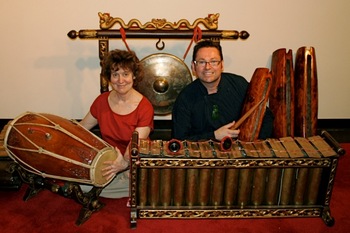
Susan Walton and Gareth Farr
photo by Gareth Farr
“Basically, it’s a piece that is effectively a dialogue between the percussion of two different cultures, Indonesian and European,” said Farr, who wrote the piece after meeting Walton in New Zealand, where she performed with a gamelan in his home city of Wellington. “It’s a piece for gamelan, with a few rhythms that are mine, and then you have the percussionists with more Western-style instruments.” Those include tom-tom drums as well as actual brake drums and even flower pots.
“They all got together in the same room last night,” he said, speaking about a March 17 rehearsal of the gamelan with the Western percussionists, and my God, it was loud!”
It will be less loud on the Hill stage, Walton noted, indicating that “Pukul” is basically in the “soft” gamelan style, with a very “floating” sound. The piece marks the first time, she said, that the gamelan has collaborated with members of the U-M Percussion Ensemble.
Like other contemporary composers, Farr is fascinated with mixing world traditions, and “Pukul Wainui” is not the first of his works to fuse the traditional musics of Indonesian gamelan with other traditions. Among other compositions for percussion and gamelan, Farr has also written for Cook Island drums and symphony orchestra, incorporating Maori chant and mythology. Farr has also been drawn to the dance dramas of Indonesian, Cook Island and Maori cultures, and he has produced a short theatrical work as well.
The gamelan is part of the U-M School of Music Stearns Collection of Musical Instruments. The concert is sponsored by the Center for World Performance Studies, the Center for Southeast Asian Studies, the School of Music, Theatre and Dance, Arts at Michigan and the Fulbright Scholar-in-Residence Program.
Susan Isaacs Nisbett is a free-lance writer who covers classical music and dance for AnnArbor.com.