

UMMA exhibit explores "Art, Anti-Art, Non-Art" in postwar Japan
The University of Michigan Museum of Art’s “Art, Anti-Art, Non-Art: Experimentation in the Public Sphere in Postwar Japan, 1950-1970” is a powerful examination of one set of cultural norms colliding with another culture’s artistic sensibilities — until their fusion sets off another round of aesthetic changes.
Various strains of mid-20th century modernisms (especially abstraction) were long-fermenting artful battlegrounds running across the entire century. And much American art of the latter half of the 1900s can now be seen as a direct reaction to the intense intellectualization of abstraction during the 1940s and 1950s.
"Challenging Mud" by Kazuo Shiraga
Courtesy of the Unviersity of Michigan Museum of Art
The condition in Japan was similar in that there was also a spate of abstraction in its history of art following World War II. “Art, Anti-Art, Non-Art” illustrates by example some of that country’s artists’ responses by highlighting “a dynamic phase of avant-garde art in postwar Japan characterized by self-reflection and multimedia experimentation.
“From 1950 to 1970, numerous artistic groups emerged,” says the exhibit’s gallery statement. Most notable among these groups were the Gutai Art Association, Group Ongaku, Tokyo Fluxus, Neo Dada, Hi Red Center, Vivo, Provoke, Intermedia, and Experiments in Art and Technology (E.A.T.), in which each cadre tested “the definition and practice of art by producing objects and ephemera that combined a variety of traditional and new media, including sound improvisation, language, performance, photography, video, and an expanded notion of sculpture (collaborating) beyond the boundaries of collectives, artistic genres, and conventional exhibition spaces, often presenting their work in the streets, temporary theaters and other public spheres.”
Whew. That’s quite a handful of ideas.
The UMMA’s Works on Paper Gallery does a good job of laying out this expansive territory in such a way as to allow for sufficient differentiation between these varied art forms. The exhibit is a bit graphic-heavy with documentation via books, magazines, and other such materials in display cases outlining the genesis and results of these collaborations. It’s a useful setup because what’s most striking about this exhibit is the focused energy these artists, writers, and musicians put into their reaction to what was perceived as the American and Japanese fine arts of their time.
This aesthetic transition was, therefore, no mere cultural appropriation. Rather, it was as much a cultural reexamination and cultural repudiation of the status quo as it was an endorsement of alternative forms of art.
As “Art, Anti-Art, Non-Art” points out, the traditional styles of Japanese art — various schools of calligraphy, painting, sculpture, and architecture — were challenged (as they were in the West) through decidedly unconventional techniques and materials.
The 1950s Gutai Art Association refined Japanese neo-Dada performance art and conceptual art. Tokyo Fluxus blended various 1960s anti-art aesthetics to create various forms of sound art, mail art, and concrete poetry. Hi Red Center incorporated flotsam and everyday objects into its collective projects.
The visual cacophony of artistic; non-artistic; and anti-artistic approaches in this exhibit can seem bewildering. But it’s a small price to pay for art that’s as radical as it is emotionally and visually raw.
Neo-Dada in its various forms deliberately seeks to be off-putting. And in being off-putting, it strives to take art down from its perceived intellectual pedestal to make it walk on the street.
Tracing such Japanese art from its 1950s neo-Dada “found art” orientation through the 1960s shift towards a technology-based aesthetic through the late 1970s reaction to this art is to trace Japan’s cultural history from martial defeat to assimilation to confrontation.
“Art, Anti-Art, Non-Art” manages the nifty trick of being politically incorrect as well as occasionally mystifying. And it’s this marked defiant attitude that makes the display so relevant today — even as it’s a fascinating historical primer.
Shiraga Kazuo’s 1955 “Challenging Mud” is both a form of body painting and performance. Kazuo’s contribution to Japanese art history, as illustrated in the photograph, was to take his aesthetic out of the gallery/museum site and wrestle concretely (in the literal sense) with his medium. Raising the question of where does performance stop, and painting begin, Kazuo made a virtue of getting his art down and dirty.
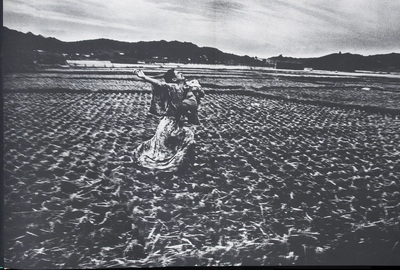
"Hijikata Tatsumi Holding an Infant and Running across a Rice Field" by Hosoe Eikoh and Hijikata Tatsumi
Hosoe Eikoh’s 1965 “Hijikata Tatsumi Holding an Infant and Running across a Rice Field” black and white photograph runs along similar lines as Shigra’s work, with the distinct difference that this image and project was a collaboration between photography and dance. Photographer Hosoe has captured dancer Hijikata in maniacal full-stride dressed as a “kamaitachi” (Japanese legendary creature that slashes victims it as passes by in a gale of wind) during what the UMMA gallery says was “an impromptu performance” when Hosoe was accompanying Hijikata to supplement the dancer’s memoir. It’s also a vividly realized photographic vérité combining an inspired performance in an otherwise naturalistic setting.
Ay-O’s 1964 “Tactile Box” and “Finger Box” certainly travel along the lines of confounding high art with its deliberately chosen pedestrian elements. The “Tactile Box” is constructed of cardboard with vellum, paint and paper while the “Finger Box” is constructed with brushes, elbow pipe, glove, paper, sawdust, and steel with a plastic vial in a larger vial, wax paper and wood.
The irony is that the exceedingly delicate nature of these objects has now effectively created an inconsistent situation for them. They were crafted to be handled — and they bear the visible marks of being overly-handled — necessitating their protection. As such, they have involuntarily become a sort of art inadvertently sired by anti-art sentiment.
“Art, Anti-Art, Non-Art” therefore indicates that, irrespective of the artist’s stance, art itself occupies — whether culturally high or culturally low — a thoroughly distinct place in its environment. And the contradiction of some of these artworks is that they no longer have a life except either as a photographic remnant — or removed from direct contact with the public.
And that raises a confounding question: Does the more art change, the more it remain the same? The exhibit is neutral on this point. But the incongruity is powerful — just as many of these artists would have likely wanted it.
“Art, Anti-Art, Non-Art: Experimentation in the Public Sphere in Postwar Japan, 1950-1970” continues through June 6 at the University of Michigan Museum of Art, 525 South State Street. Museum hours are 10 a.m.-5 p.m. Tuesday-Saturday; and noon-5 p.m. Sunday. For information, call 734-763-UMMA.
John Carlos Cantú is a free-lance writer who reviews art for AnnArbor.com.