

UMMA's "Eye of the Beholder" showcases European drawings
“The Eye of the Beholder: European Drawings from the Pulgram-McSparran Collection” is the second of 2 displays drawn from the donation of 2 University of Michigan Museum of Art benefactors, Ernst Pulgram (late professor emeritus of romance and classical linguistics) and Frances McSparran (associate professor emerita and chief editor of the “Middle English Compendium”). The new exhibit continues the UMMA’s exploration of this hefty bequest.
The prior UMMA Pulgram-McSparran exhibit, last April’s “Expressions of Vienna: Master Drawings by Klimt and Schiele,” focused on these two artists of the Vienna Secession. Both men reflected Vienna’s Fin-de-Siècle culture with its predilection for mature aesthetics and freedom of form.
This exhibit focuses on similar early 20th century graphics by Herbert Boeckl, Otto Dix, George Groz, Felix Albrecht Harta, Ernst Kirchner, Oscar Kokoschka, Alfred Kubin, Emil Nolde, and Christian Rohlfs; landscapes by Kirchner, Lovis Corinth, and Erich Heckel; a select set of 18th century etchings by German expatriate Franz Edmund Weirotter; and a magnificent double-folio engraving by Giovanni Battista Piranesi “Marble monuments erected by the Senate and people of Rome….” taken from his 1792 “Lapides Capitolini.”
As U-M PhD history of art candidate Kristine Ronan tells us in her gallery statement about this display, “Much of the collection was purchased on annual trips to Europe beginning in the 1960s. Several European gallery owners served as Pulgram’s ‘tutors’ and also became lifelong friends. These friendships helped Pulgram develop his eye and his individual taste. He was particularly drawn to the purity, spontaneity and economy of line found in works on paper — qualities highlighted in this exhibit.”
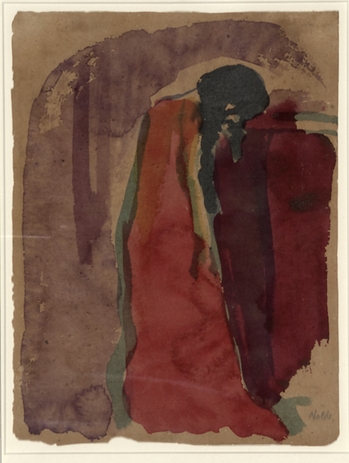
"Actress" watercolor on paper by Emil Nolde.
courtesy of the University of MIchigan Museum of Art
Some works — for example, Emil Nolde’s 1912 watercolor on paper, “Actress,” — features a variegated sweep of saturated watercolor that creates the figure he’s crafting. While Christian Rohlfs’ 1911 tempera and ink on paper, “Female Nude Lying on Stomach,” uses a similar heightened mood through a single powerful tawny tempera.
Oskar Kokoschka's 1934 blue crayon on paper, “Nude with Arms Overhead,” uses a spirited freehand to create volume out of a feisty economy of line. Yet perhaps the single most inspired scaling-down of form in this exhibit is Ernst Kirchner’s undated ink on paper, “Two Female Nudes,” in which his figures are created out of a felicitous swiveling ink.
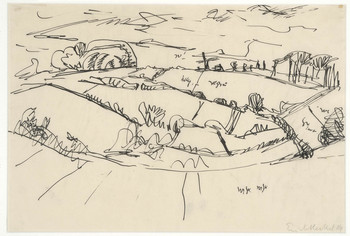
"Landscape" graphite and ink on paper by Erich Heckel.
courtesy of the University of Michigan Museum of Art
Yet the exhibit’s most significant find is 8 Franz Edmund Weirotter etchings drawn from various folios — 1759’s “Paysages”; 1760-61’s “”XII Vues de la Normandie”; 1761-62’s “Views of the Seine”; and 1775’s “First Folio of Regions and Old Fragmented Edifices” — where each print is second to none.
John Carlos Cantú is a free-lance writer who reviews art for AnnArbor.com.
“The Eye of the Beholder: European Drawings from the Pulgram-McSparran Collection” continues through March 14 at the University of Michigan Museum of Art, 525 South State Street. Museum hours are 10 a.m. to 5 p.m. Tuesday, Wednesday and Saturday; 10 a.m. to 10 p.m. Thursday-Friday; and noon to 5 p.m. Sunday. For information, call 734-763-UMMA.