

University of Michigan's theater department turns a spotlight on "Uncommon Women"
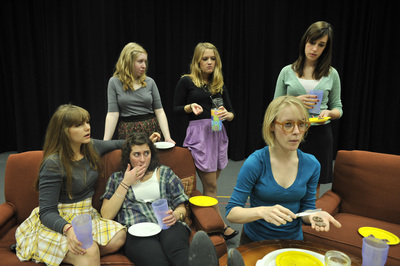
The cast of "Uncommon Women and Others."
Peter Smith Photography
But in the case of Wendy Wasserstein's "Uncommon Women and Others", now being staged by the University of Michigan's theater department, setting the play on Mt. Holyoke's campus simply makes sense. For if you're writing about young women, in the wake of feminism, struggling with both new choices and still-firmly entrenched limitations, then focusing on the women who are granted the very best opportunities to succeed seems a wise choice.
And since Wasserstein was a Holyoke grad herself, she's able to establish and powerfully re-create the school's atmosphere in "Uncommon." The play begins and ends with five Holyoke grads meeting for lunch, six years after graduation; but the rest of "Uncommon" is set during their senior year.
Kate (Emily Berman) is an academic and charismatic superstar bound for law school; Leilah (Devin Lytle) is a friend and former roommate who's struggling to get out from under Kate's shadow; Muffet (Bridget Coyne Gabbe) vacillates between dreaming of independence and Prince Charming; Holly (Laura Lapidus) is a directionless trust fund baby who's overwhelmed by choices; Samantha (Quinn Scillian) simply plans to marry her boyfriend after college; and Rita (Elly Jarvis) is the wild child of the group, trying to push boundaries at every turn.
The play isn't linear, with rising action that builds to a climax, but rather episodic in its structure (which feels appropriate, given its exclusive focus on women). In this way, the audience comes to feel like they're yet another student at Holyoke, spending time with these hyper-literate women as they hash out their fears and hopes. (Watching the play made me miss my grad school girlfriends something fierce.)
Yet at two and a half hours, the play feels a bit bloated and self-indulgent at times, and two women in the dorm - catatonic-but-brilliant freshman Carter (Stephanie Williams) and over-the-top pep machine Susie (Bonnie Gruesen) - stand out by virtue of Wasserstein's one-dimensional, cartoonish characterizations. Indeed, they often seem to serve no purpose but to provide comic relief, or, in Carter's case, a silent sounding board that others can deliver a monologue too, so we learn about what they can't tell others.
Wasserstein applies this same idea when Holly makes a call to a stranger and then pours out her soul. Yes, the one-sided conversation reveals much to us about her character, but because I didn't quite believe it, my attention was drawn from the play to the playwright.
Also, director John Neville-Andrews has Holly wandering freely around the set while carrying the rotary phone; this felt wrong, since she would have, in that era, been tethered by a cord. And on opening night, a sound cue was noticeably botched (recorded music started playing just as Scillian crouched to put a record on).
Even so, Janine Wood Thoma's scenic design nicely establishes the play's cozy, New England college setting, and Neville-Andrews has cast the show well. Gruesen, despite having an underwritten role, consistently injects energy and fun into the proceedings, and as enigmatic house mother Mrs. Plumm, Janet Maylie scores some laughs of her own.
The play can be frustrating at times - when Samantha announces her engagement, none of the other women ask her, or each other, what exactly the purpose of an elite education is when a woman simply plans to get married afterward - yet I generally enjoyed spending the evening with these smart, witty women.
Of course, the extensive glossary in the program initially stirred up those SAT anxieties; but then, as I watched the play's scenes unfold, I came to appreciate the way Wasserstein had shined a spotlight on contemporary women, taking their choices, their minds, their wit and their relationships seriously.
Now, if only that had become a broader trend since the play's 1977 debut …
Jenn McKee is the entertainment digital journalist for AnnArbor.com. Reach her at jennmckee@annarbor.com or 734-623-2546, and follow her on Twitter @jennmckee.
Comments
Captain Magnificent
Fri, Nov 20, 2009 : 8:28 p.m.
The last play I went to was Terminator Two. It was awesome- my favorite part was the "I'll be back" part! I gotta see that play again.
A2lover
Fri, Nov 20, 2009 : 1:37 p.m.
Not pretentious either, Vernice. It's the job of a theatre reviewer to have extensive knowledge of all aspects and concepts of theatre presentation. The willing suspension of disbelief is one standard aspect of theatre that everyone has to embrace, to the point of realizing that a phone cord on stage (whatever length) would induce enormous constraints on the actor's movement. And in a theatre where the audience is on three sides, I imagine the director employed the willing suspension of disbelief so the audience could see the actor as much as possible during an extensive phone call. If you see the show perhaps you'll realize the need and success of not using a phone cord. One would have hoped Ms. McKee, a theatre person, would have realized the need as well.
a2a2
Fri, Nov 20, 2009 : 11:50 a.m.
I thought the phone call was the most moving part of the show. I appreciate Mckee's reviews, but am sometimes embarrassed by her narrow perspective and glorification of the spectacular as opposed to the everyday. She is more drawn to musicals and overacted farces, as is most of the general public, but it's a shame that she is Ann Arbor's main critic, as she doesn't seem to have a full understanding or respect for real theater.
Vernice
Fri, Nov 20, 2009 : 11:42 a.m.
In that case, I suppose my question should have been: why so pretentious?
A2lover
Fri, Nov 20, 2009 : 11:25 a.m.
Not defensive, Vernice, no reason for it. Just pointing out a flaw in the reviewers theatrical acumen.
ScioReader
Fri, Nov 20, 2009 : 10:32 a.m.
I must admit the walking with the phone did bother me a bit, but I thought I was just being too critical. More importantly, as I lived in the Northampton, Mass area for a number of years, it that the school is Mount Hol-yoke (2 syllables) not Mount Hol-y-oke (3 syllables). The y is a consonant, not a vowel. Just a little thing, but as annoying to Mass. residents as someone say "Yipsilanti" to our ears. Otherwise, loved the show and enjoyed the "glossary". Proud to say I knew most! I didn't forget everything from the '70's!
Vernice
Fri, Nov 20, 2009 : 10:27 a.m.
A2lover- why so defensive?
Dog Lover
Fri, Nov 20, 2009 : 10:13 a.m.
I don't think Ms. Mckee did anything wrong by mentioning the phone. I find it very distracting when plays (or movies or tv shows) get the props wrong in an obvious way. I never look for those things, but sometimes they are so obvious it's hard not to notice and feel frustrated because they take you out of the scene. It's kind of ironic that you criticized her for being picky, I might add. Considering your comment.
A2lover
Fri, Nov 20, 2009 : 7:48 a.m.
According Ms. Mckee, "Also, director John Neville-Andrews has Holly wandering freely around the set while carrying the rotary phone; this felt wrong, since she would have, in that era, been tethered by a cord." Well, also, the turntable on the record player didn't turn, even though we heard music, the wine and the sherry the actors drank probably wasn't real, and was that real Earl Grey tea they were drinking? There were no doors on the dorm rooms or light switches, even though there were lights on and, at times (surprise!) dimmed all by themselves! And were those corn nuts in the show really from Mississippi? So why mention a cordless phone? Come on, Ms. Mckee, it's called theatre and, in case you aren't aware, it's my understanding that theatre liberally employs the "willing suspension of disbelief". As a reviewer of theatre I would have you'd known that. On another note, and if you really want to be picky, I doubt those girls would have had phones in their rooms, having to use public phones in hallways. Indicated in the play by actors coming on calling out "Long distance, LD for..." such and such a character.