

Vienna Boys Choir falls a bit flat in Hill Auditorium show
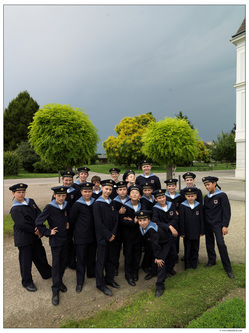
Vienna Boys Choir publicity photo
I’m home again Sunday night after a concert at Hill Auditorium by the world-famous Vienna Boys Choir, conducted by Manolo Cagnin, puzzling over what made so much of this University Musical Society concert, a highly anticipated overture to the Christmas music season, seem somewhat flat and less than inspirational. And so short on the soaring purity of boys’ voices that I, and many others, came to hear.
Granted, there was more of that angelic beauty of sound in the second half of the choir’s “Christmas in Vienna,” which was devoted to songs of Christmas, sacred and secular. But the first half, a genre-crossing mix of choral and solo pieces from around the globe and across the centuries, was shorter on good singing and inspiration. It was also, in the inclusion of a happy-faced, decontextualized “If I Were a Rich Man,” from “Fiddler on the Roof,” ironically short on a sense of taste and history.
But “Fiddler” is a quibble. The bigger concern has to be with the concert as a show and with the singing itself. To start with the singing, let’s entertain the possibility that 24 young voices, voices that are trained but cannot be pushed, are just not enough to fill a Hill Auditorium, glorious though its acoustics may be. Maybe two choirs’ worth of boys could have done it (the Vienna Boys Choir divides into four groups to tour). At times Cagnin, accompanying the boys at the piano, overwhelmed them. But at others, it was just hard to hear them, especially at their entrances.
I think there was also a vagueness and uncertainty about those entrances — which Cagnin might have helped with better direction — just as there was, on too many occasions, uncertainty about pitch. And rare were the times, in the first half of the show, when the music-making was not four-square but forward-moving. Best were the excerpts from Verdi’s “Four Sacred Pieces,” with affecting shifts in dynamics; and Fauré’s “Cantique de Jean Racine,” with its pungent dissonances.
Like lighting in a play, all these details make a difference in how music moves us, or fails to. So does spirit, and that’s where the dichotomy between the boys’ demeanor and Cagnin’s came into play.
On stage in their sailor uniforms, the boys, 10 to 14, are all spit and polish — and reserve. On Sunday, that reserve almost seemed a lack of engagement. Did Cagnin feel some need to make up for that? In any case, making his first appearance here with the choir, Cagnin seemed like he was from another movie altogether — effusive in his gestures and speech, over the top as a master of ceremonies, drawing attention to himself (and away from the boys) with some clowning. He acknowledged the boys repeatedly, but his smiling, puppeteer-ish manner (OK, come forward, now take another bow, no, really, it’s OK, now go back) seemed somehow condescending, though I’m sure it wasn’t meant to be.
Cagnin indulged less in grand gestures in the program's second half; that, coupled with singing that was more energized and true, let the music take primacy of place. A sublime “Adeste Fidelis,” sung as the boys filed in procession back onto the stage, led to a lovely succession of carols, and, showing themselves young masters of many styles, the boys charmed in a close-harmony arrangement of “I’ll Be Home for Christmas.”
Comments
letshearit
Wed, Dec 16, 2009 : 1:07 a.m.
Dear Aracel, Regarding the comment that the Vienna Boys Choir was simply "awful", actually the claim was consistently awful for the last 30 years, that is 300 awful-concerts-a-year kind of awful. I think this comment speaks more about the intelligence of the author or a lack of such, than the quality of the performance. You obviously have strong prejudice against this group of of 9-14 year olds with singers... thankfully millions of people around the world disagree with you. Comparison with a larger and older group from Cambridge is apples and oranges.
letshearit
Wed, Dec 2, 2009 : 11:03 p.m.
Ok, some of the comments I may agree with BUT Having heard Vienna Boys Choir on different occasions, in other countries, I mostly disagree with the notion of parts of the concert being decontextualized, in poor taste and sense of history. The show was conceived in Europe, by Viennese musicians and singers. It seems out of context here, well, this is why we invite musicians from other countries to share some of the context, right? If I were a rich man seems decontextualized? Well, we do not own this or any other piece of music; we do not get to determine the reading of a piece of music. It seems short on taste and history? What taste and what history? The story written by a Ukrainian Jew, the score/lyrics by a NYC Broadway team, it has been performed all over the world since 1964, and is contextualized differently in NYC, Israel and China. A 12-year-old from Vienna has a right to interpret this song, just as anyone else; there is nothing poor taste about it. This was one of the most popular songs on their previous tours of Asia and Europe. If the conductor seems too gestural, well, this is just too bad. He is an Italian, for Gods sake. It is very clear that the choir sees the interplay between the boys seriousness and conductors temperament as part of the performance and the charm. If it seems over the top and out of context?... what happened to multiculturalism? One may want to consider that you are talking about 11 and 12 year olds that practice endless hours, have been performing every night for a month and a half.
holytoledo
Tue, Dec 1, 2009 : 11:47 p.m.
What? Is AA a city of snobs? Such a tough crowd on a bunch of 11-year-olds. I saw the Vienna Boys Choir in Vienna, Austria 29 years ago. Loved them then! Love them now! I think this group of reviewers were disappointed because Adam Lambert wasn't performing, i.e., bumping and grinding throughout the show with various sexually explicit moves and screaming his head off. It's refreshing to sometimes see a show stripped down and not all hyped-up with dancers, flashing lights, extreme costumes, heavy makeup and bad singing, e.g., the American Music Awards.
Araceli
Mon, Nov 30, 2009 : 6:42 p.m.
Compare this group with the choir of King's College Cambridge, who also performed at Hill Auditorium and had no trouble filling the hall with their rich sound, with dignity of manner, and with high artistry and beauty. The problem with the Vienna Choir Boys is simply that they are awful. I heard them about thirty years ago and hoped they might have become less awful, but the truth is that they are more awful: tuneless, contrived, cutesy, unmusical, mawkish. The uniforms are handsome, and the piano playing was impressive.
TMC
Mon, Nov 30, 2009 : 6:26 p.m.
We agree wholeheartedly with your comments. We attended the Patti LuPone and Vienna Boys Choir concerts and found that the piano overpowered the singing. Hope there is some way to get the word out to the piano players! We have heard the Vienna Boys Choir before a cappella and feel that they could have carried the auditorium.
Wystan Stevens
Mon, Nov 30, 2009 : 5:23 p.m.
I didn't realize that the Vienna Boys Choir still existed. I too heard them in Hill Auditorium, but that was fifty plus years ago. The boys I heard then must be geezers like me now....
Andy
Mon, Nov 30, 2009 : 5:16 p.m.
Full agreement with the reviewer. The piano thoughtlessly overwhelmed the singers; the conductor made too much distracting show; the choir sounded shockingly unprepared--there clearly were moments when the lower voices were lost and sang octaves with the melody. The reputation of the group has been made on its musicianship and polish, and it was jarring to see both of these lacking. And, yes, the group was too small for the room.
comment1
Mon, Nov 30, 2009 : 10:37 a.m.
I too attended this concert, and I could not disagree more. I found it delightful. One must remember that these are, in fact, children performing, not polished seasoned healiners. I found it to be a light-hearted wind that blew away some of the cobwebs of old, out-dated formality. Overall rating: enchanting. I was not disappointed.