

This Week's Web Picks: Photo editing online; books too great to read; operatic archives; know-it-alls
Editor’s note: This is the next installment of a weekly column by Paul Wiener designed to point readers to cool or useful websites.
This is, for my money, the best and easiest DIY photo editing program available. It's free! It's found online but not as a download: you use it only on the web. Edit your photo in the cloud, but keep it in your pocket! Simply import or drag a picture to a small box on the home page and begin editing.
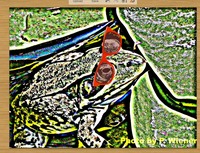
Fun with PicMonkey
The directions couldn't be simpler, and there are many options. It's not a Photoshop or a Gimp, but nearly every editing function you might wish for is here, and more. You can crop photos, re-color them, distort them, re-size them, put text, decorative symbols or word balloons on them, add all kinds of special effects, touch up skin, frame them, or make photos look 100 years old.
You can save them to your computer, no strings attached, or even make collages out of a small collection. Even the Help page is user friendly. PicMonkey also exists as a Facebook app.
Though there are others like it, this new application is as easy as it gets, and you don't have to go through another site, like Flickr, to use it. As I said, it's free, but there are hints it might not always be so. If you try it even once, you'll find that its fluid photo manipulation can be almost as addictive as a game. Harnessing one's own creativity can be like that.
We've all been asked "Read any good books lately?" But who gets asked "Read any great books lately?" No one? That's because the idea of greatness in books — the canon of great books — has largely disappeared from schools and public conversation. Some say the academics killed it, others that the concept offends democracy, still others that there's no longer time for greatness, only for change. But if you still believe great books exist as a class apart from the rest, rest assured you have company.
This site presents dozens of lists of Great books that are still taught, discussed, debated, revered, awarded, neglected, tortured by theses, and even read. Great Books are still taught at St. John's College. There are Eastern canons and contemporary canons. There are library lists, authors' lists, Columbia's and Chicago's University lists, critics' lists, Nobel lists, Modern Library lists and magazine lists to worry about.
And when all else fails, there's always Harold Bloom, who's literally read everything he insists is worth reading. Who would have guessed that Phillipe de Commyne's Memoirs was a must-read? Or E.H. Gombrich's The Story of Art? There are thousands of other great books we've forgotten about, don't have time for, find incomprehensible, and pay outrageous tuition to read about. There's not another minute to lose.
Here's a list of all the titles that are included in all these lists. One thing you can be sure of: not a single great book on these lists was written in the last five years. That's a shame: I can think of at least three — can't you?
Sounds of the Metropolitan Opera
If you don't like opera, I understand. It's not my favorite genre either, but I love some of the music anyway and feel obliged to tell the many opera lovers out there where they can listen to more than 200 shortened arias by world class artists recorded over the past 115 years.
hat's right: you can listen to Lilli Lehmann singing Wagner's Liebestod from Tristan und Isolde more than 100 years ago. Or Ezio Pinza in Don Giovanni. Or Jon Vickers in Peter Grimes.
Chaliapin, Carreras, Sills? Even some orchestral excerpts are here, all by performers who starred at the Met. Real opera buffs won't mind the sometimes scratchy, thin fidelity of the very early recordings and will be surprised at how good many 60-year old ones sound.
Particular recording dates are usually not included, but orchestras, conductors and record labels with catalog numbers are. The site also links to other Met Opera pages, including a timeline of its history, summaries of dozens of opera plots and links to current productions, telecasts, news and streams. If the archived recordings could be played back to back, you'd have more than five hours of listening pleasure. But sad to say, they can't be.
I don't understand much about the world, but usually I'm glad it's there. Even so, I envy people who take it less seriously than I do. Some of those who take it much more seriously, though, like to focus their confusion on rooting out cover-ups, conspiracies, and deceptions.
On this site the world of journalism collides with an ever-receding world of justice. Things are dire, satisfaction is only an expose away, and anger is cleansing. Here is what's behind everything, not only 9/11, but the bank bailouts, big brotherhood, microchip implants, vaccines, global warming and global cuddling.
Most of the issues are linked to real news items from major and alternative media, including documentaries from HBO, the BBC and the History Channel. Inspirational matters, like fluid intelligence and near death experiences, are given a proper airing. All sources are cited in detail. The New Paradigm gets as much respect as history's oldest assumptions. A course in the Hidden Knowledge is offered for free. Just when you thought reality was in your face!
If this all sounds a bit kooky and slippery, well, that's what too much information can do. It happens when you take the world so seriously. If you look closely enough here, you could swear you were missing something important. I wouldn't know.
Paul Wiener of Ann Arbor was a librarian for 32 years at Stony Brook University, in Long Island, N.Y., where he managed the English Literature, Art and Film Collections and taught internet research. He may be reached at pwiener@gmail.com.