

Are you a good witch game or a bad witch game?
Mike Hulsebus | Contributors
Let's be honest: board games are expensive. There are some games out that I would love to try but that I can't every imagine spending seventy five dollars on, no matter how much acclaim they have gotten.
Today's game, Witch Trial, is a lot like pizza by the slice at Backroom Pizza; part of what makes it so enjoyable is the fact that you didn't pay much for it. Designer James Ernest realized that many games all contain the same components and that it was pointless to keep charging customers for extra sets of dice, play money and pawns when they could always raid Monopoly and Yatzhee for all the supplies they needed. Despite how inexpensive it is (my copy of Witch Trial cost $8), the game is more fun that plenty of other, more expensive games that I own.
In Witch Trial, players each play Victorian-era trial attorneys who would look to put the local townsfolk on trial for witchcraft. During the course of the game, players draw from a common deck of cards and combine suspects and cards together to bring to trial.
On a player's turn, he will most commonly combine a suspect with a charge card and then wait until the next turn to bring that trial to court. Court is a green cardstock courtroom that tracks the current state of the trial and how many jury members are on the side of the prosecution. When a player takes a trial to court, one of the other players acts as the public defender and receives a small sum for defending the case, with a shot at getting a larger amount if he wins the case.
Mike Hulsebus | Contributor
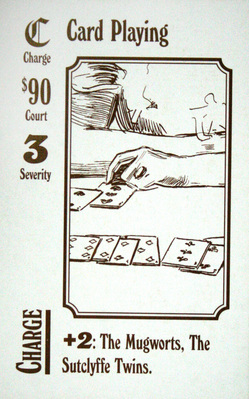
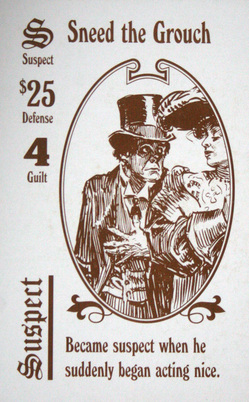
Without the cards, their great art and their absurdity, the game would be pretty disappointing. But the cards are ultimately what makes the game fun.
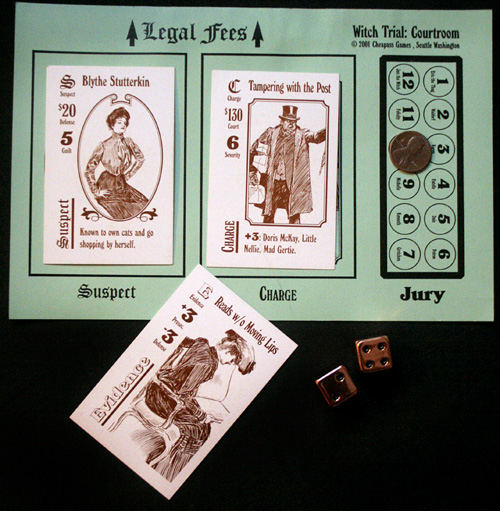
“I would like to charge Blythe Sutterkin with tampering with the post!” one player might say, putting the two cards in the courtroom, setting the jury value to a value based on the assumed guilt of the suspect and the severity of the crime. The prosecuting player then gets to make his case by playing evidence cards to win jury members over.
“Have you noticed, for example, that she is able to read without moving her lips?” he could ask, playing the Reads w/o Moving Lips card and move the jury by that number.
Once satisfied with the value, the prosecution rests his case. The defense can the play as many cards as he likes. The defense might, for example, play the “Prays Often” card to move the jury marker four spaces in the defense's favor. The defense then rests its case.
Finally, the prosecution gets to play one final card as closing arguments before finding out the guilt or innocence of the suspect. This is accomplished by rolling two dice and adding their total to the current jury value. If the result is higher than twelve, the suspect is guilty and the prosecution collects all the legal fees.
The cards themselves aren't weighed toward one side of the other. For every +5 card that the prosection has, the defense has a -5 card in the deck. The problem is that the process itself is weighed toward the prosection. First of all, the prosecution usually only chooses cases where the jury starts at a value of 10 or higher, so already the defense starts out behind. Not only that though, but the prosecution gets the option of playing an extra card at the end of the trial.
Mike Hulsebus | Contributor
The end result is almost all court cases are won by the prosecution. The game's winner is largely, therefore, determined by which player happened to be the defender when the prosecution had an unlucky roll of the dice. Furthermore, the easiest cases to win are also the ones worth the most money, so there is no benefit to trying to pull off more difficult cases.
In short, the game isn't mechanically well designed but is fun to play and has great cards. The game is fun and engaging to play, but no one really cares about who wins in the end. This isn't a game that you'll want to play again right away or a game that you'll leave saying “if only I had played my cards differently I would have won,” but it's a game that I think you'll have a lot of fun pulling out and playing from time to time.
If you're interested in picking up some of James Ernest's games, some of the company's games are still sold online, and local stores may be able to track down distributors that still have copies of specific games in stock. Witch Trial itself seems to be out of print, but their Web site has more information about titles they have available and where to find them. A few of his more popular titles have been picked up by larger publishes who have printed them with higher production values as well (Spy Game, Kill Doctor Lucky, Give Me the Brain).
One-Sentence Reviews:
Jake: There's a certain pleasure in accusing Meek Little Sarah of golfing, using a Faithful Pet to turn the case in your favor, and then trying to imagine what this trial would sound like if you were there.Allie: Although the game is very fun, the Married to the Sea-style comics and non-sequitur captions are the best part.
Mike Hulsebus made it the entire column without making a “You'll have no OBJECTION to playing Witch Trial” joke. If you would like to thank him, he can be reached at mikehulsebus@gmail.com.
Comments
Karen H
Thu, Apr 15, 2010 : 3:14 p.m.
You didn't ask for my review. I don't think the low cost is most of the appeal. It really is a fun game- good for groups.