

Amistad Community United Church of Christ's faith based on 'black liberation theology'
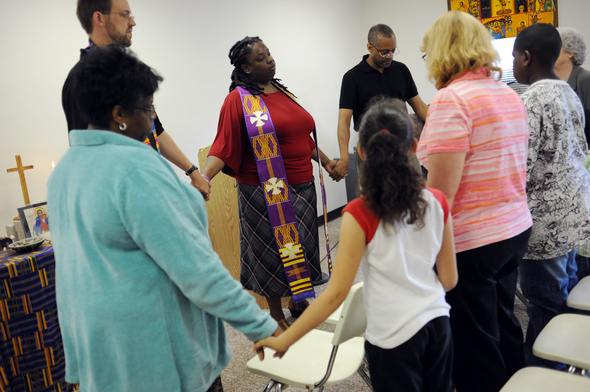
Amistad Community Church pastor Dominique Atchison, center, holds hands with church members as they pray during Sunday service.
Melanie Maxwell | AnnArbor.com
A cross between Malcolm X’s black power movement and the theology behind Martin Luther King Jr.’s speeches during the civil rights movement - that's how the founder described the faith practiced by members of Ann Arbor's Amistad Community United Church of Christ.
Formed in 1991, Amistad Community Church is a part of the United Church of Christ, a protestant Christian denomination.Â
The 20-member congregation and Pastor Dominique Chantell Atchison practice black liberation theology. Services are held every Sunday at 11 a.m. in a space at 2730 Carpenter Road.
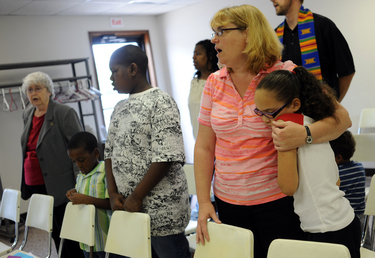
Kim Lowe, holds Ashleigh Lowe, 7, close as they sing during service on Sunday morning at Amistad Community Church.
Melanie Maxwell | AnnArbor.com
“Black liberation theology or black theology is saying that God is a God of the oppressed. God is a God who wants people to not be oppressed and stands on the side of the oppressed,” Atchison said. “It is a way to read the bible”.Â
The church is formed around two ideas: One is that Jesus was physically and culturally black due to the location of his birth, lowly status and association with the oppressed. Second, since “African Americans have always been among the oppressed” Jesus would associate with the oppressed if he were in our cultural context, Atchison said.Â
Amistad Community United Church
Facts at a glance:
- Location: 2730 Carpenter Road
- Head pastor: Pastor Dominique Chantell Atchison
- Congregation size: 20
- Faith description: Practices black liberation theology
- About the church: According to its website, Amistad “is an intentionally multiracial, multicultural and Open and Affirming church that believes in and serves God through Christ.”
- On the web: http://amistadannarbor.org/web/Home.html
Black liberation theology was developed by James Cone. During the 2008 National Theological Conference at Trinity Institute, Cone explained that he was inspired to reinterpret his childhood faith because he wanted it to address his race.
“The blackness in that phrase comes from Malcolm X, the theology in it comes from Martin King. So I bring Martin and Malcolm together, the civil rights movement and the black power movement together, in order to develop a black theology of liberation," Cone said.Â
Pastor Atchison was born in New York and raised in a Baptist church that practiced black liberation theology. She recalls being taught that “God was not separate from what some might consider politics, or racial politics, that God was on the side of those who were oppressed."Â
However, she moved away from the Baptist church because it lacked a progressive stance regarding sexual orientation and gender. Atchison did not want a tolerant church but rather one that is progressive and placed importance on its ministry to women and people of the black liberation community. Atchison joined Amistad Community Church in January. She chose it because it was racially diverse and politically progressive.
Every Sunday, the worship service at Amistad Community Church begins with singing "Siya Hamba," a traditional West African song sung in Swahili. Following the processional, there is praise, worship and the singing of "Dame La Mano" in Spanish. Amistad tries to sing in Swahili, Spanish and English at every service. The congregation is then given an opportunity to partake in anointing, “an individualized prayer and blessing,” said Atchison. Communion is offered on first Sunday of every month.
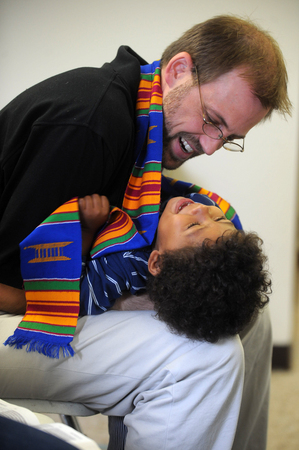
Aaron Wilson-Alhstrom plays with his son Langston, 2, during service on Sunday morning at Amistad Community Church.
Melanie Maxwell | AnnArbor.com
Community outreach at Amistad is focused on a book and film club called Sankofa that was started by the founder of Amistad, Herbert Lowe. Its members discuss books and films about African American history through the perspective of black liberation theology. The club meets at Amistad on Tuesday nights at 6 p.m.
The name Amistad Community Church was chosen to commemorate La Amistad, a 19th century slave ship on which the slaves revolted and overtook the ship. The men responsible for enslaving the passengers were eventually prosecuted for illegal importation of slaves.Â
Atchison explained that “the United Church of Christ often celebrates La Amistad as part of their history of social justice and because we celebrate African history and the afro-centricity of Jesus I think it was an appropriate name to combine African American history with the United Church of Christ. […] In the spirit of La Amistad we want to do justice and love and mercy in Washtenaw County and the world. It is a part of our understanding of who we are.”
Katherine Axelsen is a Senior at the University of Michigan double majoring in English and Comparative Religion. She covers U-M campus, Faith and neighborhood stories for AnnArbor.com. For further questions, email her at kaxe@umich.edu.
Comments
Gabrie'l J. Atchison, Ph.D.
Tue, Jun 29, 2010 : 3:07 p.m.
I had an opportunity to visit Amistad Community United Church of Christ, and the people there really took this word 'community' to heart. There was a small group, mainly due to the weather, but the Spirit of God was present with all of us. I was impressed by the diversity in the room: age, race, gender, ability and sexuality. What if all churches could embrace this kind of difference and make everyone feel welcome? I found the singing in different languages especially exciting, because God belongs to everyone. Pastor Dominique Atchison's sermon was accessible to us all. She did an excellent job of using scripture to contend with contemporary issues. After the sermon we enjoyed snacks and had a wonderful conversation. I do not live in the area, but if you have an opportunity to visit this church... it will be a wonderful experience.
bedrog
Fri, Jun 25, 2010 : 3:36 p.m.
the inhabitants of the middle east...now and in roman times...would be surprised to hear themselves described as african/black. and the notion that 'misery= oppression= worthy of support' begs the question in those regrettably many instances when the miserable owe their problems at least as much to their own behaviors/values as to 'oppressive'' others, who may just be trying to survive in their neighborhood...and where uncritical support for the miserable may thus be counterproductive to solving real problems. again, aspects of the contemporary middle east come to mind. sorry to be such a curmudgeon, but as one involved in such questions on a professional level for over 3 decades, and in a world of runaway emotional extremism fueled by often really bad history, its fair to raise the issues. and, btw, why is a west african song sung in swahili...an east african language?? just askin...