

End Times: Do Doomsday predictions tarnish religion?
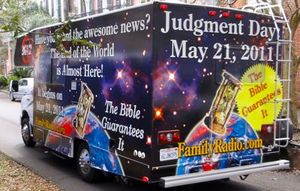
"Have you heard the awesome news? The end of the world is almost here. It begins on May 21, 2011. The Bible guarantees it!" proclaim the caravans led by Harold Camping, President of Family Radio.
Photo courtesy of WikiMedia Commons.
Editor's note: This post is part of a series by Dr. Baker on Our Values about core American values. This week Dr. Baker is discussing the world's long-standing fascination with predicting The End, and why America may be particularly fertile ground for this obsession.
Tomorrow’s the day earthquakes will shake the world, true believers will ascend, and the End Times will have begun. At least that’s what Christian radio broadcaster Harold Camping predicts. Not all of his staffers share his belief, according to media accounts. But some have gone on a spending spree in anticipation of the end.
What’s the effect of these End Times predictions on religion? I wouldn’t be surprised if it gave atheists something to snicker about. Just more reason to be “good without God.” But these predictions also concern devout Christians. Robert Jeffress, pastor of a Baptist mega church in Dallas, Texas, gives three reasons why he’s concerned about predictions like Camping’s:
First, these predictions “give non-Christians one more reason to discount the Bible.” When nothing unusual happens tomorrow, it will just add to the interpretation that the Bible is wrong.
Second, some people make “foolish decisions” when they buy into a prediction of the end of the world. Some people quit their jobs, abandon their families and friends, and give away their assets, as we discussed Wednesday. Others make extravagant purchases or run up huge bills. These are common patterns when it comes to Doomsday predictions.
Third — and to Jeffress “the most harmful consequence of Camping’s false prediction” — is that it distracts religious people from the Bible’s true message. “It discourages people from making the necessary preparation for the real event when it actually occurs.”
Do you agree with Jeffress’s analysis?
Do you share his three concerns?
What do you think people will do as we pass through this weekend?
Dr. Wayne E. Baker is a sociologist on the faculty of the University of Michigan Ross School of Business. Baker blogs daily at Our Values and can be reached at ourvaluesproject@gmail.com or on Facebook.
Comments
Ann English
Thu, May 26, 2011 : 11:31 p.m.
The only Jesus I saw Saturday evening was Jesus Castanon, Shackleford's jockey. Shackleford won the Preakness Stakes, so Jesus Castanon was interviewed. He was born in Mexico, not in Israel.
dotdash
Wed, May 25, 2011 : 3:57 p.m.
I think another damaging effect of false predictions of doom, not mentioned by Jeffress directly, is it highlights the ease with which crazy people hijack religious conversations. Sure, this particular crazy man will not be believed by many. But then one starts thinking: is Camping any more crazy than Joseph Smith? Was Jim Jones crazier than Joan of Arc? What about Jesus himself? It opens up a whole lot of scary questions.
rocco
Sat, May 21, 2011 : 6:04 p.m.
I can't believe I'm commenting on this. Nothing will happen due to this non event. When prophesies fail, true believers will reinforce their beliefs. They will say that they have intervened to save the world or avoid the catastrophe. The majority of rational people don't believe in doomsday scenarios. There are enough real world phenomena that can cause disasters (tsunami's, super volcanoes, earthquakes, etc.) So we don't need religious prophecy to remind of these possibilities. Modern religions have gotten away from prophecy and even biblical interpretations that suggest future events. So any organized religion that embraces them surely deserves its own demise.
ChelseaBob
Sat, May 21, 2011 : 10:58 a.m.
Jesus made it very clear that no man knows the hour and time. That makes these predictions very foolish from the Christian perspective. Also, the end of the world that we should be concerned about is the end of our world. Death will come to each of us, as a thief in the night, with no warning. Is our life what we want it to be in light of that unavoidable fact?