

Praying at a graduation ceremony: What's the fuss about?
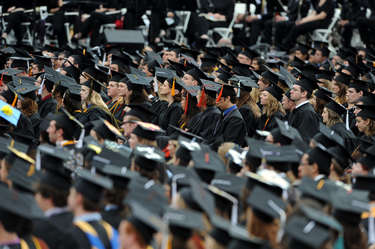
More than 8,500 graduates filled Michigan Stadium to hear President Barack Obama deliver the keynote address for their commencement ceremony on May 1.
Lon Horwedel | AnnArbor.com
So what’s all the fuss about prayers at graduation ceremonies? I bet thousands of prayers were uttered earlier this month at the University of Michigan commencement in the Big House: Parents were giving thanks that their sons and daughters had finally graduated—and they wouldn’t be writing tuition checks anymore.
Of course, the issue isn’t about private prayer. It’s about public prayer. Spring is the season for graduation—and along with it the continuing controversy over prayers at public ceremonies.
For example, students at Greenwood High School in Indiana planned to recite a prayer at commencement later this month. The senior class valedictorian objected, filing a suit with the assistance of the American Civil Liberties Union (ACLU), according to newspaper accounts. The suit claims that the public prayer would violate the separation of church and state.
Read more about this case and join the conversation at Our Values.
Comments
W. Vida
Mon, May 10, 2010 : 6:58 p.m.
The point of the 1st Amendment was to protect the church from abuse by the state. If the state established a particular denomination (as it had the Anglican Church in England), this would create headaches for the Baptists, Presbyterians and etc. There would be different tax laws, and inevitable persecution and a lot of other things that the folks in North American had traveled half way around the globe to escape. The first amendment was not to protect the Presbyterians from having to suffer through having to listen to an Anglican prayer. I think that the Puritans would have never left England if their persecution was that their teenagers might have to listen to an Anglican say a prayer at an optional graduation ceremony. The problem with secularism is that it doesn't realize that it is itself a religious world view. It is one thing to say were are all free to express our religion as we see fit. It is another thing to say that we can only express our religion at state sanctioned times/places. That is to force another religion (secularism) on the rest of us. http://religionannarbor.wordpress.com/