

Holiday music rings clear at area schools
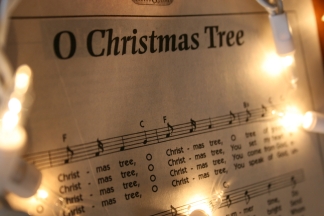
Instructors at Ann Arbor Public Schools are able to educate their students on religious music, so long as the song types are in balance and the melodies are taught with an educational element.
Photo by Stephanie Fenton
“Coming back to Ann Arbor from Yale, I appreciated the efforts of many to acknowledge the separation of church and state in our public schools.” Still, with music such a prominent part of the Christmas celebration, Westerman admits to a little ambivalence. “As a Christian, I sometimes wish I taught at a private Christian school (because) there are many pieces I would enjoy sharing with my students.” Ann Arbor Public Schools follow the Religion in Public Schools Federal Guidelines - a set of principles created by people of different faiths, according to Robin Bailey, the district’s Fine Arts coordinator. While schools may not promote or inhibit any religion, students can be educated on various religions so long as the means is secular. “We always include an educational element in our music performances,” Bailey said. “When I taught, I did a ‘Music from Around the World’ concert with my second-graders. In that, we’d have a script and would tell, in two or three sentences, about each holiday and why we were singing about it. [In today’s programs] we might talk about Kwanzaa, Los Posadas in Mexico or Christmas in France and Germany.” Since some instructors and directors at Ann Arbor Public Schools feel it would just be too difficult to mark each religion’s holidays at the appropriate times, some places of education - including Pioneer - choose to celebrate none of them. Extracurricular ensembles at Pioneer provide the only exception to the school’s music program principles.
“We want to be inclusive, [but] we certainly want instructors to do what they feel comfortable with, and [too] students and parents can opt out of anything they don’t feel comfortable with,” Bailey said. “If they aren’t comfortable, they don’t have to do it.” When holiday music is related to material taught at the level of secondary education, on the other hand, some direct religious correlations can’t be avoided, Bailey said. Secondary schools may allow their choirs to sing sacred songs, as long as they are in balance, she said. “Often, throughout the year - because of the historical context of music at that level - secondary schools will teach about these types of songs because many of the famous composers actually wrote for the church,” said Bailey. “That’s how the composers made a living, so to prohibit the sacred songs would be almost impossible!” The bottom line? Christmas is a major holiday in the Christian religion, and students are educated on this fact - as well how Yom Kippur and Rosh Hashanah are important to the Jewish religion, Ramadan and Eid al-Fitr are central to the Islamic religion, and that Kwanzaa is a special observance for many African Americans. While not all of these holidays and observances fall in December, students are educated on them throughout the school year. At the college level, things can get more complicated. The Washtenaw Community College Jazz Orchestra, for example, was asked this year by the administration to refrain from performing any songs that contained the word “Christmas.” “We were left with about two songs to play,” said Joe Kastely, a longtime member of the Washtenaw Community College Jazz Orchestra who plays the trumpet. “Although in the end, we played some Christmas songs, anyway.” The Thomas More Law Center, an Ann Arbor-based nonprofit law firm that promotes America’s Christian heritage, made headlines recently when it challenged in federal court on the Maple-South Orange school district’s ban on all religious Christmas music. The law firm claimed that the school district’s ban conveyed a government-sponsored message of disapproval toward religion, in violation of the Establishment Clause. “Christmas is a national holiday that celebrates the birth of Jesus Christ, not the birth of Frosty the Snowman or Rudolph the Red-Nosed Reindeer,” said Richard Thompson, president and chief counsel of the Law Center. Contributor Stephanie Fenton covers Faith for AnnArbor.com.
Comments
gamebuster
Thu, Dec 17, 2009 : 12:48 p.m.
It's wonderful. Students should have been introduced to various things including religions in a balanced way. In the past, i disliked the schools called 'Winter Holiday" but not 'X'mas holiday". parents brought some X'mas decorations to school were all rejected. It was so rigid. Now, it's changed better. Things can be done in a moderate way. Hurray!