

How to explain your divorce between helpings at Thanksgiving dinner
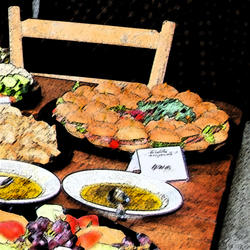
Give yourself permission to decide how much divorce information gets served up this Thanksgiving.
Dell Deaton | contributor
By comparison, family get-togethers for Christmas will tie to extended worship schedules and the invariable distraction of unwrapping presents. Firework spectacles on July 4 light up the sky with noisy crackles that’ll effectively interrupt any meaningful attempts to talk at any length with one another.
Here in Michigan, our State Court Administrative Office lists only four basic holidays for consideration in divorce. Three of these readily lend themselves to escapes from conversational corners. Picnic settings and situations where a pick-up game of horseshoes could be had in some far-off place if need be. Holidays that all better enjoyed outdoors than in.
But when it comes to your divorce and this Thanksgiving Day, it’s everyone together around one big table or intimately around a number of smaller ones. Doors closed. Ovens heated.
Now, what will happen when you and your divorce rise to the next topic of discussion?
Let’s start by acknowledging that all families aren’t the same. Some individuals deeply welcome holidays as a time when work and school and other obligations cease, allowing them to indulge in the reconnections they’ve been aching to make since— oh, my, has it been that long?
Others would be relieved to get a last-minute call from the alarm company saying there’s been a disturbance at the store. “Sorry, honey. You know I’m the only one who can make sure nothing’s missing, that everything’s buttoned back up again right. Make my excuses to everyone at dinner.”
Divorce can further complicate this as reality and fantasy collide every holiday.
“I’m just so lucky to have a family that will stand behind me at moments of crisis like this,” one woman said to me last Thanksgiving. We’d been working together almost a full year by that point. So the first time I’d heard her say those words was just before Christmas of 2008. Her subsequent debriefing in my divorce support group the following January sounded rather more like Cain’s retort to God at Genesis 4:9. In reality, her holiday sojourn hadn’t evidenced a brother’s keeper of any sort.
In all impending cases of holiday, the first thing I do is remind people in any phase of the divorce process that they need not be defined by divorce. We are all a great many things besides husbands or wives; we have careers and skills and diversions and interests and dreams that in isolation or combination can variably speak to what we choose to share with others at any given time.
Last summer, Pastor Peter Rufener of Saline Community Church revisited the Ten Commandments, one by one, in a series of sermons. Exodus 20:7 is the one that reads, “Thou shalt not take the name of the Lord thy God in vain….” God protects His brand name. It’s not ours to use in any way we choose or there for us to take by demand.
Nor should you have your own name be, as Pastor Rufener subsequently discussed after his out-of-the-box preaching here. Scripture is replete with examples of how our loving God does not merely instruct, but further models for us how He would have us treat ourselves and one another.
“How are you doing?”
Before you answer, think about what is most important for your family to know about you, right here, right now. A friend of mine suggests what he calls the Encyclopedia Britannica approach. Whole books and sometimes library shelves are filled with information on historical events that, when referenced in an encyclopedia, are necessarily reduced to mere pages. And mostly just a paragraph or two. In boiling things down for publication, some editor had to decide what limited image best summarized the whole.
Remember, too, that it’s a lot easier for most people to offer advice than to simply take in updates without comment or question. Your family members and friends aren’t there for your cheap therapy. You gain by unburdening yourself to them; it’s not right to further ask that they then carry that burden in silence (eg, “I just want you to listen”).
In other words, don’t bring up anything without further recognizing that you are encouraging its further dialogue. Wherever that discussion may lead, for however long it may go.
“Yeah, but what about your divorce?” someone asks, when you talk about anything but what to many will seem like a pink elephant in the room. After all, there’s been a conspicuous change in place settings and occupied chairs around the Thanksgiving table this year.
Again by way of perspective, let’s assume that people ask because they care. In its larger context, when Jesus tells us not to pre-judge at Luke 6:37, He is among other things suggesting an initial approach in favor of a desired end. “Do not condemn, and you will not be condemned.” Or, as relationship expert Dr. John Gottman has further confirmed by scientific study, “94% of the time,” he Tweeted this past September 22, “the way a discussion starts determines the way it will go.”
If you don’t want to discuss your divorce here, it’s perfectly acceptable to say something positive in response to inquiries. “Thank you for asking. I’m working with professionals I trust and I’m moving forward with them so I can keep that separate from the time I want to enjoy here with you all on other things.”
The Quest Study Bible notes that Jesus spoke in parables in part because “it was best for certain secrets of the kingdom to be kept somewhat hidden from his many casual observers, from overzealous but poorly-informed supporters and from outright opponents.”
Can you think of a single word in this excerpt that doesn’t apply to a family gathering consisting of people from all along the spectrum of expertise, discretion, and affection for your (soon-to-be-) former spouse?
So far we’ve focused exclusively on you. But it’s important to make sure we’re on the look out for favorite tools that the devil likes to offer as tempting “not-us” traps. Anything that is very, vary narrowly limited to a discussion of you, and you alone, is your story to tell. Anything said about someone else, eg, husband or wife, irrespective of official status vis-Ã -vis you, is gossip.
“Without wood a fire goes out,” reads Proverbs 26:20; “without gossip a quarrel dies down.”
Never once have I seen someone throw slightest bit of mud without getting themselves dirty. Surely your grandma taught you better than to come with dirty hands to her nicely-set Thanksgiving table, right?
I won’t suggest that you give thanks this Thursday for the many blessings that God has given you. The Holy Spirit will walk with you to that point when the time is right. For now, for most people deep in the painful process of divorce, a call to “count your blessings” is way too much to ask. At best, we can ask others to remember us in their prayers; those who love us undoubtedly are already doing so.
Instead, be open to whatever new opportunities may present themselves this Thanksgiving. For some, that will be a new place at the table, sitting a chair closer to someone with whom you haven’t been able to enjoy mealtime conversation in years past. Or maybe you’ll find yourself a guest invited to the table of another family. Papa Deaton (my grandfather) liked nothing better on Thanksgiving than to have guests at his table, regardless of what brought them.
You may be alone — if that’s what you choose. But keep in mind that there are plenty of volunteer organizations that would greatly receive any part of your day that you’d care to share with them.
Not one of these opportunities requires that you be defined by divorce.
No explanation necessary.
Period.
Dell Deaton is a divorce pastoral counselor, independently practicing since 1983. He can be reached through www.divorcepastor.wordpress.com or on (734) 668-2001 in Saline. Also check out /divorcepastor to Follow me on Twitter.