

Local churches welcome GLBT community
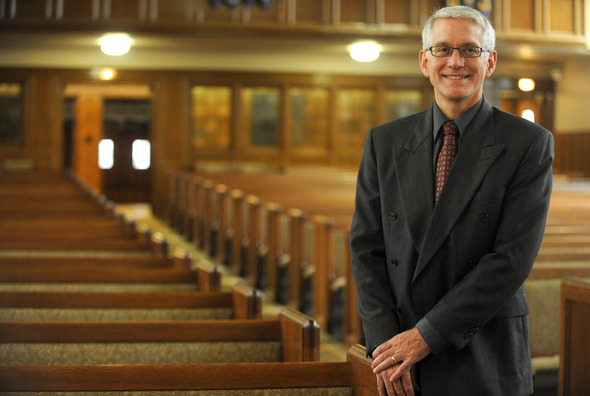
First United Methodist Church pastor Douglas Paterson has actively worked to change the Ann Arbor church’s view on sexuality and gender identity. The church is a so-called "welcoming church" when it comes to the gay and transgendered communities.
Angela J. Cesere | AnnArbor.com
For years, the senior pastor at the First United Methodist Church of Ann Arbor has actively worked to change the church’s view on sexuality and gender identity.
The Ann Arbor church is one of a growing number of so-called “welcoming churches.” These churches allow full participation by those in the gay, lesbian, bisexual and transgendered community and do not regard these identities as sins.
Paterson does not believe in so-called “reparitive therapy” pushed by some Christian denominations that believe homosexuality is a mental disorder or an elective lifestyle that can be changed.
“If change needs to happen, it’s not our job,” Paterson said.
In 2007, members of the First United Methodist Church voted and passed with 90 percent approval a welcoming statement that declared their intent to be inclusive of all, including those in the GLBT community.
“All of the members knew we were voting on the issue to be welcoming to the LGBT community, and we had a good turnout.” Paterson said in an e-mail.
Of course not all church members agreed to the new policy and a “handful” left. But they were easily replaced by those in the GLBT community, according to Paterson.
The welcoming statement does not change the language in the Methodist Book of Discipline, and clergy from other Methodist churches in the Detroit conference, which First United belongs to, have attempted to bring charges against Paterson.
But none of them stuck, he said.
Paterson finds the Book of Discipline, which outlines the Methodist church’s policies, to be contradictory in regards to sexuality and gender identity.
While the Discipline says “Homosexual persons no less than heterosexual persons are individuals of sacred worth,” it also says they do not condone the practice of homosexuality and “consider[s] this practice incompatible with Christian teaching,” according to the First United Methodist of Ann Arbor website.
Regardless of any divisiveness he might encounter, Paterson remains optimistic. “In half a generation, this is not going to be an issue.”
Others are not quite as optimistic.
Darcy Crain-Polly, the associate minister at the First Congregational Church of Ann Arbor, thinks acceptance in Ann Arbor is almost expected, but this is not the case for the rest of the country.
She says she first became aware how contentious the issue was when a Presbyterian pastor turned down officiating over a gay marriage ceremony at the Congregational church because she would lose her position at the church. The pastor participated in an unofficial capacity.
Crain-Polly says that her church takes a very relaxed position to the issue. When a baptism for a lesbian couple was announced, “nobody flinched,” she said. She has presided over three same-sex marriage ceremonies, one of which was in the church.
Although same-sex marriages are not recognized in Michigan, Crain-Polly says the ritual is “hugely important” for gay couples and she counsels couples to go in that direction.
What often keeps churches from adopting an open and affirming policy is what they see as a conflict between homosexuality and the Bible.
The Rev. Coqui Conkey is the interim minister at the Church of Good Shepherd of the United Church of Christ in Ann Arbor, which includes clergy who are part of the LGBT community. The church adopted a welcoming statement in 1989. They plan to update their statement to include transgendered people specifically.
Conkey says that while people may see them as blatantly disregarding Scripture, this simply is not the case. She says the church has studied it thoughtfully and with the “eye of interpretion for our current generation.”
Paterson says that people who oppose homosexuality generally pull from five verses in the Bible that mention same-sex acts. However, he says, none of them discuss a committed homosexual relationship and are directed at issues like pagan worship.
“[The Bible] talks more about idolatry than sexuality,” Crain-Polly said.
You may reach reporter Ann Dwyer at anndwyer@annarbor.com.
Comments
Speechless
Fri, Oct 29, 2010 : 8:30 a.m.
"... I seem to remember Potius Pilate having fairly similar opinions... "What is truth?" In addition to Pilate, you may wish to include some other folks, such these two: "I know that I know nothing" Socrates "Keep the company of those who seek the truth, and run from those who have found it." Vaclav Havel ------------ "... The Moral law remains in effect for Christians but the Ceremonial law is not... and the Civil law is not...." This is political spin, as applied to ancient scripture. Religious conservatives (and maybe others as well) will try to get around the harsh, umseemly nature of certain scriptural passages by offering to pick and choose for us which sections of sacred text must to be interpreted literally, and thus regarded as timeless law that everyone else must follow. Naturally, they will select those sections which appear to conform to their contemporary social viewpoints. The rest can therefore be conveniently shunted aside, when the ancient text goes a bit too far beyond the pale in its archaic expressions of social mores.
W. Vida
Fri, Oct 29, 2010 : 12:03 a.m.
Hi Edward, I think you are misunderstanding the role of the Old Testament Law in Christian life. Christians divide the Old Testament Law into three categories: 1. Moral Laws (the ten commandments, sexual codes, etc) 2. Ceremonial laws (how to be ceremonially clean in the Temple, how to be a priest etc) 3. Civil laws (how the Government of Israel should enforce the Moral and Civil laws, what sorts of punishments should be given etc). The Moral law remains in effect for Christians but the Ceremonial law is not (the Temple is no longer needed) and the Civil law is not (the Church is not the Government).
AAFish
Thu, Oct 28, 2010 : 7:55 p.m.
@Max Peters -- "I need to be told what I need to do." Yup, much easier than actually THINKING. I am a member of FUMC -- A2. It's probably one of the only churches I ever could have joined, and still maintained my intellectual integrity. (Essentially, I'm an agnostic, but I nonetheless feel welcome at FUMC, and feel comfortable attending it.) As I've perceived it over the years, the United Methodist Church's stand, is, essentially - God gave you a brain. USE IT! @glimmertwin -- "I'm not all that familiar with this particular church in A2." Boy, you said it!! "for some churches, this is just a ditch-attempt to attract new members." Or -- perhaps -- a genuine attempt to have the church actually be something that practices what it preaches. (What a thought!) "Younger people and GLBT see through this in a heartbeat." Um -- see through WHAT? An attempt for the church to truly be sincere in its acceptance of the whole of humanity? Oh, No! What are we coming to?
stunhsif
Thu, Oct 28, 2010 : 7:47 p.m.
The Methodist church like other "liberal" protestant reformation branches ( Methodist--Presbyterian-Lutheran - Episcopalian) are losing members at alarming rates compared to Pentecostal and other fundamental religions which are growing dramatically. These churches are slowly commiting suicide. They wish to be all inclusive and grow their membership but with the new members they attract, they lose even more in current membership who wish to adhere to what the Bible says in scripture. But I know from being a member, these reformation churches simply bypass scripture, see ( Genesis 19:24)and will not, for example talk about what happened to Lot and the cities of Sodom and Gommorah. There is a lot more scripture besides this folks! Selective reading from the bible is what they are doing and most folks don't like that.
W. Vida
Thu, Oct 28, 2010 : 7:01 p.m.
One thing that I would have liked to see in this article is a voice from a clergy who does not agree with the changing of sexual ethics. Most Christian pastors affirm traditional/biblical sexual ethics. There is a non-hateful and intellectually satisfying argument that can be made from this position.
Black Coffee :)
Thu, Oct 28, 2010 : 4:58 p.m.
Max peters I could not agree more. Preaching the Truth not so much
Max Peters
Thu, Oct 28, 2010 : 3:32 p.m.
I seem to remember Potius Pilate having fairly similar opinions of truth - "What is truth?" (Jn 18:38)
glimmertwin
Thu, Oct 28, 2010 : 2:02 p.m.
>> The trend toward 'welcoming churches' reflects a growing acceptance for LGBT persons within the larger community in which FUMC and other local religious organizations are active. Perhaps. I generally think it's because church's giving units, are dying off and younger potential members are turned off by closed mindedness - even if they may agree with the underlying concept. In general younger persons have opinions on this topic, it's just that they are more accepting of those unlike them than the older generation is. Churches are usually classified very distinctly: Old people, young people, black people, white people. The "Old people" churches cannot continue simply due to their membership is declining. I'm not all that familiar with this particular church in A2, but for some churches this is just a ditch-attempt to attract new members. Younger people and GLBT see through this in a heartbeat.
Speechless
Thu, Oct 28, 2010 : 1:20 p.m.
The devout are sincere in teaching what they believe to be the truth. Yet over the long course of historical time, sacred truths inevitably modify as the surrounding human society continues to evolve and its cultural values shift. To take a single cultural "snapshot" at a particular place and time will show a common adherence to rock-solid beliefs in the nature of truth which appear to be immutable. In larger social context, the widely shared core beliefs will seem universal and timeless. But move to another era and/or geographic location, and one discovers a somewhat different set of immutable truths, which likewise seem universal and timeless within their own cultural context. In regard to the ongoing history of human communities, one can maintain an absolute certainty in continued variability for the perception of absolute truth. Currently, this variablility finds a contemporary doctrinal expression in the changes taking place at FUMC and at the many other welcoming churches.
A22Ypsi
Thu, Oct 28, 2010 : noon
@Speechless: I notice that you take the word "truth" out of your response. Do these churches not believe that they teach true things, merely whatever things the majority of them wish to be true?
Speechless
Thu, Oct 28, 2010 : 11:55 a.m.
"... Do theological truths really change according to the majority vote of the congregation?" Yes, they can. Theology in all its forms is a product of human cultures, and it is fully subject to long-term shifts in core social values. I view theology as a bellwether for cultural changes taking place beneath the surface of society. Human communities have long been in the habit of projecting contemporary beliefs and values onto their environment and the universe around them. The trend toward 'welcoming churches' reflects a growing acceptance for LGBT persons within the larger community in which FUMC and other local religious organizations are active. They serve as a kind of social benchmark.
treetowncartel
Thu, Oct 28, 2010 : 11:33 a.m.
Church of the Good Shepherd was welcoming long before they issued a statement about it.The United Church of Christ is one of the more liberal and forward thinking protestant denominations to come out of the era of Martin Luther. Even Obama was a member of one of their churches, before he threw his pastor under the bus for a twenty second snipet of a two hour sermon that was taken out of context by the Rushies.
Karen Hale
Thu, Oct 28, 2010 : 11:12 a.m.
This is why, when I do go to church, I go to the First United Methodist Church in Ann Arbor. Thank you pastor Paterson and your congregation for being the kind of loving and generous Christians that Jesus intended you to be. I and my family always feel welcome there.
A22Ypsi
Thu, Oct 28, 2010 : 10:38 a.m.
Ann Arbor's Catholic churches have all been welcoming to me as a same-sex attracted man. They teach that I am valuable, deserving of dignity, and as capable of following their teachings about sexuality as anyone else. I don't need them to change their beliefs to accommodate my personal temptations. Do theological truths really change according to the majority vote of the congregation?
Max Peters
Thu, Oct 28, 2010 : 10:03 a.m.
Frankly, I want a church that will judge me. I know I'm not perfect and I need to be told what I need to do. This whole I'm ok, you're ok thing is a joke.
glimmertwin
Thu, Oct 28, 2010 : 9:34 a.m.
Ypsilanti's FUMC has been for years. It's one think to "say" you are something. It's another for the entire congregation to buy into it...
A2
Thu, Oct 28, 2010 : 8:42 a.m.
Finally a church that is reading the bible as it was meant to be read and not using the bible as a tool to hate or pass judgment..
Forever27
Thu, Oct 28, 2010 : 8:31 a.m.
I commend this church for opening its doors to all who wish to enter. The church I grew up in (also a United Methodist church) did the same thing with much backlash from the parishioners. Sometimes you have to do what's right, not what's popular. I only wish the rest of the christian community would accept people for who they are and not hate them for not being who they want them to be.
81wolverine
Thu, Oct 28, 2010 : 7:46 a.m.
Our church became a "welcoming church" some years back, which was a very good thing in the eyes of most of the parishoners. But the transition wasn't without it's contention and difficulty. Some members left the parish to be sure, and we were the target of at least one protest group. But, we're lucky to live in a community that is very open-minded and progressive in many ways. Other parts of the state and country are much less so still.
Megan S
Thu, Oct 28, 2010 : 7:22 a.m.
This is wonderful, glad you wrote this article!