

Am I Seeing Things?
Floaters, or spots, are particles that appear to drift in front of the field of vision. They are very common and are usually benign. A gel-like substance called the vitreous humor fills the inner part of the eyes. Floaters occur when parts of the vitreous break loose from attachment points on the retina. The actual floaters are not visible. The particles cast shadows on the retina causing the perception that a spot is in front of the eye.
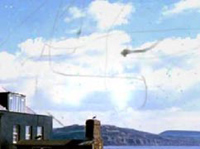
Floaters are specks or strand-like particles that appear to "float" in from of the eye.
www.retinahawaii.com
Floaters usually look like small black or translucent specks. However, they come in all shapes and sizes, some being strand-like or resembling cobwebs. They are most noticeable when one is looking at a plain lighted background like a clear sky or a light colored computer screen. Flashes of light may accompany floaters. This indicates the vitreous is pulling on the retina. The flashes usually appear in the peripheral vision and may look arc or streak-like. They are most visible in a dark room or when the eyes make a rapid movement from side to side.
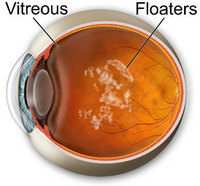
Floaters are suspended in the vitreous humor.
www.centerforsight.com
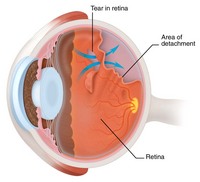
The vitreous fluid can invade a tear in the retina and cause the retina to detach from the back of the eye
Bethesda Retina
Vitreous detachments are common and do not usually lead to permanent vision problems. However, on rare occasions when the vitreous detaches it can cause small tears or holes in the retina. When a tear occurs the liquified vitreous can then invade the opening and push the retina off the back of the eye. This is called a retinal detachment. When part of the retina detaches it can no longer get the oxygen and nutrients it needs to survive and vision loss can occur. A retinal detachment can be repaired surgically and vision can can be restored if it is treated soon after symptoms start.
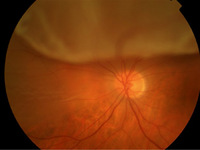
Retinal detachment
Timothy Jackson
Risk factors for retinal detachment include nearsightedness, age, diabetes, and cataract surgery. Regular eye examinations including dilation are recommended for these patients whether or not symptoms are present.

Dr. Jamie Barnes is an associate doctor at Bennett Optometry, with two offices in Ann Arbor. Contact her at bennettoptometry@gmail.com. Please visit our website http://www.bennettoptometry.com