

In the news today: What's happening with H1N1 flu
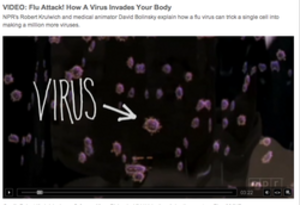
National Public Radio posted a light-hearted video about how viruses work.
With all the talk of H1N1 or swine flu, do you ever wonder what's going on when your body gets the flu virus?
National Public Radio produced a light-hearted video looking at how viruses spread so easily and successfully infect their human prey. From the first sneeze to the body's copying of the virus by the million, viewers get a short refresher course on what's going on and just how the immune system fights infection.
NPR posted the video on the FluPortal.org Web site, a partnership of public radio and television stations to more effectively cover the H1N1 flu virus.
Times announced for H1N1 flu clinic
The H1N1 flu vaccine clinic planned this weekend at Eastern Michigan University's Convocation Center will again employ wristbands to help distribute vaccine to priority groups.
The clinic is planned for Sunday, Nov. 22, between 10 a.m. and 7 p.m., the county announced. Washtenaw County will begin distributing wristbands to those who are eligible at 9 a.m. at the center, 799 N. Hewitt Road in Ypsilanti.
Wristbands signify people have been screened for eligibility, that a dose is available for them and they are able to leave and return at a specified time. Wristbands must be worn at the time of vaccination.
Those who are eligible to be vaccinated at Sunday's clinic include:
• Pregnant women.
• Caregivers of children younger than 6 months old.
• Health care workers who provide direct patient care.
• Young people ages 6 months through 24 years old.
• Those ages 25 through 64 who have underlying medical conditions that put them at greater risk of flu complications. Those medical conditions can include chronic lung diseases, weakened immune system, cancer, diabetes, kidney or liver disorders and cardiovascular disease.
The county will be distributing both the injectable flu shot and the nasal spray vaccine, but doesn't expect to have the injectable, preservative-free vaccine.
Parents and guardians can pick up wristbands for their children and return with the children at the appointed time, but must accompany a minor during the vaccination.
Individuals may also pick up wristbands for people with physical disabilities affecting mobility.
The public health department has nurses and health educators available to answer more detailed questions at 734-544-6700.
See additional H1N1 flu virus and vaccine coverage from Ann Arbor.com.
Pharmaceutical company says lower dose could be effective
Half a dose of the H1N1 vaccine may be enough to help people fight the flu, a pharmaceutical maker said Tuesday.
According to an Associated Press report, Novartis AG said the U.S. clinical study of 4,000 people suggested halving the dose required per individual could help stretch the current supply of vaccine.
The trial was conducted with the U.S.-approved vaccine Fluvirin.
Tina Reed covers health and the environment for AnnArbor.com. You can reach her at tinareed@annarbor.com, call her at 734-623-2535 or find her on Twitter @TreedinAA.
Comments
blueeyedpupil
Wed, Nov 18, 2009 : 12:57 p.m.
GoBlu, you are using numbers for expected seasonal flu deaths ending in the spring. Comparing them to H1N1 deaths only thru the beginning of November of end of October. You need to look at the H1N1 deaths and serious illnesses at the end of this flu season to get an accurate comparison. I understand if you choose not to be vaccinated, of course if you become ill, i hope you remember to stay home and away from others who may die from flu. But to make it some conspiracy is nonsense You might want to do some reading on pandemic flu before making such judgements
blueeyedpupil
Wed, Nov 18, 2009 : 12:50 p.m.
thanks RB, for the hint. after reading the post on the other article from the health dept, i phoned and they were so kind and concerned i was impressed. We were able to schedule an Aride direct trip at 8am thanks to AATA. RB you and the health dept could not have been more helpful. We are exceptionally greatful for all the help and advice.
Tom Teague
Wed, Nov 18, 2009 : 10:29 a.m.
The distribution of the 80% to others isn't a secret. Susan Cerniglia of the Washtenaw County Public Health Department posted a comment the other day that said "Washtenaw County has received approximately 30,000 doses of the H1N1 vaccine; on average about 80 percent is going to hospitals, universities and community health care providers for their priority patients and staff. Public Health is using the roughly 20 percent remaining for mass vaccination clinics for priority groups." The idea of vaccinating health-care providers first is to ensure their availability to work during an epidemic without fear of catching the disease. Also, much like creating a firebreak in a forest fire, vaccinating health care workers greatly reduces the chance that they will pass along the flu from H1N1 sufferers to patients seeking treatment for other reasons.
Rork Kuick
Wed, Nov 18, 2009 : 10:03 a.m.
To try and answer Cash briefly, and with few references. Detroit news reported yesterday that 42 novel H1N1 deaths have occurred in Michigan so far, which is good news considering how many people appear to have contracted it already, and the early very bad news about the number of deaths from Mexico at the start of the pandemic. I haven't heard death numbers for seasonal flu but our county health department shows there are almost no cases of it this year yet (that's typical though, it's too early; they show counts by date for every year). Manufacturers switching to making novel H1N1 vaccine is often given as the cause for the lack of seasonal flu vaccines available now. When more will come is a good question. Hard to tell how much concern we should have about seasonal flu this year - predicting the future is hard. I got that vaccine in September, in order to help protect others, which is my major motivation every year.
Tom Teague
Wed, Nov 18, 2009 : 9:38 a.m.
Not sure that it's fair to characterize the flu as a "dud." Tina Reed, who has been doing an excellent job covering this story, noted a few days ago the higher death rates among young people for this disease which is of great concern to parents: "At least 22 million people in the U.S. have been sickened by the H1N1 flu virus and 3,900 people - including 540 kids - have died from the illness in the United States, the Centers for Disease Control said this week. A USA Today story looked at the national impact thus far and said an estimated 98,000 people have been hospitalized with the flu. The typical seasonal flu usually causes 36,000 deaths in the U.S. - 80 of them kids - and puts 200,000 in the hospital." Possibly, part of the reason that it hasn't sickened or killed more is the result of the extraordinary public health response that's currently underway.
Vernice
Wed, Nov 18, 2009 : 8:23 a.m.
As few as they may seem compared to the average flu stats, I don't think the families who've lost loved ones as a result of H1N1 would agree that it's "a dud".
tommy_t
Tue, Nov 17, 2009 : 9:24 p.m.
So there were 30,000 doses received in the county with 80% distributed to others and 20% for the public. Who are the others and where in blazes can you find them? Why is it a secret? How much vaccine was or is ordered for Washtenaw county? Why don't they have a pre sign up during the week instead of a fire drill trying to get to the door and wasting many people's time, gas and aggravation?
Cash
Tue, Nov 17, 2009 : 7:16 p.m.
How many people have died from H1N1 as opposed to the seasonal flu? I had read elsewhere that the numbers were about the same. Is that still true? If so, shouldn't we be concerned about both vaccines? It's almost impossible to find the seasonal flu vaccine now.... why?
RB
Tue, Nov 17, 2009 : 6:26 p.m.
There you go blueeyepupil... "Individuals may also pick up wristbands for people with physical disabilities affecting mobility." Good luck and take care.