

In the news today: What's happening with H1N1 flu
Five additional H1N1 or swine flu virus-related deaths were reported in the state this past week, officials said Monday.
That brings the total number of deaths from the virus statewide to 59 since April, when the flu virus was first identified, officials said. There were 25,074 reported cases of flu-like illness in the state in the week of Nov. 14-21, compared to more than 35,000 in the previous week of Nov. 8-14.
There have been 1,660 hospitalization with flu-like illness this flu season - from the beginning of September through Nov. 21. Of the 59 H1N1-related deaths, 54 have been investigated. Of those:
- More than 60 percent were men.
- The average age was 44 years old.
- The age range of those who died was between 3 months and 73 years old.
- About 46 percent - or 25 people - were between the ages of 45 and 64. About 7 percent - or four people - were between the ages of 0 and 17, and 11 percent - or six people - were over the age of 65.Â
Vaccine becoming more prevalent at county health departments
The next mass H1N1 vaccination clinic for Washtenaw County residents in the priority groups will take place at Manchester High School on Dec. 5.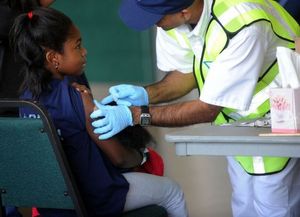
As vaccine becomes more prevalent across Michigan, the state said every health department will be offering swine flu vaccines to the five priority groups originally designated by the Centers for Disease Control and Prevention, starting Tuesday.
The Michigan Department of Community Health said Monday it had been allocated 2.2 million doses of the vaccine.
Some health departments in the state, including Washtenaw County, decided to follow even stricter guidelines about who was deemed eligible for the H1N1 flu vaccine because of concerns about how limited the supply was.
Washtenaw County has since opened up vaccinations to those five priority groups outlined by the CDC, which include:
- Pregnant women.
- Caregivers of infants younger than 6 months old.
- Health care and emergency medical services personnel with direct patient care.
- Individuals from 6 months through 24 years old.
- Individuals ages 25 through 64 with medical conditions that put them at a higher risk of flu-related complications. Examples of underlying medical conditions include: chronic lung diseases such as asthma or COPD; weakened immune systems; cancer, diabetes, kidney or liver disorders; cardiovascular disease (except hypertension); and other conditions.
The next mass H1N1 vaccination clinic for Washtenaw County residents in the priority groups will take place at Manchester High School on Dec. 5. Vaccinations will begin at 10 a.m. and continue until 3 p.m., or until the last person with a wristband is served. Wristbands will be provided to eligible people on site starting at 9 a.m.
The Dec. 5 clinic will take place at the new high school, 20500 Dutch Drive.
For updates to the H1N1 vaccination clinic schedule, visit www.ewashtenaw.org/flu. Public health nurses and health educators are available to answer more detailed H1N1 questions at 734-544-6700.
Swine flu cases down, CDC reports
Cases of H1N1 flu across the U.S. are down, the CDC reported Monday.
Doctor visits were down dramatically in the week ending Nov. 21, with 32 states reporting widespread flu activity, down from 43 states the week before, Bloomberg reported. However, hospitalizations, deaths and doctor visits are still higher than expected at this time of year, the CDC said.
Officials at both the state and national levels warn it is still too soon to tell whether the flu season has peaked. They say it's likely the flu season will last well through the winter and spring months.
More employers spending big to limit H1N1 impact
More large companies are throwing resources into reminding employees about good hygiene, trying to strengthen contingency plans for covering critical workers, holding fewer in-person meetings and offering free seasonal vaccine to limit the reach of the flu season, the Associated Press reported today.
So far, there have been few large disruptions in work from either the H1N1 flu or seasonal flu virus, both the CDC and dozens of companies told the Associated Press. But a Harvard School of Public Health study found a majority of businesses could not maintain normal operations if more than half their workers were out for two weeks, the AP reported.
Tina Reed covers health and the environment for AnnArbor.com. You can reach her at tinareed@annarbor.com, call her at 734-623-2535 or find her on Twitter @TreedinAA.
Comments
Tina Reed
Tue, Dec 1, 2009 : 2:22 p.m.
Thanks Tom. Yes - vaccine supplies are becoming more prevalent across the state and are getting into the county faster. But there is still a shortage and there are no specifics. In a conference call with reporters on Monday, state health officials said that as early as by the end of the year, if not in the next few weeks, some county health departments may be able to begin general distribution of the vaccine. Both the county and the state have said that will depend on whether they feel those in the priority groups have had an adequate chance to get a dose of the vaccine. County officials said it has been getting larger amounts of the vaccine to local health care providers who have largely been giving it to patients that are in the high risk groups.
Tom Teague
Tue, Dec 1, 2009 : 2:10 p.m.
Thanks for your good coverage of this. The story noted that the H1N1 vaccine supplies are more prevalent across the state. Has there been any announcement about when the vaccine might be available for those of us who are not in a high-priority group? And have you heard whether it will be available through other providers such as local physicians, pharmacies or walk-in clinics?
Rork Kuick
Tue, Dec 1, 2009 : 11:02 a.m.
We can't really ask these folks to be serious inquisitors. Enforcement would not be uniform, and would be taken as overly intrusive. Health care folks don't want to be the police.
KJMClark
Tue, Dec 1, 2009 : 9:16 a.m.
I really don't see any run-on sentences. Where do you? "Short." doesn't qualify as an actual sentence. I suppose if "..." is a verb, that fragment after "short" might be a sentence. Could you please send comments about a reporter's style directly to the reporter in the future? "They say it's likely the flu season will last well through the winter and spring months." - That's a key sentence. Don't be surprised if the flu reports rise again two weeks after holidays. That's a week after the holiday for the case to develop and another week for the report delay. I hope those mall Santas managed to get shots. I'll quit harping about the vaccine distribution now. I managed to get a shot yesterday. My last rant: the appointments person asked me my age, but no one asked for the health condition that put me in a priority group. I would have expected some kind of checking.
julieswhimsies
Mon, Nov 30, 2009 : 6:33 p.m.
Your run-on sentences make it a challenge to read anything you write. Short.Concise....and to the point. That grabs a reader.