

Swimming pool inspections ensure facilities stay safe and clean
“They had a 911 phone right there and all the rescue equipment. This is our fifth or sixth near-drowning in this county this summer, but we’re blessed we haven’t lost a child in any of them.”
-The Ann Arbor News, Monday, August 6, 2001
Julie Rowe, Environmental Technician
An emergency telephone is one of the state safety requirements our local sanitarians and technicians look for when they inspect public swimming pools. Fortunately in the case mentioned in the article from 2001, the pool was not allowed to open for the season until the emergency telephone was working.
Stories like these are just one of the reasons my colleagues and I at Washtenaw County Public Health's Environmental Health Division work hard to ensure our county’s indoor and outdoor public swimming pools are safe, clean and ready for use during the summer swimming season and throughout the year.
There are approximately 280 public swimming pools and spas in Washtenaw County (roughly 165 are outdoor and 115 indoor). If you or your family enjoy any of these during the summer months or any time of year — you may have wondered if the pool was, in fact, safe and clean.
I have good news! Our county’s Environmental Health Division inspects all public swimming pools annually — and takes water samples every two weeks throughout the year. We inspect and sample the pool and spa water at hotels, apartment complexes, schools, parks and swim clubs.
When we inspect, we look for a variety of items: water quality (such as pH and disinfectant levels); safety equipment (including functioning emergency telephones as well as a spine board); and properly functioning drains, skimmers and filters.
An outdoor pool must pass inspection before opening for the season, and an indoor pool must pass annually. As you can imagine, the weeks leading up to Memorial Day and the “official” start of the outdoor swimming season are an incredibly busy time for us.
Water samples are collected every two weeks, and the visits are not scheduled ahead of time. At each site, we check the disinfectant level and the pH of the water. A water sample is refrigerated and sent to a certified lab to test for coliform bacteria and evaluate the standard plate count. The presence of coliform can indicate contamination with fecal matter. The standard plate count measures the overall bacteria load in the pool.
If coliform is present or the standard plate count is elevated, the pool is closed and “shocked.” Shocking allows heavily chlorinated water to circulate through the system to disinfect it and reduce the bacterial load. The pool is then re-sampled to ensure the water meets water quality standards.
If a pool has repeated unsafe samples, we will work closely with the operators to determine the cause and correct it. Some pools also shock on a regular basis, such as after a big rain or after heavy use, to prevent samples from coming back unsafe for swimming.
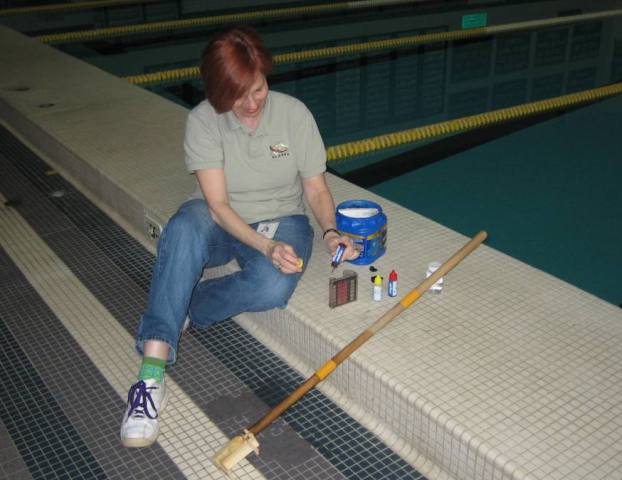
Julie checking the pH of the water.
Although this is a busy time of year for us, and we take the safety and health of our local pool environments very seriously, it does have its lighthearted moments. Once while inspecting a hotel pool, I was surprised to see a dozen or more lamp shades along the bottom of the pool. Thinking there had been some sort of wild party or mishap, I alerted the manager. Unfazed, the manager explained that they shock the pool after busy weekends — and sometimes soak the lampshades in the chlorinated water to clean them! We got a laugh out of this situation, but we did have to instruct the hotel to find a new way to clean the lamp shades.
Washtenaw County’s Environmental Health Division also monitors the water quality at public bathing beaches from Memorial Day through September, sampling the water for bacteria five times per month.
For more information on the Environmental Health Division’s Recreational Water Program, or any of our other programs, please visit http://environmentalhealth.ewashtenaw.org.
Julie Rowe is an Environmental Technician with Washtenaw County’s Environmental Health Division. She is busy making our sure our public pools and spas are safe and clean, and she wants you to know a lamp shade goes on your head, not in the pool. She can be reached at 734-222-3800.