

Inside Washtenaw County Public Health: World Rabies Day

Donna Nussdorfer
Sept. 28 is World Rabies Day, a global health observance that seeks to raise awareness about rabies and enhance prevention and control efforts. Co-sponsored by the Centers for Disease Control and the Alliance for Rabies Control (ARC) since 2007, World Rabies Day has been celebrated in countries throughout the world, including the U.S.
World Rabies Day is an excellent time to take steps that can help prevent and control rabies, such as vaccinating pets, including dogs and cats, and providing education on how to avoid the animals that typically transmit rabies: feral cats, bats, skunks and foxes.
While rabies is rarely diagnosed in humans in Michigan, cases do occur. We’ve recently confirmed the second rabies-positive bat since 2008. And as recently as 2009, a 55-year-old man from our state died of rabies due to a bat strain of the virus. The patient did not seek treatment following an exposure to a bat months earlier. Prior to this, the last human case in Michigan was reported in 1983, also likely acquired from contact with a rabid bat.
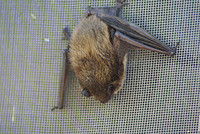
Brown bat, typically found in Michigan
We are involved in many interesting interactions here in Public Health, but I’d like to share a cautionary tale involving a family from out west visiting our area. It was a beautiful day, and they decided to stop near a stream in Ypsilanti for a photo opportunity with a mother mink and her babies. All of the family, including two children, picked up the babies for pictures. The final baby had had enough and bit one of the children.
The unfortunate result was the baby mink being euthanized and sent to Michigan Department of Community Health for rabies testing, which thankfully came back negative. The child healed well from the bite and went home with some great pictures. The moral of the story is: don’t pickup wild or unknown animals. It puts you at risk for rabies and may cause a needless death in a healthy animal. If you see an animal that is acting strangely, get away from it and call animal control or the Huron Valley Humane Society at 734-662-5585. Do not attempt to capture it yourself!
Some rabies facts for you: bats are the species most often tested for rabies in Michigan;
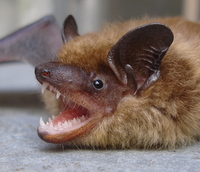
Remember, if a bat is present in your home and you or your pet had contact with it, if a person was sleeping in a room with the bat or if a young child or impaired person was unattended in a room with a bat, capture the bat, and call Washtenaw County Public Health Department at 734-544-6700 for assistance. If you are unable to capture the bat, call the Human Society of Huron Valley at 734-662-5585 for assistance.
For more information on rabies, please visit our Web site: www.publichealth.ewashtenaw.org.
Donna Nussdorfer is the Communicable Disease Nurse Coordinator for Washtenaw County Public Health. She can be reached at 734-544-6880