

Lyme Awareness month springs local advocate and longtime Lyme sufferer into action
Schryver and her family are experts on Lyme Disease because they have been living

Wendy and son, Jeff, both Lyme sufferers for the last decade.
April Scarlett | Contributor
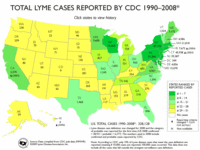
Courtesy Centers For Disease Control
Ticks hide in shady, moist ground litter, but adult ticks can also be found above the

There is a lot of controversy surrounding the subject of Lyme Disease. What is it? We know it is tick-born, but is it carried by all ticks? Is it truly only rampant in certain parts of the United States? As long as you catch it right away, you can be cured, right? You’d certainly see or feel a tick on you before it had time to do any damage, wouldn’t you? Can’t we trust the screening test if it is positive? The answers to these questions are highly debated among medical professionals, government regulators and insurance companies. The subject of Lyme is exploding, and in some states, making headlines on a daily basis. There are national organizations, high-profile court cases, physicians state-hopping to be able to keep their practices, conspiracy theories and downright denial. The basic definition, however, is agreed upon.
Lyme disease, or lyme borreliosis, is an emerging infectious disease caused by at least three species of bacteria belonging to the genus Borrelea. The disease is named after the village of Lyme, Connecticut, where a number of cases were identified in 1975. Early symptoms may include fever, headache, fatigue, depression, and a characteristic circular skin rash (bulls eye). Left untreated, later symptoms may involve the joints, heart, and central nervous system. Late, delayed, or inadequate treatment can lead to the more serious symptoms, which can be disabling and difficult to treat.
The Schryvers know this well. Wendy Schryver takes forty-two to forty-six pills per day, and would take intravenous antibiotics if she could afford it. “I try to cram them (pills) all in, in the hours I’m awake,” she says. One of her symptoms is chronic fatigue, with intermittent bouts of insomnia, sometimes for forty hours at a time. A typical day for Wendy may include chronic pain in her legs, joints and lower back, migraines, skin pain, tingling, itching and feeling hot all of the time, major vision deterioration and burning feet. “If I stand up, in less than one minute I feel like my feet are going to crumble underneath me,” she says. Her husband, and number one advocate, Dan Schryver, says he notices the cognitive changes. “She (Wendy) has lost the ability to organize,” he says, “its Wendy, everything is there, but it’s like everything is dampened, only thirty-five percent of her is there.”
Somehow, despite her symptoms, she is fueled by those who need her. First and

Wendy Schryver talks to a Lymie while researching Lyme Awareness.
Contributor | April Scarlett
Those in her Lyme community, find her irreplaceable. They gush over her, “can’t say enough” about her, “don’t know what they would do without her”, “thank God “ for her, even send her plane tickets to Texas. Most of these people are people Wendy has never met, but continually reaches out to, to help because Lyme Resources are so limited when it comes to treatment. Schryver has a Facebook page strewn with articles, court hearings, and postings from physicians’ offices, medical journals, investigation findings and fundraising events for awareness. She writes to officials, gets petitions signed and answers her constantly ringing phone. With all of her illness, what is it that drives her? She says “a mother should never have the same disease as her child. I know. I see everyday what my child goes through. I know the pain he is in.” Wendy Schryver may be a Lymie, but she is a mother first. This is yet another bond she forms within the Lyme community. With so many children afflicted, there are concerned and panicked parents with each case.
Yesterday while researching Lyme on the web, Schryver noticed the comments of a woman named Jennifer from Rhode Island, with a very sick thirteen year old daughter whose health had deteriorated greatly over the last ten months. “She had nobody, I had to help her,” Schryver said. Schryver went immediately into advocate-mode, drafted an email to a contact at the Rhode Island Lyme Association and found a doctor in Boston available to take the appointment. Within twenty-four hours, the young girl had been driven to Boston and started in treatment. Jennifer posted onto Wendy‘s Facebook page today, “No words can express my gratitude…”

Wendy and Dan Schryver
Contributor | April Scarlett
The Infectious Disease Society of America (IDSA) guidelines state the treatment for Lyme Disease to be no longer than two weeks at the onset, and possibly four weeks if needed of oral antibiotics. Lyme physicians, who have treated thousands of cases, also prescribe antibiotics, but for more like two years intravenously, instead of four weeks orally. The argument is ongoing regarding the best course treatment for sufferers of Lyme, and whether or not chronic Lyme even exists. Herein lays the main issue for the Schryvers and many other families nationwide. They live Lyme every day, year after year. For them, there is no question chronic Lyme exists. It took seven years for their son Jeff to test positive “enough” according to CDC guidelines. Up to that point, he only showed a “strong antibody response “which, though was specific to the disease, wasn‘t a definitive test result. The Schryvers feel confident, had there been a better test nine years ago when their son was bitten, he would be cured today. In fact, the CDC in April 2010 reports “the problem is that these are antibody tests and Borrelia burgdorferi, the bacterium that causes Lyme disease, has been shown to be an intracellular pathogen that has the ability to evade the immune system. Therefore, antibody tests cannot always appropriately indicate whether or not a person is infected. Even the ALA states patients are restricted to “limitations of currently available serological (blood) tests.”
“They (IDSA and CDC) won’t even listen!” Dan Schryver says, out of his chair, voice raised, obviously frustrated by the entire ordeal.
After years of trying, there aren’t many local physicians available to treat long term Lyme because of the IDSA guidelines. And if the treatment is received elsewhere by a physician who is willing to treat, there isn’t an insurance company that will cover the treatment, again because it is in violation of the IDSA.
The Schryvers travel out of state every six months to see their Lyme doctors. In the last five months alone, they have traveled to Connecticut, South Carolina, and Washington D.C. Five trips last year totaling 5000 car miles, none of it covered by insurance. They follow their doctors from state to state, as they are forced to move their practices.
Dr. Joseph Jemsek is one of the more renowned Lyme-literate doctors in the U.S. Between 2003 and 2006, he took on an average of eighty new patients per month at his Lyme Clinic in North Carolina, coming from forty-six different states. He was eventually sanctioned by the North Carolina Medical Board for failing to follow IDSA guidelines in the treatment of Lyme. This event allowed a law suit to be filed by Blue Cross Blue Shield to recoup fees they had paid for unauthorized treatment. Jemsek was forced to file bankruptcy. He moved his practice to South Carolina, and his patients followed. Lyme doctors like Dr. Jemsek have a very loyal following. The Lyme movement is getting so large and so controversial, that it is getting more and more coverage. One such vessel of information is the 2010 Academy Award semifinalist film “Under Our Skin” by Open Eye Pictures (www.underourskin.com). It is the winner of four different national and international film festivals, and is sweeping the country with community showings this month in honor of May being “Lyme Disease Awareness Month.”
Again, this film sets Wendy Schryver into advocate mode. She and her family have arranged to have a FREE screening of “Under Our Skin” in Saline” as part of a Lyme Disease Awareness night. “I want people to be educated so they don’t have to go through what we’ve gone through”, Schryver says, “if one person learns something from our awareness night than it will have been a success.” Summer is coming. The awareness night is for parents and other adults who want to be informed. The film is not recommended for young children.
So Wendy Schryver will board her Texas bound plane, with medications in hand for herself and a “Happy Thoughts Jar” for Desiree. “I called on all of my Lyme friends to send Desiree words of encouragement,” Schryver said. “That way when she’s having a rough time, she can reach into the jar and pull out well wishes from other Lymies.”
“That’s just Wendy,” Dan Schryver says, “she’s a quiet warrior. She get up, puts her foot on the floor and thinks about how she can help someone else.” Schryver certainly has her family behind her. As we wind down the interview, she says, “I know I can do this. I have the sense of urgency.” Meanwhile her husband is singing an old Monkey’s tune from the kitchen “I’m a Believer”, with her daughter Lindsay chiming in
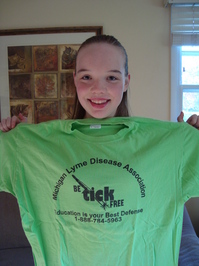
Daughter Lindsay shows off her MLDA tee.
Contributor | April Scarlett
The FREE Lyme Disease Awareness Night with screening of “Under Our Skin” will be Wednesday, May 26th at 6:30 pm in the Liberty School Auditorium, 7265 N. Ann Arbor St., Saline, MI. For information please call the MLDA 1-888-784-5963 or Wendy Schryver 734-429-8479.
April Scarlett is a freelance writer. Find her work at www.fromherdesk.com, www.successfulwomenweekly.com, www.aprilscarlettwrites.blogspot.com, www.aprilscarlettmotherboard.blogspot.com, on Facebook search ASW-April Scarlett Writes and on Twitter @ajscarlett.