Macular Degeneration
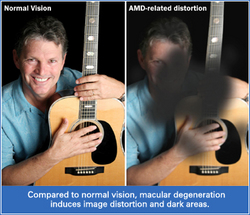
Macular degeneration (AMD) is the leading cause of blindness in people over the age of 65. The macula is located in the back of the eye or retina. It is the most sensitive part of the retina and is responsible for central vision and color vision. As the macula degenerates a person with AMD may find it more difficult to drive or read. Peripheral vision is usually unaffected.
Tricity Eyes
There are two forms of macular degeneration, the dry (non-exudative) form and the wet (exudative) form. The dry form is the most common and less severe. It accounts for 85-90% of cases. The wet form occurs when blood vessels leak under the macula. It is less common but can produce sudden, severe vision loss. In some cases the dry form can convert to the wet form. It is very important that this type of change is detected and treated as soon as possible to minimize the vision loss.
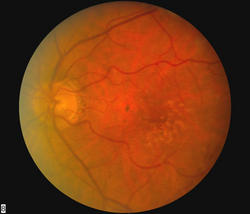
Dry AMD causes yellow deposits called drusen and pigment to accumulate in the retina.
www.medrounds.org
Some symptoms of AMD include a gradual loss of clear vision, objects appearing distorted or wavy, loss of clear color vision, or a dark spot appearing in the center of vision. During a comprehensive eye examination an optometrist will perform a variety of tests to detect macular degeneration. Currently there are no FDA approved treatments for the dry form of AMD. A National Eye Institute study (AREDS) showed that high doses of some vitamins and minerals can prevent the progression of early AMD in up to 25% of cases. Unfortunately, no treatment can restore vision loss due to dry AMD.
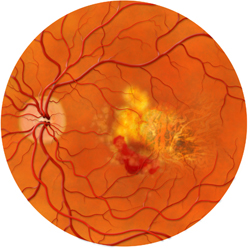
Wet AMD causes abnormal blood vessel growth in the retina. These blood vessels leak blood which causes vision loss.
Spector Eye
Some cases of wet macular degeneration can be treated with injections that stop the blood vessels from growing and even cause them to regress. If the injections are done early enough and often enough some vision can be regained. This is usually not the case for other forms of treatment such as laser or photodynamic therapy. These treatments stop blood vessel growth but usually harm the surrounding retina. The goal of these treatments is to prevent any further vision loss.
Macular degeneration is associated with aging. However, there is some evidence that there is a genetic component. It is most common in white females. Risk factors for macular degeneration include high blood pressure, lighter eye color, and obesity. Smoking is associated with more severe vision loss in 25% of cases of wet AMD. It is thought that UV radiation may play some role in the development of AMD but this theory has not been proven. Although there is no cure for AMD severe vision loss may be prevented if it is caught early and monitored closely by an optometrist. Yearly eye exams are recommended to identify risk factors for AMD and to diagnose cases promptly.