

Protecting skin from summer sun
Now that summer is upon us it is smart to learn how to protect your skin from the effects of the sun. More than 1 million people in the U.S. are diagnosed with skin cancer each year and 90 percent of skin cancers are linked to sun exposure.
The incidence of deaths from melanoma, an aggressive form of skin cancer, is increasing in most populations around the world. Worldwide there are about 60,000 deaths per year caused by cancers from too much sun exposure. Cataracts, a condition of the eyes that leads to loss of vision, can also result from prolonged sun exposure. But there are steps you can take to protect yourself against the harmful effects of the sun.
The sun emits three types of ultraviolet (UV) rays, classified by wavelengths, but only two types of UV radiation cause harmful health effects: UVA and UVB radiation. It is still unclear which wavelengths of sunlight cause melanoma. Evidence suggests that both UVA and UVB radiation are involved in all types of skin cancers.
Our exposure to UVA and UVB depends on our geographic location, time of day, season, clouds and the ozone layer. UVB rays mostly affect the surface of the skin. They cause the typical sunburn and the tanning that follows. Our bodies also use UVB radiation to make vitamin D. UVA rays go deeper into skin layers, causing cell damage that leads to thickening, wrinkling and premature aging of skin.
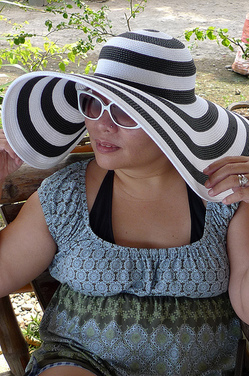
When going out into the summer sun, make sure to wear a wide-brimmed hat and sunglasses to protect yourself. Don't forget the sunscreen.
Photo by flickr user PLETypus
The best way to protect your skin and eyes is to limit sun exposure, especially between 10 a.m. and 4 p.m. This is when the sun’s rays are the strongest. If you have to be outside during this time, wear protective clothing and look for shade. A wide-brimmed hat will protect your scalp, ears, face and neck. Wear sunglasses labeled to protect your eyes against both UVA and UVB rays. Don’t rely on clouds or water to protect you from the sun’s harmful effects. Clouds only block about 20 percent of UV rays, and water does not block any sun rays. And always apply sunscreen anytime you intend to be outdoors longer than 20 minutes.
Select sunscreens that say “broad spectrum” or indicate protection against both UVA and UVB. Sunscreens are labeled with a number known as the sun protection factor (SPF) but this only applies to the amount of UVB protection the product supplies. The SPF represents the ratio between the time it takes a person to burn without sunscreen to the time it would take the same person to burn after applying sunscreen. Simply put, a person who can typically stay in the sun for 20 minutes before starting to burn could prolong their time in the sun to 200 minutes by applying sunscreen with SPF 10. This is a rough estimate. Time of day, season and correct application of sunscreen must be factored in.
Protection against UVA radiation is not as straightforward. Products with similar SPF ratings can have marked differences in the degree of UVA protection offered. There are currently four chemicals that have been approved by the Food and Drug Administration (FDA) to protect against UVA radiation: avobenzone, ecamsule, zinc oxide and titanium oxide.
Avobenzone and ecamsule work as chemical barriers that absorb UVA radiation in the skin. Avobenzone is very effective because it absorbs longer UVA rays. However, it cannot be used alone because it becomes unstable in sunlight and loses its protective properties. It is often mixed with oxybenzone, a chemical that protects against UVB. When combined in this manner it becomes stable in the sun. Helioplex is a patented combination of avobenzone and oxybenzone and provides protection against the full spectrum of UVA and UVB radiation. It is contained in several products manufactured by Neutrogena. Some people are sensitive to oxybenzone. If you develop itching or a rash after applying sunscreen, look for a product without oxybenzone. Many preparations made for young children and babies are formulated without it.
Ecamsule has been an ingredient in sunscreens in Europe and Canada for many years. It was approved in the U.S. by the FDA about 2 years ago. It has generated a lot of excitement due to its ability demonstrate superior UVA protection in studies comparing several sunscreens. It is found in Anthelios 15 Sunscreen and Anthelios 40 Sunscreen, manufactured by LaRoche-Posay. In Canada it is marketed as Mexoryl.
Zinc oxide and titanium oxide are physical barriers that reflect and scatter UVB and UVA rays. They are among the best sunscreens available because they stay put and remain active longer. However, they are not as cosmetically desirable because they remain on the skin as a pasty white substance. They are excellent for people with very fair skin that easily burns and are often used on the nose and tips of the ears. Products with micro-fine particles are available and are less obvious when applied. Zinc oxide and titanium oxide are unlikely to cause skin reactions that can be associated with the chemical barriers.
Babies younger than 6 months should be kept out of the sun. Everyone else should use sunscreens with an SPF of 15 or higher. Products with SPF above 30 provide little additional sun protection and often cost more. Apply sunscreen at least 30 minutes before going into the sun and use it in adequate doses. A rule of thumb is one ounce (2 tablespoons) for the average-sized adult. Distribute it in the following manner: 1 teaspoon for each leg/top of foot; ½ teaspoon each for the face, neck, arm, back and torso. If you prefer spray-on products, rub them in after applying. Reapply sunscreen at least every 2 hours, even on cloudy days. In addition, reapply after swimming, heavy sweating and toweling off. If your outdoor plans include the water, look for sunscreens labeled “water resistant”. In the U.S., products labeled in this manner must maintain 50 percent of the SPF protection after 40 minutes in water.
If your outdoor activities also require insect repellents, avoid products that combine sunscreens and bug repellent. Repellents typically do not require reapplication as frequently as sunscreen. Apply sunscreen first, followed by insect repellent. Sunscreens can be considered stable for three years after the date of manufacture when stored at room temperature. This does not apply to products that are stored in hot cars, beach bags or left in the sun. Abide by expiration dates that are printed on products by the manufacturer.
All of the currently available sunscreens have disadvantages as already discussed. This has led to the marketing of a number of supplement products aimed at “sun protection in a pill”. The manufacturers claim that these products protect against the sun “from the inside out”. According to their marketing statements, they are used in addition to sunscreens, not instead of them. These products should be avoided. They may potentially cause harmful side effects and, at a cost of $1-$2 per tablet, are also very expensive.
Finally, be aware that medications you take can increase the likelihood of skin reactions from sun exposure. This often results in exaggerated sunburn in skin areas exposed to sun. Allergic reactions often manifest as rashes and itching, even in skin not exposed to the sun, swelling and fever.
The list of drugs that can cause reactions is extensive but some of the more common medicines include some antibiotics; antihistamines; blood pressure medicines; isotretinoin (Accutane); birth control pills; cancer-fighting drugs and pain relievers. Talk to your health care provider to learn if you are taking medicines that trigger skin reactions in the sun.
Sunburned skin will be red and tender. If the burn is severe, swelling and blistering can occur. For minor sunburns without blistering, apply cool tap-water compresses or take a cool bath. Your health care provider or pharmacist can help you choose over-the-counter products to help relieve pain. If you have a severe sunburn and experience fever, chills, upset stomach or confusion seek medical attention immediately. In spite of evidence to the contrary, rumors of sunscreens causing cancer persist. There is no convincing evidence that sunscreens cause cancer. On the other hand, there is strong evidence that sunscreen prevents cancer.
The summers in Michigan are delightful. It is impossible to stay indoors with all our lake shores, parks, sporting events and barbecue grills urging us outside. Being physically active is one of the best things you can do to stay healthy. Protect yourself against the sun and go enjoy the outdoors. Summer will be over before you know it.
This guest commentary was written by one of the providers on the Packard Health staff who practices with Dr. Rion, Julie Walker R.N. MSN, CS - a family nurse practitioner. Ms. Walker graduated from Michigan State University in nursing and from Creighton University with a bachelor's of science in nursing. Her clinical interests include women's health, management of chronic conditions, and children's health. Both she and Dr. Rion can be reached at info@packardhealth.org or by calling 734-971-1073. Visit the website for more information www.packardhealth.org