

St. Joseph Mercy Health System tailors care to seniors with new ER
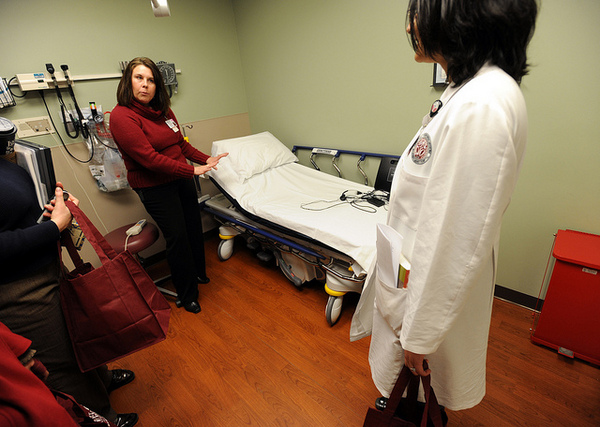
Tina Witkowski, left, shows off one of the new rooms at St. Joseph Mercy Hospital's senior ER during an open house and tour of the facility Wednesday.
Lon Horwedel | AnnArbor.com
An elderly diabetic patient had been a regular visitor in the ER at St. Joseph Mercy Ann Arbor.
But the visits stopped after the patient received a new brand of treatment in the hospital’s new senior ER.
Staff gave her a cognitive screening, asking her to remember three objects and then draw a clock, and discovered that she couldn't follow the instructions. It was her cognitive function, not her diabetes, that led to the unnecessary trips. It was also unlikely that she could properly treat her diabetes without help, caregivers determined.
The woman received treatment at a 12-bed senior ER that opened this fall in a repurposed space near the existing ER.
A ceremony at St. Joseph Ann Arbor on Wednesday formally marked not only the facility's arrival, but also a change in philosophy from the typical rush-rush world of emergency medicine.
Staff has received special training, with an emphasis on slowing down. An increase in staffing supports that approach. Doctors and nurses can spend more time with each patient. And they use the time to ask questions that explore depression, cognitive ability, the potential for interaction with existing medications, and patients' living conditions in order to help identify problems and make improvements.
“The amount of seniors with depression has been alarming,” said Jennifer Dunn, manager of the emergency room.
Adults who bring older parents to the ER are often shocked to learn of a parent’s cognitive decline, she said.
The comprehensive approach is meant to improve the way the aging population is treated and make what could be a frightening and disorienting experience tolerable and productive, hospital officials said.
Those with urgent problems such as heart attacks are treated in the regular ER, while individuals with milder complaints, like leg cramps, are seen at the senior ER.
Seniors entering the ER will find pleasant lighting and glare-free, no-slip floors. The private rooms are outfitted with flat screen TVs and high-tech beds to assuage pressure points and prevent falls. A big white board outlines the care plan for the day. Discharge instructions come with bigger fonts, and large-print puzzle books and reading glasses are also available in ample supply. The repurposed space has the capacity to expand to hold 22 seniors at a time.
This type of care is increasingly important as baby boomers hit 65 this year, said Rob Casalou, CEO of St. Joseph Mercy Health System’s Ann Arbor, Saline and Howell hospitals. Over the next 20 years, the senior population is expected to double, he said.
“The senior ER model considers the needs of patients and adapts to meet those needs,” he said.
But it also aims to keep individuals who could receive better care at home outside of the hospital altogether, he added. The need might be for home care or hospice care, rather than emergency medicine. A medical social worker reviews all charts to help determine how to best meet each patient’s needs.
The senior ERs are available at all St. Joseph Mercy hospitals in southeast Michigan, including Saline, Chelsea, Brighton and Livingston.
Juliana Keeping is a health and environment reporter for AnnArbor.com. Reach her at julianakeeping@annarbor.com or 734-623-2528. Follow Juliana Keeping on Twitter.
Comments
Lauren Stokes
Fri, Feb 25, 2011 : 2:28 p.m.
@Paul and @Cash - the Medicare reimbursement rate for Senior ER care is the same as the regular ER. So, the cost of care is the same. You can learn more about our Senior ER at stjoeshealth.org. Thank you for your question! Lauren Stokes SJMHS Communications & PR
Pablo
Thu, Feb 24, 2011 : 6:49 p.m.
Can someone post the difference in costs...surely higher? When we/our insurance company is billed for a day's inpatient stay, what can we (not) anticipate as the increased billing (for a same-description stay).
Cash
Thu, Feb 24, 2011 : 10:57 p.m.
Paul, cost is the ENTIRE issue for most of us. Most of us do not have the Cadillac Insurance plans and be sure Medicare isn't going to cover fancy-schmanzy stuff. I doubt this is affordable for a senior with Medicare even with a basic gap plan.
julieswhimsies
Thu, Feb 24, 2011 : 6:46 p.m.
This is a step in the right direction. I once spent 27 hours in the U of M ER before being seen. I was not allowed food or water the entire time. I raised hell and was finally seen. It was determined that I needed an IV, as I was severely dehydrated. Hmmm....I wonder why? As I was so dehydrated, ER personnel had great difficulty finding a vein, and I was "poked" multiple times! This was truly a frustrating, painful, and frightening experience. Yes, I made a formal complaint. Nothing was done. Are you listening U of M?
julieswhimsies
Fri, Feb 25, 2011 : 3:31 a.m.
Dare not criticize sacred U of M...:)
Cash
Thu, Feb 24, 2011 : 10:58 p.m.
Don't worry Julie...they just buried the article 4 pages back!!!!!!!
julieswhimsies
Thu, Feb 24, 2011 : 7:40 p.m.
No, Craig...not that I could find....of course I was quite ill at the time. ERs don't like to give people water in the off-chance that you might have to have surgery...although...my case did not fit that category. I was on a gurney the entire 27 hours in various hallways...asking repeatedly for water, or ice chips. I was refused.
Craig Lounsbury
Thu, Feb 24, 2011 : 6:58 p.m.
In my St Joe experience while your waiting in the ER waiting room they do have drinking fountains and vending machines. They don't even have a drinking fountain in the UofM waiting room?
julieswhimsies
Thu, Feb 24, 2011 : 6:58 p.m.
Yep. I was told I could not have food or water until I was seen by a physician, Cash. I hope A2.com doesn't remove my post!
Cash
Thu, Feb 24, 2011 : 6:49 p.m.
Oy!! Gosh ...dehydrated? 27 hours with no water could have an impact on that, huh?
Barbara J. Hopkins
Thu, Feb 24, 2011 : 4:29 p.m.
My58 year old husband had a horrible ER experience on 12-22-10. He had an internal bleed 5 days after polyp removal. We rushed to St. Joes emergency after speaking with his doctor who called ahead for us. Within 20 minutes he was taken into triage and then asked to go to the waiting room. He sat for 3 1/2 hours passing blood and finally passed out cold on the waiting room floor before the ER decided he should be taken in the back! I guess we're not senior enough yet to matter.........yet we were charged $909 for the ER and $7577.20 for the overnight stay in the hospital for that kind of care. No wonder health insurance costs so much!!
Cash
Thu, Feb 24, 2011 : 5:43 p.m.
Craig, Absolutely, I agree. People need to know what goes on. Once a lady working in ER advised us to go to St Joes in Saline! They said the ER was better there. Goodness, that was a bit disconcerting!
Cash
Thu, Feb 24, 2011 : 5:38 p.m.
Oh my HEAVENS!!! Well, all of the fancy stuff does not make up for good common sense and human understanding! How horrible for your husband and for you. I'm guessing he had a colonoscopy? I hope you did file a written complaint about the waiting in ER. He could have died right there! It doesn't do much good but your have my sympathy...not only did you and your husband go through a nightmare experience during your ER visit, but then get slammed with an outrageous bill. I hope and pray your husband is okay now.
Craig Lounsbury
Thu, Feb 24, 2011 : 5:33 p.m.
The last time I was in the ER at St Joe the wait was nearly 5 hours although it wasn't nearly as serious a situation. The last 13 days of my Dads life began with a trip to ER with rather vague symptoms. The wait that day was almost 7 hours. He was 85 at the time. I hope AnnArbor.com lets these posts stand
Craig Lounsbury
Thu, Feb 24, 2011 : 12:45 p.m.
My parents who have passed on were born in 1918 and 1919. At birth, their life expectancy's were in the mid 50's. Those who already reached the age of 20 at that time had a total life expectancy in the mid 60's. People back in the "good old days" didn't become "elderly" they didn't retire. They died on the job. Health care as an industry didn't even register on the economic pie chart. We as a society have done a miserable job of facing these facts. This appears to be a small step in the right direction.
Cash
Thu, Feb 24, 2011 : 12:53 p.m.
Craig, My mother was born in 1918 and is still living. I'm a lucky person! The issue with all of the medical attention to elderly is....... will it be affordable for them? Buying health insurance to cover the gap of Medicare is already unaffordable for many.
Juno
Thu, Feb 24, 2011 : 12:34 p.m.
When my father was declining with Alzheimer's, going to the traditional ER was traumatic for him and altogether unpleasant for other waiting patients and staff, who were ill-equipped to handle his condition. The new ER is great step forward in acknowledging the unique challenges of older adults.
Cash
Thu, Feb 24, 2011 : 12:24 p.m.
' "The amount of seniors with depression has been alarming," said Jennifer Dunn, manager of the emergency room. ' No kidding. You work and pay your bills and your taxes your entire life. When the time comes that you no longer can work, your income is set for the last part of your life while the cost of everything continues to climb. How long will the elderly be able to afford gas to drive to St Joes? How about affording water in their homes? Medicare bill?(yes seniors pay Medicare premiums) Heat? Food? Medicine? You lose your family and friends one by one and going to funerals becomes way too common. Add to that the fact that an elderly person has more pain and discomfort as the body declines, as Bette Davis said "old age ain't for sissies." The "dream" fades and reality sets in. Yes, it is depressing. But it is reality.
McGiver
Thu, Feb 24, 2011 : 11:34 a.m.
Great to know this. Many of us who take care of aging parents will find this helpful.