

Ann Arbor ironman Scott Lankton makes architectural art and furniture that endures
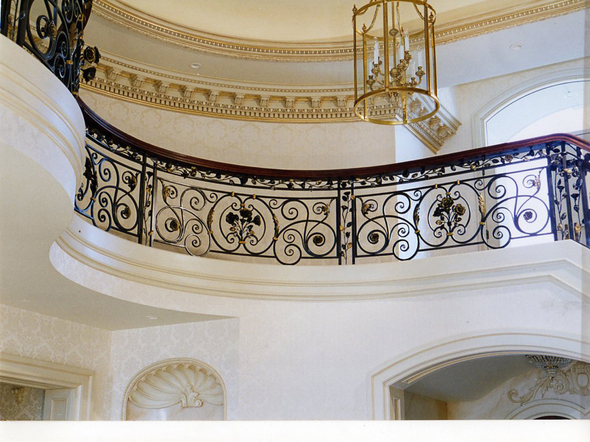
Ann Arbor blacksmith Scott Lankton fashioned the intricate rose-patterned banister on this staircase.
Photo courtesy of Scott Lankton
For 30 years, this Ann Arbor ironman has been making custom stair railings, fireplace fronts and screens, furniture, gates and fences, copper range hoods and anything else that can come from steel, 3,000 degrees of heat and a hammer. The last 26 years have been out of his blacksmith shop along Jackson Road.
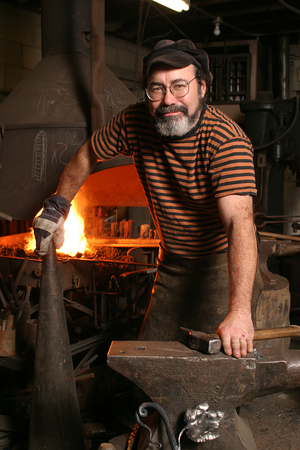
Blacksmith Scott Lankton in his Ann Arbor studio.
Brad Ziegler | AnnArbor.com
Lankton got his start as a teenager working in a jewelry store. He learned jewelry making in college, which lead to ironworking. He traveled to Germany to hone his blacksmithing skills.
Now, he said, “I’m making big jewelry. A railing is like a big necklace for a house.”
Lankton knows that when he tells people he’s a blacksmith, they get the wrong impression.
“They think horseshoes. Blacksmiths who make horseshoes are called farriers,” he said.
He’s never shoed a horse.
Lankton makes things that are practical but also beautiful. While he’s done some sculptural work (including two 20-foot twisting ribbons of iron and bronze that hang from the ceiling of Providence Hospital in Novi), most of his work has a functional purpose.
“You need a railing to keep from falling down the stairs or falling off the balcony. You need a table to put things on. I like to enhance the everyday living experience,” he said.
He also likes to take a cue from nature. Most of Lankton’s designs have an element of nature: An understated railing of braided wheat, a wine cellar door of grapes and grape leaves and a chandelier with squirrels and acorns. He’s made a gate with blue herons, an 18th century-era French-style railing of roses and scrolls and a fireplace front of gazelles influenced by early 20th century artist Edgar Brandt.
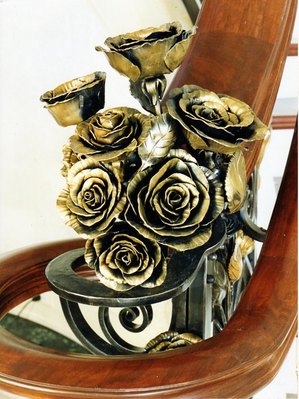
DETAILED WORK: A rose fineal by Ann Arbor blacksmith Scott Lankton on a staircase banister.
Photo courtesy of Scott Lankton
Still, his design cover a range of periods, from medieval to Art Nouveau to contemporary, he said.
While he works with bronze, silver and other metals, steel is his favorite, Lankton said. “It’s the most forgiving and the most workable.”
While Lankton is artist and forger, he also needs engineering skills. Railings and gates need to be made with precision to fit snugly into their space.
“Architectural ironwork becomes part of the building,” Lankton said.
He wants to make things that will endure, Lankton said. “Most of society is made up of cheap things that get thrown away. But people still want quality.”
That quality comes with a price. His work is labor intense - it takes 10 minutes to make a single iron leaf from a bar of steel with constant heating, pounding and heating again until the shape and the detail come to life.
Tables cost between $1,000 and $10,000 while railings cost between $500 and $3,000 a running foot.
Lankton is known by many names: blacksmith, metalsmith and ironworker, he said.
“One person told me I should call myself a thermo-mechanical manipulator of ferrous materials.”
Comments
cook1888
Sat, May 22, 2010 : 4:34 a.m.
I know it has been said already, but this is so beautiful and he lives right here in our own backyard. Sometimes that is as far as you need to look.
jt
Thu, May 20, 2010 : 3:35 p.m.
For more info: abana.org or Michigan Artist Blacksmith Association (MABA) Lot's of smiths around. including...me...sine-27718@mypacks.net
A2K
Thu, May 20, 2010 : 3:23 p.m.
Absolutely stunning workmanship, it's unfortunate that functional-decorative blacksmithery is such a rarity. Bravo!
Karel
Thu, May 20, 2010 : 12:15 p.m.
Very nice article. YOur work is so beautiful. To take something from the earth and transform it to such great beauty is truly a gift.
bunnyabbot
Thu, May 20, 2010 : 11:37 a.m.
when I win the lotto this man will have a lot of work!
braggslaw
Thu, May 20, 2010 : 10:17 a.m.
I am very interested in metallurgy. Does Scott offer classes?
Rasputin
Thu, May 20, 2010 : 10:17 a.m.
Exceptional beauty!
David Briegel
Thu, May 20, 2010 : 9:31 a.m.
Ditto!!
Ignatz
Thu, May 20, 2010 : 9:23 a.m.
Outstandingly wonderful beautiful work! Thank for this great aticle about this artist.
Steve Pepple
Thu, May 20, 2010 : 7:51 a.m.
@MikeD - you can see more of Scott Lankton's work at www.scottlankton.com/lanktongallery.html.
Mike D.
Thu, May 20, 2010 : 7:46 a.m.
Three photos? You've got the be kidding me. I want to see more of his gorgeous work!