

Ann Arbor Native - Bring your landscape closer to nature, and nature closer to you
Rick Meader | Contributor
In the days of yore, the wilds were a terrifying place, full of wolves, bears and cougars that could threaten a homeowner at his or her doorstep. Well, in these parts, anyway, we’ve pretty well removed that threat. A more real threat is the chance of losing many of the songbirds, salamanders and toads that served as the basis for many songs, poems and childhood memories.
A major cause of that is the loss of habitat, including sources of food, water and cover that wildlife need to survive. Where an acre of land may have been covered with seed-bearing grasses, wet meadow with fruiting shrubs or forests or savannas with nut-producing trees (all of which housed insects, which were also wildlife food), that same acre may now be covered with a house, driveway and lawn.
You can change at least a part of that by modifying some or all of your yard to a more habitable form and increase the interest of your yard to wildlife, and, in turn, to you.
For the purposes of this discussion, we’re going to work from a now-traditional landscape on a one-acre lot, and see what we can do to change it some, without shocking you or the neighbors. In the next installment, we’ll do the thing with a smaller, city-sized lot. After that, we’re going to take this a step further to make them even more natural, and save your lawn maintenance budget while we’re at it. So, let’s get started.
Below you’ll find an aerial/plan view of a one-acre lot that measures 200 feet wide by 217 feet deep. It has your standard 2,000-square-foot house with garage, a few shrubs along the foundation, perhaps yews or burning bushes, a small ornamental tree at the corner of the building, maybe a Japanese maple, and a large canopy tree out at the street in the lots front corner. Since they’re so popular, we’ll say this is a Crimson King Norway Maple. The rest is lawn.
With some variations, perhaps a few more shrubs scattered about, this is the makeup of a lot of yards across America. Neat, tidy, and pretty devoid of wildlife, especially in the lawn (maybe a mole here and there). Without much effort, we can bring the “nativity” of this lawn up 300 percent (don’t check my math).
First, let’s talk about the plants immediately around the house, the focal point of the yard. Instead of the burning bush (Euonymus alata), which is quite pretty in the fall but is basically just green or sticks the rest of the year, we could plant black chokeberry (Aronia melanocarpa) instead, whose leaves also turn red in the fall. As a bonus, it is native to Michigan, has white flowers in the late spring/early summer, and the black berries, which are persistent into the winter, are eaten by birds. It’s a durable shrub and can tolerate a lot of conditions. Of course, you should check them out, as you should with any plant, native or non-native, to be sure the plant will survive where you want to put it.
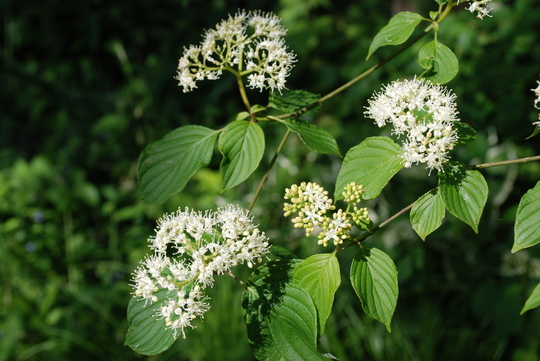
Now, instead of planting an expensive Japanese maple (Acer palmatum), why don’t you plant a flowering dogwood (Cornus florida), or a Pagoda dogwood (Cornus alternifolium), or a hawthorn (Crataegus spp.)? You’ll get attractively-shaped ornamental trees with pretty flowers, berries that birds love and maybe even provide a nesting spot for birds (especially with the hawthorn).
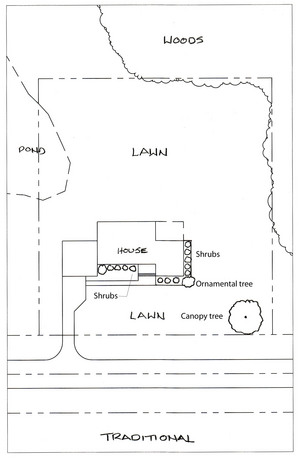
A modern traditional landscape, with lots of lawn, a few shrubs, an ornamental or two, and a specimen canopy tree
Rick Meader|Contributor
Now, about that shade tree. Norway maples (Acer platanoides) are popular, no doubt, but they kill grass beneath it with their dense shade. Additionally, their roots protrude above the surface, tripping those who get close to them, and they are alien to North America and invasive, shading out wildflowers, grasses and sedges in wild areas where their wide-spreading samaras fly. There is a wide range of native shade trees that could serve as an able substitute for the King.
First, consider an oak. Depending on your conditions, White Oak (Quercus alba), Red Oak (Quercus rubra), Chinkapin Oak (Quercus muehlenbergii), Pin Oak (Quercus palustris), Scarlet Oak (Quercus coccinea) or Swamp White Oak (Quercus bicolor) would all be a beautiful shade tree, are all native to Michigan and allow at least some sun through to support plant life below it. Just learn about them and pick the right one for your conditions.
You might have to start small with species that aren’t found in the mainstream nursery trade, but the trees are long-lived and will be a big help to wildlife (and not just squirrels). If you’re not a fan of acorns in your yard, Sugar Maple (Acer saccharum) is a beautiful maple, turning bright orange in the fall. Red maple (Acer rubrum) is also native, but seems to be infiltrating habitats where they’re not naturally found (which is wet, swampy areas) so I’d go with the Sugar Maple if possible.
Tuliptree (Liriodendron tulipifera) is another great native shade tree that grows quite tall, and quite straight. Some others that you might consider that don’t get a ton of play in the landscaping world are Kentucky Coffeetree (Gymnocladus dioica), Hackberry (Celtis occidentalis) and Blackgum (Nyssa sylvatica) and might make nice, native additions to your yard.
So, there you have it. The layout hasn’t changed, the precious lawn is preserved, and you’ve completely changed the native quotient of your yard’s woody plants up to 100 percent. Next time we’ll actually cut into that lawn with some design concepts that convert some of the ground layer from lawn to more diverse, more native groundcovers that still won’t shock your neighbors. Until then, get out, take a look at the snow-covered landscape, look for signs of spring, and enjoy nature, everyone!
Rick is a local landscape architect with a special interest in all things natural, including native plants and the critters that eat them. You can contact him at yourland1824@gmail.com.
Comments
Rick Meader
Tue, Mar 8, 2011 : 3:21 a.m.
Thanks for your comments, guys! And yes, Rork, I like burr oak too (it is the symbol of Ann Arbor, after all), but it's hard to get in any size but small because its tap root makes it tough to transplant larger trees (like 2 1/2" diameter). I mentioned Tuliptree because my parents have one in their back yard and my grandfather used to have a HUGE one growing right next to his house in Washington D.C. (i.e. it was touching). It grows very straight and tall. Thanks again for your comments! Rick
Rork Kuick
Mon, Mar 7, 2011 : 5:41 p.m.
Agrees with Ben. Sugar maples are so astonishing in fall, I'm shocked people plant others so often. I thought Burr Oak was back in fashion too. I'm a little leery of Tulip Poplar, suspecting it uproots or breaks in wind too easily, and it makes a bit of a mess with the flowers. Consider Basswood (American Linden) perhaps. Rick won't name every bush and tree in one article ofcourse - see his previous writing.
Ben Connor Barrie
Mon, Mar 7, 2011 : 3:47 p.m.
This is a really solid article. The suggestions of non-traditional canopy trees are great.