

Ask Betty: The cost of living clutter-free - is it worth the occasional regret?
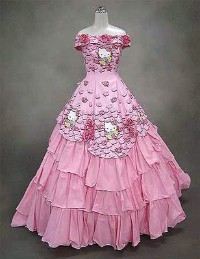
just the ticket for the school play
Saturday you donate the ugly pink bridesmaid dress you wore at your best friend’s wedding. The following Monday, your daughter scores a part in the school play and needs a costume, preferably pink and hideous.
You finally give away your set of Noritake dishes, only to find them selling like hotcakes on Ebay.
In March I blogged on the costs of valuing stuff over space. But when you value space over stuff, it’s bound to happen from time to time: you regret having parted with something.
The question is, how much are you willing to pay for the benefits of the method you choose? And where do you lie in the continuum?
Because we think ahead, we store items, knowing or at least guessing that we’ll use them in the future. Pantries are stocked with canned goods, jars of sauce, pasta we got on sale, etc. Freezers hold extra meat, frozen cookie dough, bread and juice.
There’s a balance between having so little that you need to shop daily, and being so overstocked you can’t get down the hall. Somewhere between the extremes is the feeling of being comfortably prepared.
It’s an individually determined state on the continuum, but it implies confidence in the outside world. You trust that if you need something, you can always go out and get it.
When we hear there's a blizzard coming, we temporarily lose trust in our ability to get what we need “out there,” so we stockpile batteries, water and food. It might crowd us in the house, but it’s okay because we feel safe and prepared, and we know it’s only for the short term.
The storm passes, we use up the extras and go back to trusting that we can get what we need out in the world.
The mantra of the hoarder is: “I might need that someday,” while the space cadet says, “I probably won’t ever need that, but if I do, I can always find it again, and if not, it’s not the apocalypse. “
If you’ve ever seen Hoarding: Buried Alive, you've seen people with way too much stuff for their spaces. The opposite extreme is rare in the U.S., but check out this piece about a woman who lives in a 90-square-foot apartment in New York. She keeps only what she needs, including flatware pared down to one knife, one spoon, one fork.
As you come in to the middle from these extremes, it becomes less clear. We each have a point at which the clutter starts to bother us, and that’s an individual variation. Day after day, as stuff builds up, irritation rises.
Conflicts erupt in families and in couples over differences in comfort levels. When we have similar approaches to clutter, we can easily compromise. But what if you can’t stand one dirty plate in the sink, while your partner, after throwing a party, is content to leave the mess for days?
You’re a Felix, and she’s an Oscar. How do you find a balance?
I’d love to hear from people who live with that conflict as well as those who have found solutions. Send a comment (below) or email me!
Judy DiForte is a professional organizer for The Betty Brigade, a full-service personal assistance and concierge company based in Ann Arbor. Email her at Judy@BettyBrigade.com.
Comments
JustMyTwoCents
Wed, May 4, 2011 : 12:25 p.m.
"You're a Felix and she's an Oscar. How do you find a balance?" For me the balance was found by divorce. Some may term this a failure rather than a balance, but for me the end result of living in an environment that provides me with peaceful comfort far weighs maintaining a marriage filled with clutter. For the record, we remain on very close terms and see each other often...just gave up the idea that we could ever survive in the same space with such different ideas of what constitutes "preparing for an eventual need" and "hoarding".
Judy DiForte
Wed, May 4, 2011 : 2:31 p.m.
It sounds like you found a happy ending to the situation. I probably should have asked, "Can you find a balance?" rather than, "How do you find a balance," I don't know that it would be possible, without at least one person changing his/her approach. Your comment drives home the point that the Oscar isn't so much committed to clutter itself as to the comfort or feeling of preparedness that the items give him. Thanks for sharing your experience. I do wonder if all Oscars are as bothered by the Felix approach as Felixes are by the Oscar approach. If the Oscar is just messy and not a true hoarder, it would make a big difference. (I use the Felix-Oscar image as a convenient shorthand -- not to trivialize the situation.)
treetowncartel
Tue, May 3, 2011 : 2:20 a.m.
Im the son of a depression era born mother, I have a tendency to keep a nut and bolt from an item that was discarded. Drive's my wife crazy to see my t-shirts made for a twelve year od boy sitting in the closet. I think to myself that someday that boy of mine might wear them. Sad thing is I only have daughters. I loathe the day I have to go over to Mom's and make sense of what she has assembled over time. I have done my best to reduce three storage bins worth of stuff into one over time. You never know when you are going to need that term papaer you wrote for History 202 that is so conveninetly stored in Hard copy and on a floppy disk.
Judy DiForte
Wed, May 4, 2011 : 2:09 p.m.
Thanks for your comment. In doing organizing projects for elderly people, we often see the impact the Depression has made on their sense of trust in the outside world -- including banks. In the homes of clients who have died, we sometimes find money hidden here and there ...