

Beetles and chafers, oh my!
I recently attended the Japanese Beetle Biocontrol Field Day sponsored by Michigan State University. I came away with pathogen-infected beetles to help reduce their population, plus some interesting information about grubs in general.
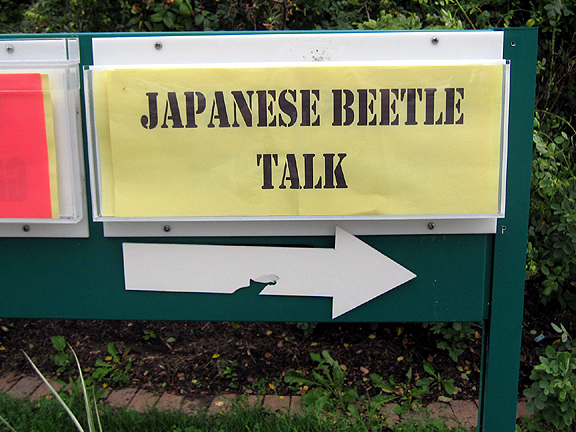
There's a sign you don't see every day.
Monica Milla | Contributor
Entomologist Dr. David Smitley explained that the pathogen used to infect the beetles to reduce their population occurs naturally and was discovered on golf course in Connecticut in 1990. Long-term trials on golf courses in Southeast Michigan showed that infected grubs are half as likely to survive winter in the soil, and female beetles emerging from infected grubs lay half as many eggs as non-infected beetles. After about five years, the pathogen significantly reduces the population. MSU has shared the pathogen with organizations in Kansas, Arkansas and Colorado.
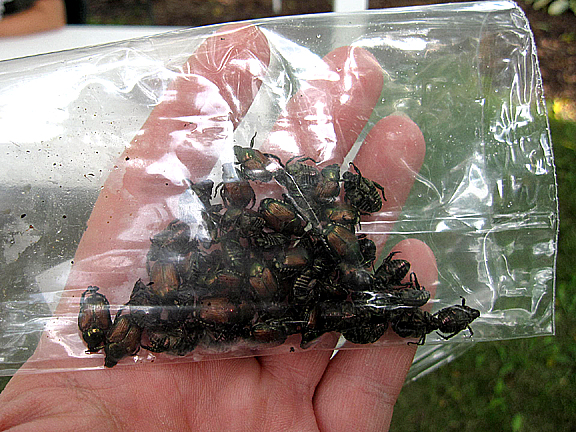
We each got a bag of 50 dead Japanese beetles, infected with a live pathogen, to distribute into our lawns.
Monica Milla | Contributor
Dr. Smitley explained that Japanese beetles lay their eggs in August and they prefer doing so in moist turfgrass, like in irrigated lawns and in low-lying areas where moisture accumulates. They also like areas near linden trees.
People who took the beetles promised to keep their lawns watered (with a quarter inch of water every other day) throughout the August egg-laying season, and they will dig one-inch holes with screwdrivers and place a dead beetle in each hole. Lawns into which the beetles are introduced can't be treated with insecticides (like Grub-Ex).
If we have a dry August (like last year), that means we'll have fewer Japanese beetles the next year (with or without infected pathogens). This also explains why my own garden doesn't get a lot of Japanese beetles. I don't really have turfgrass, but weeds, as lawn. I keep them mowed but never water them, so my conditions are too dry. Yay for lazy gardening! (In case you're wondering, I passed my beetles on to someone who has the right conditions.)
However, I have seen those white C-shaped grubs in my garden, so I was curious what those were. Dr. Smitley explained that in dry lawns, these grubs are not Japanese beetles, but European chafers.
European chafer grubs damage grass roots (if you have grass damage, it's likely caused by chafers, not beetles), but they do not eat or otherwise damage plant foliage, as Japanese beetles do.
The infected beetles are all spoken for this season, but you're interested, be sure to attend next year's field day. For details, and to receive a bunch of other helpful gardening information, check out MSU's landscape alerts.
Monica Milla, the Garden Faerie, is a master gardener volunteer, garden speaker, garden coach, and author of "Fun with Winter Seed Sowing."
Comments
Monica Milla
Thu, Aug 5, 2010 : 8:34 a.m.
Mike, This should work slowly, over time. I like keeping up with MSU research! :) Rork, Preaching to the choir, lol. Cheap & lazy rules my world. I've never fertilized or used any -cides on my lawn, even when I lived in more traditional suburban subs. I didn't water too much then and let the lawn go dormant. I now live on a little forgotten deadend street in the "bad" part of town, 15 feet from Mallett's Creek--which suits me beautifully. I have never watered this lawn--no need to, weeds stay green. I actually mow them really short but not too often. I have converted at least 1/3 of my lawn to garden beds, but my property is large so creating/filling more beds is a financial and upkeep issue.
Rork Kuick
Thu, Aug 5, 2010 : 8:22 a.m.
"Lazy gardening" may be a much better way when it comes to "lawns". You can avoid the time and expense of apply fertilizers, herbicides, fungicides, and insecticides, and may then need to mow less frequently too, saving more time, money, gas, and air quality. Applying nothing will be good for our river and it's life and people's drinking water. You likely will be able to water less (if you water at all), also good for our river and your wallet. In my neighborhood people water lawns that are very sunny, cause they burn up, rather than doing the obvious - plant a tree around there. Your lawn can be less of a monoculture and be more resistant to being devastated by infestations of single insect species. Also, the insecticide you apply doesn't just kill nasty alien invaders - it's very indiscriminate. Try doing nothing for a few years and see what happens. If you can't manage that, try reducing. Your lawn may not be dark green by April 10, but it'll be OK. Get over this "perfect", unnatural, expensive, and polluting lawn wish.
Mike Hulsebus
Wed, Aug 4, 2010 : 1:41 p.m.
I didn't know one method of getting rid of these was by infecting the population: interesting!
Monica Milla
Wed, Aug 4, 2010 : 11:06 a.m.
I'm not sayin' I'm not creeped out. I mean, a baggie of 50 dead bugs is ookey... and I heard one dude say to another* on the way out "What will happen if the ones that don't die become immune or mutate?" It's hard being part geek/researcher-wanna-be and part skeptical/naysayer! *Even tho garden events are attended primarily by women, certain topics (trees, shrubs, lawn, bugs, tools--you know, the ones I like (well, except lawns)) predominately attract men).
Ramon
Wed, Aug 4, 2010 : 11 a.m.
I'm kind of still creeped out by this. I know, I know. The pathogen is naturally occurring all, but still... It is too early in the morning form me to be reading. I read it as European chauffeurs and was really confused. I've seen both the grub and the adult beetle in my garden. Wish I had taken pictures now that I know what they are.