

Posted on Thu, Apr 1, 2010 : 7:21 a.m.
Clunky kitchen makes way for family entry and open kitchen in historic home
By Marcia Lyon
Original kitchens in historic homes are usually spacious and inefficient. If they had counters at all, they were usually equipped with drain boards for the sink. Typically, appliances appeared to be added with no particular cooking convenience in mind. It was all just meant to be practical, not beautiful.
PROBLEM
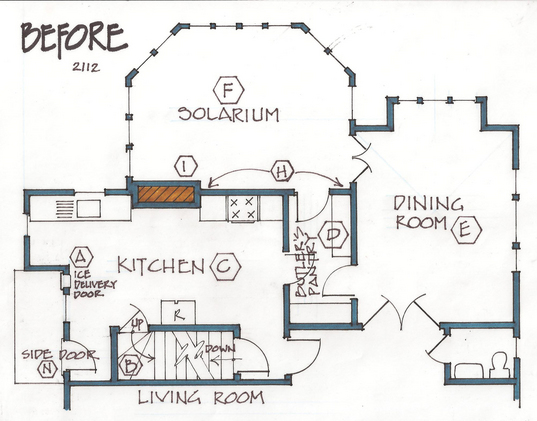
This was the case with this grand old home, which came with the ice delivery door (A) intact. Like many homes of this era, there was a second staircase (B) leading to the second floor and the maid’s quarters. The kitchen (C) proved somewhat clunky, with the sink, range and refrigerator all on separate walls.
With the grandness of this style of home, a butler’s pantry (D) divided the kitchen and the dining room (E), with storage for service pieces and fine china.
A very large and bright solarium (F), I suspect, was added later. It was not too contemporary since the brick and architectural details matched the existing house. It did seem a bit over scale and had no door to the outside.
The homeowners wanted to create some place for coats and shoes at the side door, and also to end up with a highly efficient kitchen for the cooking couple. The butler’s pantry was not significant to them, but they did want to maintain the formal dining room for their dinner parties. They wanted to keep some charm in this house while updating the function of the kitchen.
SOLUTION
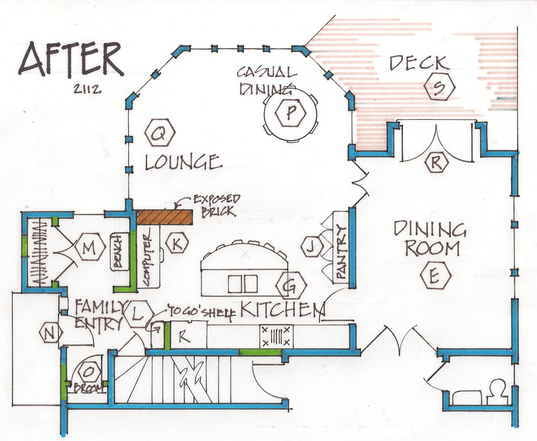
I felt it was essential to try to capture the light from the solarium (F) to brighten the new kitchen (G). To do this, I shifted the new kitchen to the right, where I could remove the entire wall (H) that was not masonry (I) [which we exposed.] This centered area allowed for a linear pantry and a desk (K) for the family computer. The sink was placed in the island so that the view is towards the light. The curved counter for stools was raised to 42” to conceal any sink clutter.
The resulting family entry (L) works great, with an alcove (M) for a coat closet and bench. By shifting the door (N), we centered it and made a broom closet (O).
The solarium (F) became a bright and airy room for casual dining (P) and lounge furniture (Q) - a real gathering place for the family.
All of the existing doors in the dining room (E) remained intact; however, we added French doors (R) that lead out to a new deck (S) to complement their entertaining.
Marcia Lyon is a professional remodeling designer and freelance writer, producing projects locally and several other areas across the United States and Canada. Her new book on remodeling design, “The Essential Planner for Home Remodeling,” is available on her Web site www.creatingspaces.net. Reach her at marcia@creatingspaces.net or 515-991-8880.