

Dark and dowdy Ann Arbor Hills ranch given a second life
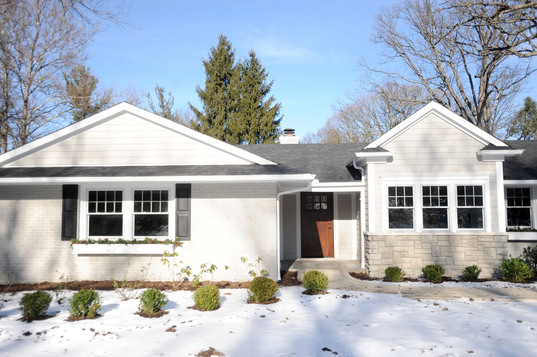
This 1950s era ranch in Ann Arbor Hills got a facelift and a complete interior renovation.
Angela J. Cesere | AnnArbor.com
For Millman, the four-bedroom grey brick and stone ranch on Geddes Avenue is an experiment: She wants to see if the market has shifted toward smaller homes.
Traditionally, the Millman Development Group - the company Millman owns with her husband, Darren - builds and remodels larger-scale houses, usually in the 3,000- to 5,000-square-foot range.
But Bruce Wallace, who bought the Geddes Avenue ranch in 2003 for $384,500, turned to Millman, a friend, after his house sat on the market for a year. The house, Millman said, was dark, dated and depressing.“In the Ann Arbor community, people are looking for move-in condition,” she said.
It wasn’t a surprise that it didn’t sell. 

“It has a couple of layers of handyman specials that weren’t well done. It was very dated. It was ‘50s dated, ‘60s dated and some ‘70s dated. We literally needed to get everything out and start over,” Millman said.
That meant gutting the house. About the only thing that remained were the two stone-faced fireplaces, one on the main floor and a second on the lower level.
Everything from the roof, light fixtures, cabinetry, doors, appliances and all windows were replaced.
Located at the edge of Ann Arbor Hills, with its Currier and Ives neighborhood of stately homes, the Geddes Avenue ranch, even in its sorry condition, was structurally sound and only minutes from The Arb.
“It was well-constructed,” Millman said. 
“It just needed some love.”
Walls were removed and windows added and repositioned.
“We reconfigured the space to give it a more current flow,” Millman said. “There were random windows that looked out at the sides of the other houses. It felt like being in a submarine it was so dark.”
The large, single-pane window in the living room at the rear of the house summed up 1950s design. In its place, Millman installed a cluster of four, double-hung windows, adding bold molding and trim for detail around the windows and doors.
The walls were painted grays and warm taupes.
The style now is more transitional, somewhere between traditional and arts and crafts, Millman said.
**Photo slideshow**
The arts and crafts style shows at the entrance with a large oak door accented with six small beveled glass windows. The multiple layers of crown molding also hint at arts and crafts.
The worn cream-colored shag carpet was lifted to reveal a partial oak floor. Where there was subfloor, matching oak was added. Granite countertops were installed in the kitchen along with a ceramic tile backsplash and a suite of stainless steel appliances. 

The lower level was virtually unusable space, Millman said. Carpet was laid, some walls were removed to create a niche space that can be used as an exercise or sewing room and a fourth bedroom was added.
Double egress windows were installed in the lower-level bedroom after the ground around the foundation was excavated and new footings poured.
Outside, the grounds were improved by adding mature evergreens and a covered porch with a coffered white birch ceiling was built in the backyard. A blue slate front porch was added.
Millman is banking on the idea that couples are downsizing from the 4,000-square-foot houses that popped up across Ann Arbor and are now looking for smaller but still tasteful space.
“People don’t want space that sits empty, they are re-evaluating how they live,” Millman said. “This could be for someone who wants to downsize, but they don’t want a condo. For me, this is a test, to see if that buyer is out there looking. I’m curious.”
Comments
A2K
Fri, Dec 18, 2009 : 11:55 a.m.
They did an absolutely beautiful job remodeling the home...but that is an extremely expensive home, even for that section of town.
DagnyJ
Thu, Dec 17, 2009 : 1:28 p.m.
You are joking right? I predict this house sells for $490,000 max. Dream on people.
Raspel
Thu, Dec 17, 2009 : 11:44 a.m.
I agree, Carolyn. Esp. those of us who are resigned to residing in under 1,000 sq. ft. of living space.
AA Lady
Thu, Dec 17, 2009 : 11:35 a.m.
Beautiful, very nicely done. I find it amazing what qualifies as "small" now. This place is extremely roomy as far as I can see. 1755 square is quite large.
Galluper
Thu, Dec 17, 2009 : 11:12 a.m.
Is this home on Geddes Road or Geddes Avenue?
Raspel
Thu, Dec 17, 2009 : 11:02 a.m.
Amazing what you can do if you have some spare, disposable income. We couldn't come close to affording even a modest makeover on our dumpy "New" West Side 1958 ranch, and we bought on the low (and now sinking) end about 8 years ago when prices were still shooting upwards...not because we wanted 950 sq. ft. of moldy space, but that's all we could afford in what seems to still be a very overpriced market if you want a really good neighborhood and a little breathing room.
CLX
Thu, Dec 17, 2009 : 10:18 a.m.
I agree with Jack. The Millmans build homes that will last for generations. Too many builders throw up junk these days; they build homes, which, like too many of our possessions, are throw-aways. It's better for the environment to rebuild existing homes with existing roads and service lines, and it's better to build homes that will last. Bravo, Millmans.
Jack Panitch
Thu, Dec 17, 2009 : 10:04 a.m.
Karen and Darren Millman do very thoughtful, detailed, beautifully crafted work. It is understandable to view a home primarily as an investment, but if you view it as a long-term environment, you might be willing to spend more, even in these troubling times. Again, depending on your perspective, you definitely get what you pay for and more with these two.
EngineeringMom
Thu, Dec 17, 2009 : 10:02 a.m.
The house is actually 1755 square feet per the listing on realtor.com.
81wolverine
Thu, Dec 17, 2009 : 9:21 a.m.
Looks like a great remodel job. I would think there's a very large market in the future for dated homes in nice neighborhoods to have major remodels like this. You're basically getting a brand new house, and it's in an existing, high-quality neighborhood close to schools, shopping, etc. For that neighborhood, the price actually isn't bad. Sure there are cheaper homes for sale, but I can just about guarantee they're not in the totally remodeled condition this one is.
Yogi
Thu, Dec 17, 2009 : 9 a.m.
Did they add any square footage? I agree it was nicely done but $319 a square foot?
Janet Miller
Thu, Dec 17, 2009 : 8:28 a.m.
No, the reporting on this story was done last weekend, as the project was finishing up.
mrk
Thu, Dec 17, 2009 : 8:27 a.m.
Although it does look nice, don't get me wrong. They did a great job.
mrk
Thu, Dec 17, 2009 : 8:27 a.m.
Seriously, $639,000? Guess it IS impossible for a first-time homebuyer with a middle class income to buy a house in a safe Ann Arbor neighborhood. I understand it was remodeled, but to alomst double in value over these particularly difficult last 6 years?
antikvetch
Thu, Dec 17, 2009 : 8 a.m.
Is this story from 2005?