

Looking to remodel: What rooms are really important to you?
We seem to have moved away from the concept of formal dining room, preferring to cook, eat and entertain in the same space.
I’m not saying that the dining room is dead -- many people entertain and like to have a separate space. But the dining rooms that were built in the past were for immediate family daily dining, not holiday meals with tons of family. An eat-in kitchen is desirable, but when that kitchen table is adjacent to the dining table, one of them is redundant.
The same could be said for the living room. When there is a family room, where everyone LIVES, the living room becomes redundant. That is, unless you prefer a space that is kept neat, with no television, to visit with friends. This is a personal preference.
PROBLEM
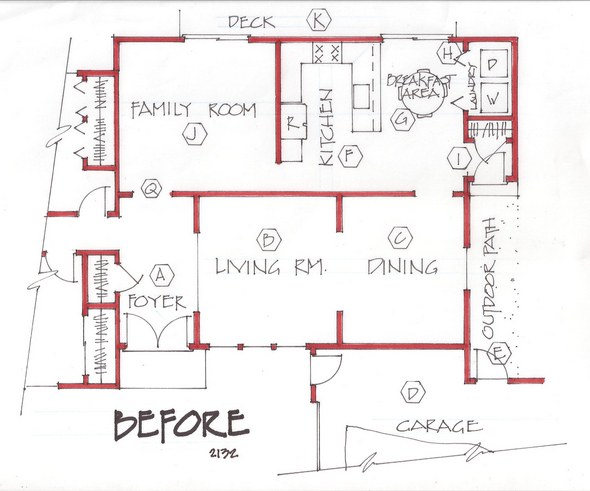
The garage (D) was attached, but had no indoor connection. The way in was an outdoor path (E), bypassing the formal rooms of the house, and right into the kitchen (F) / breakfast (G) rooms. This path works in good weather, and not so great in bad weather. The laundry closet (H) and coat closet (I) are in close proximity to the action.
The family room (J) is separate from the kitchen and kind of small for today’s standards. There is a deck (K) right outside, with access also from the breakfast area (G).
The homeowners wanted the kitchen to be the center of all activity. The open concept was what they wanted. They also wanted a ‘real’ dining room to use for everyday dining and dinner parties.
They hoped for a half bath, but felt that would be impossible.
They wanted to enclose the outdoor path (E), but knew that by doing so, they would lose the only window in the dining room (C).
The assumed they needed an addition, but were afraid that it would be huge and cost a fortune.
SOLUTION
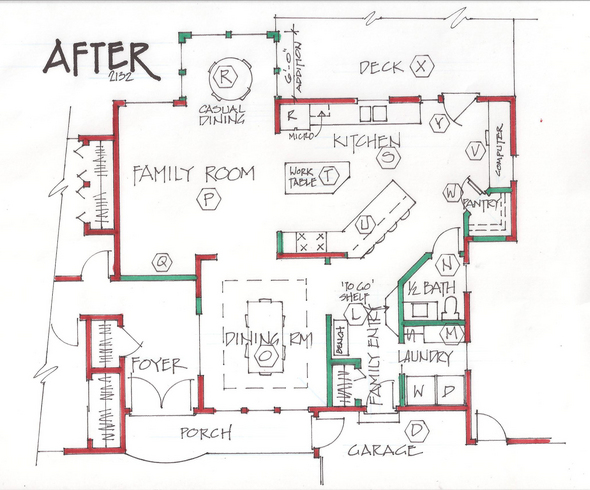
I was most concerned about the path from the garage (D) into the kitchen and creating a family entry. I took a little more space than the dining room (C) for the important elements such as closet, bench and “To Go” shelf for the new family entry (L). I also used this space to add a laundry room (M) and half bath (N), both with windows.
The rest of the living room converted into a wonderful dining room (O), with a coffered ceiling. This is the first space seen by visitors and is the path through the house.
The new, enlarged family room (P) is somewhat open to the dining room. We closed one opening (Q) in the family room to gain space and another wall for furniture. This move was suggested by the client, and they felt they could live with the change in traffic.
The only addition we built was a six-foot, glass-filled bump-out (R) for a casual dining and or game table.
The kitchen (S) is spacious and open. It features a work table (T) and angled eat-on counter (U). We also installed a counter for the family computer (V) and a corner walk-in pantry (W).
The only access to the deck (X) is a regular door (Y) and sidelight, with plenty of room to accommodate people and food.
Marcia Lyon is a professional remodeling designer and freelance writer, producing projects locally and several other areas across the U.S. and Canada. Her new book on remodeling design, “The Essential Planner for Home Remodeling,” is available at www.creatingspaces.net. Contact her at Marcia@creatingspaces.net or at 515-991-8880.